Representative Barbara F. Vucanovich
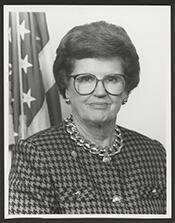
Here you will find contact information for Representative Barbara F. Vucanovich, including email address, phone number, and mailing address.
| Name | Barbara F. Vucanovich |
| Position | Representative |
| State | Nevada |
| District | 2 |
| Party | Republican |
| Status | Former Representative |
| Term Start | January 3, 1983 |
| Term End | January 3, 1997 |
| Terms Served | 7 |
| Born | June 22, 1921 |
| Gender | Female |
| Bioguide ID | V000124 |
About Representative Barbara F. Vucanovich
Barbara Farrell Vucanovich (née Farrell; June 22, 1921 – June 10, 2013) was an American Republican politician from Nevada who served as a Representative in the United States Congress from 1983 to 1997. A member of the Republican Party, she was the first woman from Nevada elected to the United States House of Representatives and served seven consecutive terms, representing Nevada during a significant period in late twentieth-century American political history. Over the course of her service, she contributed to the legislative process on a wide range of issues and became a prominent conservative voice in the House.
Vucanovich was born Barbara Farrell at Camp Dix, New Jersey, on June 22, 1921. She was the daughter of Thomas Farrell, of Irish ancestry from Troy, New York, and Maria Ynez White, who was of English and Mexican-Californio ancestry from southern California. Her maternal great-grandmother had been a Mexican citizen who became a U.S. citizen when California was transferred to the United States in 1848. Her father, an engineer by profession, served between the world wars as chief engineer for the New York State Department of Public Works. During World War II he rejoined the United States Army and became Deputy Commanding General of the Manhattan Project, placing the family in proximity to some of the most consequential scientific and military developments of the era. Farrell grew up in Albany, New York, the state capital, where she spent her formative years.
At the age of 18, Barbara Farrell married James Henry Bugden. During World War II, her husband was assigned overseas, and the couple became separated. Throughout the 1940s she was employed by several New York businesses, gaining practical experience in the workforce during a time when many women were entering employment in support of the war effort and postwar economy. In 1949 she relocated to Reno, Nevada, intending a brief stay in order to obtain a divorce under the city’s liberal divorce laws. The move, however, proved decisive for her personal life and future political career, as she chose to remain in Nevada and became deeply rooted in the state.
In Reno, Farrell met Kenneth Dillon, a local attorney and founding partner of the law firm Vargas, Dillon, and Bartlett. The two married in 1950 and had five children: Patricia, Michael, Kenneth, Thomas, and Susan. Dillon, who was active in Republican politics, introduced her to Nevada’s Republican Party at a time when it was slowly rebuilding after decades as a minority party in the state. Through him she met Paul Laxalt, then a young district attorney from Carson City. Widowed in 1964 upon Dillon’s death, she remained involved in politics and the following year married George Vucanovich, whom she had met while both were working on Laxalt’s unsuccessful 1964 campaign for the U.S. Senate. George Vucanovich would later die of leukemia in 1998. Her early political work on Laxalt’s gubernatorial campaigns and his narrow 1974 victory over Democrat Harry Reid in a U.S. Senate race helped establish her reputation as a capable organizer and loyal party activist.
Barbara Vucanovich’s formal political career advanced when she was hired as district director for newly elected Senator Paul Laxalt after his 1974 Senate win. In that role she gained extensive experience in constituent service, federal agency liaison work, and the practical operations of a congressional office. Following the 1980 United States census, Nevada was divided into two congressional districts, with the new 2nd District encompassing the entire state outside of the Las Vegas area. Encouraged by Laxalt, Vucanovich entered the race for the new seat. Campaigning under the slogan “What Congress needs is a tough grandmother,” she appealed to voters across rural and northern Nevada and won election to the House of Representatives in 1982. She took office on January 3, 1983, beginning a congressional tenure that would last until her retirement in 1997.
During her seven terms in the House, Vucanovich participated actively in the democratic process and represented the interests of her Nevada constituents. She positioned herself early as a conservative leader, aligning with a group of Republican members—including Newt Gingrich, Bob Walker, and Vin Weber—who were dissatisfied with long-term minority status and sought to build a new Republican majority. She became associated with the Conservative Opportunity Society, a caucus that helped lay the groundwork for the Republican takeover of the House in 1994. Vucanovich helped draft two of the ten bills that formed the core of the Contract with America, the Republican policy agenda in the 1994 midterm elections. She also served on the Presidential Debate Commission from 1987 to 1997, playing a role in the organization and oversight of nationally televised presidential debates.
Vucanovich’s committee work reflected both Nevada’s economic profile and her growing seniority. She served for many years on the House Interior Committee, where she eventually became the ranking Republican on the Mining and Minerals Subcommittee, a key assignment for a state with a large mining industry and extensive public lands. She also served on the House Administration Committee before being appointed in 1991 to the powerful Appropriations Committee. After Republicans gained control of the House in 1995, she became chairwoman of the Appropriations Subcommittee on Military Construction, giving her influence over funding for military bases and related infrastructure. Among her legislative achievements, she authored the repeal of the national 55 mph speed limit, a measure particularly popular in the American West, and sponsored legislation to prevent more than one state from taxing pensions and retirement benefits, an issue important to retirees.
Her policy positions reflected a blend of conservative principles and advocacy on issues shaped by personal experience. Shortly after taking office in 1983, Vucanovich was diagnosed with breast cancer and underwent surgery. This experience informed her subsequent support for increased federal funding for early screening, detection, and treatment of breast cancer. She also supported equal pay and equal treatment for women, while maintaining conservative stances on other social issues, including support for capital punishment and opposition to abortion. In House Republican internal politics, she sought and won a leadership role when she campaigned to become Secretary of the Republican Conference after Representative Bob Michel announced his retirement. Despite competition from Tim Hutchinson of Arkansas, she prevailed in a close contest, aided by a forceful nomination speech from Representative Henry Hyde of Illinois, an ally in their shared opposition to abortion.
Vucanovich’s electoral record in Nevada’s 2nd District was generally strong, though she faced serious opposition in 1992. That year, Democrat Bill Clinton carried Nevada’s electoral votes over incumbent President George H. W. Bush, whom Vucanovich supported. In the same election she was challenged by Reno mayor Pete Sferrazza and won reelection with 48 percent of the vote to Sferrazza’s 43 percent, the narrowest margin of her congressional career. She continued to serve until choosing not to seek reelection in 1996, concluding her House service on January 3, 1997. Over her seven terms, she became widely recognized as a trailblazer for women in Nevada politics and as a steadfast representative of her largely rural and small-city district.
After retiring from elected office, Vucanovich remained active in public affairs, primarily through service on external committees and continued involvement in Republican politics. Her family also continued its engagement in Nevada public life. Her daughter, Patricia Dillon Cafferata, served as Nevada State Treasurer, as a member of the Nevada Assembly, and as district attorney in three Nevada counties, and later became her mother’s official biographer. Vucanovich’s long career and status as the first woman to represent Nevada in Congress made her a figure of enduring interest in the state’s political history and a notable member of broader groups such as Hispanic and Latino Americans in the United States Congress and women in the United States House of Representatives.
Barbara Farrell Vucanovich died at a care facility in Reno, Nevada, on June 10, 2013, at the age of 91. Her death prompted tributes from across the state’s political spectrum. Nevada Governor Brian Sandoval likened her to British Prime Minister Margaret Thatcher, the “Iron Lady,” and called Vucanovich Nevada’s “Silver Lady,” describing her as the matriarch of her political generation. He emphasized that, despite her prominence in public life, she regarded herself first as a wife, mother, grandmother, and great-grandmother, and that her family remained her highest priority even as she served what he termed the larger “Nevada family” in the United States Congress.