Representative Barnabas Bidwell
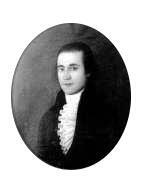
Here you will find contact information for Representative Barnabas Bidwell, including email address, phone number, and mailing address.
| Name | Barnabas Bidwell |
| Position | Representative |
| State | Massachusetts |
| District | -1 |
| Party | Republican |
| Status | Former Representative |
| Term Start | December 2, 1805 |
| Term End | March 3, 1809 |
| Terms Served | 2 |
| Born | August 23, 1763 |
| Gender | Male |
| Bioguide ID | B000446 |
About Representative Barnabas Bidwell
Barnabas Bidwell (August 23, 1763 – July 27, 1833) was an author, teacher, lawyer, and politician of the late eighteenth and early nineteenth centuries, active in Massachusetts and in Upper Canada (now Ontario). He was born in Township No. 1 (now Monterey), in Berkshire County, Massachusetts, the son of Adonijah Bidwell, a Yale College graduate of the class of 1740 and a Patriot in the American Revolutionary War, and Jemima Devotion. Through his mother he was descended from prominent early New England figures, including John Haynes, the fifth governor of Massachusetts and first governor of Connecticut, and George Wyllys, the fourth governor of Connecticut. These family connections placed him within a tradition of public service that would shape his later political career.
Bidwell pursued an extensive education for his time. He graduated from Yale College in 1785 and later attended the college in the English Colony of Rhode Island and Providence Plantations, now Brown University, in Providence, Rhode Island. After his collegiate studies he read law under Judge Theodore Sedgwick of Stockbridge, Massachusetts, a leading Federalist who served in the United States House of Representatives and later in the United States Senate. Under Sedgwick’s tutelage, Bidwell completed his legal training and was admitted to the Massachusetts bar, after which he commenced practice in Stockbridge, in western Massachusetts. In addition to his legal work, he taught and wrote, establishing himself as a figure of some intellectual and professional standing in Berkshire County.
Bidwell’s early public career developed in local and state offices. He practised law in western Massachusetts and served as treasurer of Berkshire County, a position that would later become central to the controversy that ended his American political career. He entered elective office as a member of the Massachusetts legislature, serving in the Massachusetts Senate from 1801 to 1804 and in the Massachusetts House of Representatives from 1805 to 1807. During these years he aligned himself increasingly with the Democratic-Republican Party, breaking with the Federalist orientation of his former mentor Sedgwick and emerging as a rising figure among Jeffersonian Republicans in the state.
In 1805 Bidwell was elected as a Democratic-Republican to the United States House of Representatives and served in the Ninth and Tenth Congresses. In Congress he became the leading spokesman for the administration of President Thomas Jefferson, displacing John Randolph of Roanoke as the principal administration leader in the House. He was effective in defending Jefferson’s policies, particularly the use of economic sanctions in response to British violations of American neutral rights at sea, and he played a central role in securing passage of important legislation. He directed the campaign in Congress to authorize the purchase of Florida and was a leading advocate for the bill that abolished the transatlantic slave trade to the United States, which took effect in 1808. His prominence in debate and his reliability as an administration supporter made him one of the most influential Democratic-Republicans in the House. He resigned his seat in Congress in July 1807.
Upon leaving Congress, Bidwell was appointed Attorney General of Massachusetts, serving from 1807 to 1810. During this period, his political fortunes were abruptly reversed when his Federalist opponents publicized alleged irregularities in the Berkshire County financial records from his tenure as county treasurer. Accused of embezzling public funds, he faced intense partisan attacks in the press. The discrepancies ultimately amounted to $63.18, plus fines and costs, which he later paid in full; a final judgment of the Berkshire court against him, paid in 1817, totaled $330.64 in damages and $63.18 in costs. Bidwell attributed the problem to an error by a Berkshire County clerk who had handled the accounts while Bidwell was away on official duties in Boston, and there is little reason to doubt his assertion that clerks, one of whom had died by the time the matter came to light, bore primary responsibility. Nonetheless, the controversy, magnified by his Federalist adversaries, halted his political career in Massachusetts and effectively ended his prospects for appointment to the United States Supreme Court, for which President James Madison had been considering him. Although he was promptly able to pay the sums assessed against him, he maintained that he fled not from financial necessity but from fear of political persecution.
In 1810 Bidwell and his family left Massachusetts for Upper Canada, settling initially in Kingston while the legal and political fallout from the Berkshire affair continued. In Upper Canada he resumed public life and soon sought elective office. He won a seat in the Legislative Assembly of Upper Canada for the constituency of Lennox and Addington, but his political opponents moved quickly to prevent him from taking his place. An election petition challenged his right to sit on the grounds that he was a fugitive from justice in the United States, that he possessed an immoral character, and that he had previously taken an oath of allegiance to the United States. John Beverley Robinson and Henry John Boulton financed an investigation into his American career, and their findings were published in The Kingston Chronicle in an effort to discredit him. Bidwell demonstrated that all charges against him in the United States had been settled, but after an unusually long and contentious debate in the Assembly, he was expelled by a vote of 17 to 16. The episode underscored both the lingering impact of his American political battles and the intense partisanship of Upper Canadian politics.
Bidwell remained in Upper Canada for the rest of his life. He settled at Bath, in present-day Ontario, and continued to be regarded as a figure of some note in local society, though he never again achieved the level of political influence he had enjoyed in Massachusetts and in the United States Congress. He was married to Mary Gray Bidwell, with whom he maintained a close and affectionate relationship; during his travels they exchanged extensive and deeply personal letters. Mary died around the age of forty-three after an illness, a loss that marked his later years. Bidwell died at Bath on July 27, 1833. His remains are interred in Cataraqui Cemetery in Kingston, Ontario, reflecting the Canadian setting of his final decades.
Bidwell’s family continued his tradition of public service on both sides of the border. His son, Marshall Spring Bidwell, successfully held the same Lennox and Addington seat in the Legislative Assembly of Upper Canada from 1824 to 1836 before later leaving for the United States. Through his sister, Theodosia Bidwell Brewer, he was the great-uncle of David J. Brewer, who served as an associate justice of the United States Supreme Court from 1889 to 1910, and who sat on the Court with his own uncle, Justice Stephen J. Field. These connections linked Barnabas Bidwell’s life and legacy to both American and Canadian political history and to the evolving legal institutions of the nineteenth century.