Representative Ben McAdams
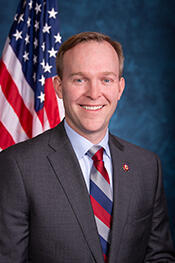
Here you will find contact information for Representative Ben McAdams, including email address, phone number, and mailing address.
| Name | Ben McAdams |
| Position | Representative |
| State | Utah |
| District | 4 |
| Party | Democratic |
| Status | Former Representative |
| Term Start | January 3, 2019 |
| Term End | January 3, 2021 |
| Terms Served | 1 |
| Born | December 5, 1974 |
| Gender | Male |
| Bioguide ID | M001209 |
About Representative Ben McAdams
Benjamin Michael McAdams (born December 5, 1974) is an American politician and attorney who served as the U.S. representative from Utah’s 4th congressional district from January 3, 2019, to January 3, 2021. A member of the Democratic Party, he was during that time the only Democratic member of Utah’s congressional delegation and aligned with the Blue Dog Coalition, a caucus of moderate and fiscally conservative Democrats. McAdams is the most recent Democrat to represent Utah in Congress and contributed to the legislative process during one term in office, representing the interests of his constituents in a closely divided district.
McAdams was born in West Bountiful, Utah, and grew up along the Wasatch Front in a Latter-day Saint family. He attended the University of Utah, where he earned a bachelor’s degree in political science, laying the foundation for his later work in public policy and government. He went on to attend Columbia Law School in New York City, receiving a J.D. with honors. While at Columbia, he was a member of the Columbia Human Rights Law Review, reflecting an early interest in legal issues related to civil and human rights.
After graduating from law school, McAdams began his legal career in New York City as an associate at the law firm Davis Polk & Wardwell, where he gained experience in corporate and financial legal practice. He and his family later returned to Utah, where he joined the Salt Lake City office of the law firm Dorsey & Whitney, working primarily in securities law. Transitioning from private practice to public service, McAdams became a senior advisor to Salt Lake City Mayor Ralph Becker, providing counsel on policy and legal matters. He has also served as an adjunct faculty member at the University of Utah S.J. Quinney College of Law, teaching and mentoring law students while remaining active in local and state politics.
McAdams entered elected office in the Utah State Senate, representing the 2nd district, which includes Salt Lake City, South Salt Lake, and a portion of West Valley City. He was elected to replace Senator Scott McCoy in a special election on December 19, 2009, and then won a full four-year term on November 2, 2010. During his tenure from 2009 to 2012, he focused on issues including education, taxation, civil rights, and environmental protection. In March 2011, he proposed a bill to ban employment and housing discrimination against gay and transgender Utahns, although his motion to hold a hearing on the bill failed on a party-line vote. His legislative record drew varied evaluations: he received a 75% rating from Parents for Choice in Education and a 77% rating from the National Education Association during the 2012 session, and an 82% score from the Utah Taxpayers Association, the highest for any Democrat that year. The Salt Lake Tribune identified him as the most liberal-leaning member of the Utah Senate in 2011, with a conservative rating of 34.4%, but in 2012 described him as the third-most conservative Democratic state senator out of eight. The Sutherland Institute, a conservative policy organization, rated him 33% conservative, while he received a 100% rating from the Utah Sierra Club for his support of environmental protection.
In November 2011, McAdams announced his candidacy to succeed Peter Corroon as mayor of Salt Lake County. He was elected on November 6, 2012, defeating Republican nominee Mark Crockett by a margin of 54% to 45%, and resigned from the Utah State Senate before taking office as mayor in 2013. He was reelected to a second term as Salt Lake County mayor in November 2016, winning 59% to 41%, and during his tenure the county maintained an AAA bond rating. As mayor from 2013 to 2019, McAdams was involved in a wide range of fiscal, social, and infrastructure initiatives. He supported renewal of the county’s Zoos, Arts, and Parks (ZAP) tax in 2014, a levy of one cent on every $10 spent that helps fund more than 190 arts and cultural organizations and about 30 parks and recreation facilities, including Hogle Zoo, Tracy Aviary, and the Loveland Living Planet Aquarium; voters approved the renewal with nearly 77% in favor. He advanced county budgets that emphasized public safety, libraries, and employee compensation: his proposed 2018 budget, ultimately passed 5–4 by the County Council, included funds for a partial opening of the Oxbow Jail, a 2.5 percent pay raise for county employees, and new libraries, though it exceeded his preliminary $1.3 billion request by $367,000. His 2019 budget proposal increased funding for public safety, including fully opening Oxbow Jail and improving recruitment and retention of sheriff’s deputies, while avoiding a tax increase and trimming overall new spending requests by about $18 million; after modifications, the council passed it unanimously.
Homelessness and regional development were central issues of McAdams’s mayoral tenure. The Utah Legislature tasked him with recommending a location for a new homeless resource center in Salt Lake County outside Salt Lake City, a politically sensitive assignment given widespread local opposition to potential sites. Before making his recommendation, McAdams spent two nights on the streets of Salt Lake City posing as a homeless person to better understand conditions and service gaps. He ultimately recommended a site in South Salt Lake, a decision opposed by that city’s mayor, Cherie Wood, and preceded by Draper Mayor Troy Walker’s withdrawal of two volunteered sites under public pressure. McAdams called for a “radically different approach” to homelessness, describing it as a “stubborn and complex social challenge,” and pledged not to support groundbreaking for the new center unless the legislature created a shared revenue pool from other cities to help fund it. He also supported state legislation granting Salt Lake County’s townships the power to determine their future governance structures, a change that led to Millcreek residents voting to incorporate as a city. As a member of the board of directors of the United Way of Salt Lake County, he helped implement a “pay-for-success” financing model that invited private investors to fund preschool programs and receive a return when specified educational benchmarks were met; in 2016, United Way recognized him for this data-driven, collaborative approach. In economic development, McAdams opposed a proposed $2.5 billion Facebook data center in West Jordan that would have received $195 million in combined city and county tax incentives, arguing the project was too costly for a facility projected to create only about 130 direct jobs. Supporters contended the center would attract additional investment, and West Jordan officials later blamed county opposition, particularly McAdams’s stance, for Facebook’s decision to locate the facility in New Mexico instead.
On October 18, 2017, McAdams announced that he would seek the Democratic nomination to challenge incumbent Republican Representative Mia Love in Utah’s 4th congressional district. At the Utah Democratic Party convention on April 28, 2018, he secured 72% of the delegates’ support, winning the nomination outright and avoiding a primary. During the campaign he distanced himself from the House Democratic leadership, publicly stating that he would not support Nancy Pelosi for Speaker if elected. National observers regarded the race as highly competitive and symbolically important: in June 2018, CNN described it as “consequential to both parties,” noting that Love had at times opposed President Donald Trump on immigration and that Democrats viewed McAdams as one of their strongest prospects to gain a seat in a Republican-leaning state. He received endorsements from the Blue Dog Coalition and the League of Conservation Voters, reflecting both his moderate fiscal stance and his support for environmental protection. On November 20, 2018, final results showed that McAdams had defeated Love by 694 votes, or 0.257%, narrowly exceeding the 0.25% threshold that would have triggered an automatic recount. Combined spending by the campaigns and outside groups totaled about $11.4 million, making it one of the most expensive congressional races in Utah history. With his victory, McAdams became the first Democrat elected to Congress from Utah since Jim Matheson won reelection in the 4th district in 2012.
McAdams served in the U.S. House of Representatives from January 3, 2019, to January 3, 2021, representing Utah’s 4th congressional district during a period of significant national political polarization and major legislative debates. As a member of the House, he participated in the democratic process on issues ranging from federal spending and health care to public lands and environmental policy, while maintaining his affiliation with the Blue Dog Coalition and emphasizing fiscal responsibility and bipartisan cooperation. His tenure coincided with the 116th Congress, which addressed matters such as appropriations, oversight of the executive branch, and the federal response to emerging national challenges. Throughout his term, he remained the sole Democrat in Utah’s congressional delegation, navigating the demands of a swing district in a predominantly Republican state.
In the 2020 election cycle, McAdams sought reelection to a second term in the House and faced Republican challenger Burgess Owens, a former National Football League player and frequent Fox News contributor. A United Utah Party candidate, Jonia Broderick, withdrew from the race in October 2020 and endorsed McAdams, reflecting the competitive and closely watched nature of the contest. Outside groups spent heavily to oppose McAdams, and the race quickly became one of the nation’s closest House contests. On November 17, 2020, nearly two weeks after Election Day, the election was called for Owens, who ultimately defeated McAdams by approximately 3,000 votes, a margin of less than 1% and slightly larger than McAdams’s own narrow victory in 2018. Observers noted that Owens overperformed in traditionally Democratic Salt Lake County, contributing to McAdams’s defeat. His term concluded on January 3, 2021, marking the end of his service in Congress and leaving Utah once again with an all-Republican congressional delegation.