Senator Benjamin L. Cardin
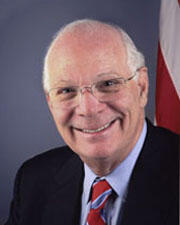
Here you will find contact information for Senator Benjamin L. Cardin, including email address, phone number, and mailing address.
| Name | Benjamin L. Cardin |
| Position | Senator |
| State | Maryland |
| Party | Democratic |
| Status | Former Representative |
| Term Start | January 6, 1987 |
| Term End | January 3, 2025 |
| Terms Served | 19 |
| Born | October 5, 1943 |
| Gender | Male |
| Bioguide ID | C000141 |
About Senator Benjamin L. Cardin
Benjamin Louis Cardin (born October 5, 1943) is an American lawyer and former politician who represented Maryland in the United States Congress from 1987 to 2025. A member of the Democratic Party, he served as a United States senator from Maryland from January 3, 2007, to January 3, 2025, and as the U.S. representative for Maryland’s 3rd congressional district from January 3, 1987, to January 3, 2007. Before his federal service, he was a member of the Maryland House of Delegates from 1967 to 1987 and served as its speaker from 1979 to 1987. Over 58 years as an elected official at the state and federal levels, Cardin never lost an election. His congressional service spanned a significant period in American history, during which he participated actively in the legislative process and represented the interests of his Maryland constituents.
Cardin was born in Baltimore, Maryland, into a family of Russian Jewish heritage. The family name was originally “Kardonsky” before it was changed to “Cardin.” His grandparents were Russian Jewish immigrants, and his maternal grandfather, Benjamin Green, operated a neighborhood grocery store that later developed into a wholesale food distribution company. His mother, Dora, was a schoolteacher, and his father, Meyer Cardin, served in the Maryland House of Delegates from 1935 to 1937 and later sat on the Baltimore City Supreme Bench from 1961 to 1977, providing a model of public service that strongly influenced his son’s career. The Cardin family attended the Modern Orthodox Beth Tfiloh Congregation near their home, with which they had been affiliated for three generations, reinforcing both religious and communal ties that would shape Cardin’s outlook.
Cardin received his early education in Baltimore and graduated from Baltimore City College in 1961. He went on to earn a Bachelor of Arts degree, cum laude, from the University of Pittsburgh in 1964, where he was a member of the Pi Lambda Phi fraternity. He then attended the University of Maryland School of Law, earning a Juris Doctor in 1967 and graduating first in his class. That same year he was admitted to the Maryland Bar and joined the private law practice of Rosen and Esterson, where he worked until 1978. His legal training and early practice provided a foundation for his later focus on ethics, fiscal policy, and social welfare in legislative work.
While still in law school, Cardin entered elective office. In November 1966 he was elected to the Maryland House of Delegates, succeeding his uncle, Maurice Cardin, who chose not to run for re-election so that his nephew could seek the seat. Cardin quickly rose through the ranks of the legislature, serving as chairman of the Ways and Means Committee from 1974 to 1979. In 1979 he became the 103rd Speaker of the Maryland House of Delegates, and at age 35 he was the youngest Speaker in Maryland history at the time. As Speaker, he played a central role in reforming Maryland’s property tax system, revising the state’s school financing formula, and strengthening ethical standards for elected officials. He remained Speaker until he left the House of Delegates in 1987, building a reputation as a skilled legislator and administrator.
In 1986, when Congresswoman Barbara Mikulski ran successfully for the U.S. Senate seat being vacated by Senator Charles Mathias, Cardin sought and won the Democratic nomination for Maryland’s 3rd congressional district, which encompassed a large portion of inner Baltimore and several close-in suburbs. He secured the Democratic primary with 82 percent of the vote in this heavily Democratic district and won the general election with 79 percent of the vote against Republican Ross Z. Pierpont, a perennial candidate. Cardin took office in the U.S. House of Representatives on January 3, 1987, and would be reelected nine times, never receiving less than 65 percent of the vote. During his House tenure, he served on the Ways and Means Committee, was ranking member of its Trade Subcommittee, and served on the Human Resources Subcommittee. He also chaired the Commission on Security and Cooperation in Europe (the U.S. Helsinki Commission), reflecting his engagement with human rights and international security issues. In 1989 he served as one of the House impeachment managers in the successful prosecution of the impeachment case against federal judge Walter Nixon.
Cardin’s House career was marked by extensive work on fiscal policy, pensions, health care, and social welfare. He authored legislation to increase the amounts individuals could contribute to 401(k) plans and IRAs, a measure enacted in 2001 that expanded retirement savings opportunities. He sponsored legislation to expand Medicare to include preventive benefits such as colorectal, prostate, mammogram, and osteoporosis screening, and he authored bills to provide a Medicare prescription drug benefit for chronic illnesses, fund graduate medical education, and guarantee coverage for emergency services. In the area of welfare and family policy, he advanced legislation to increase education and support services for foster children aged 18 to 21, a measure signed into law in 1999. He also authored bills to expand child support enforcement, improve the welfare-to-work program, and increase the child care tax credit. Cardin’s work on fiscal and retirement policy earned him recognition from Worth magazine and Treasury and Risk Management for protecting retirement plans and government-supported medical care for the elderly. He received perfect 100 percent ratings from the League of Conservation Voters and the NAACP, reflecting strong support for environmental protection and civil rights. He was also among the 133 members of Congress who voted against the 2002 Iraq Resolution, and in 2023 he voted with a bipartisan majority to repeal the Authorization for Use of Military Force in Iraq.
On April 26, 2005, Cardin announced his candidacy for the U.S. Senate seat held by Senator Paul Sarbanes, who had declared he would not seek re-election in 2006. In the September 12, 2006 Democratic primary, Cardin faced a competitive field that included Allan Lichtman, Josh Rales, Dennis F. Rasmussen, and his former House colleague Kweisi Mfume. Cardin won the primary with 44 percent of the vote, compared to 40 percent for Mfume, 5 percent for Rales, and 2 percent for Rasmussen. In the general election on November 7, 2006, he defeated Republican Michael Steele, the lieutenant governor of Maryland, by a margin of 54 percent to 44 percent, succeeding Sarbanes in the Senate on January 3, 2007. He was reelected to the Senate in 2012 in a race that included Republican Dan Bongino, Independent Rob Sobhani, and Libertarian Imad-ad-Dean Ahmad; Cardin won 56 percent of the vote to Bongino’s 26.3 percent, Sobhani’s 16.4 percent, and Ahmad’s 1 percent. He was re-elected for a third term in 2018, and on January 3, 2017, following the retirement of Senator Barbara Mikulski, he became Maryland’s senior U.S. senator.
During his Senate career, Cardin continued to focus on health care, retirement security, civil rights, environmental protection, and foreign policy, building on his long-standing legislative interests. He served on key committees and remained active in international human rights and security issues, including through his ongoing involvement with the Commission on Security and Cooperation in Europe. His tenure in the Senate coincided with major national events, including the wars in Iraq and Afghanistan, the Great Recession, the passage of the Affordable Care Act, and intense debates over voting rights, climate policy, and U.S. engagement abroad. On January 6, 2021, Cardin was on the Senate floor participating in the certification of the 2020 Electoral College vote when the United States Capitol was attacked. He was “ushered quickly — and I do mean quickly — away from the Capitol” after Vice President Mike Pence was removed from the chamber and, while sheltering with other senators at a secure location, he used social media to blame President Donald Trump for encouraging the rioters and urged Trump to call for the protestors to end the violence “peacefully.” Cardin publicly contrasted the law enforcement response to the attack with the policing of Black Lives Matter protests, calling it a “stark contrast.” After the Capitol was secured, he returned to join Congress in certifying the electoral count and subsequently stated that Trump should be held accountable for the insurrection. On January 8, 2021, he called for the invocation of the Twenty-fifth Amendment or impeachment to remove the president from office.
Cardin’s final years in the Senate reflected his continued engagement with both national and local concerns. On May 1, 2023, he announced that he would retire and not seek re-election in 2024, signaling the end of his nearly six decades in public office. In 2024, following the collapse of the Francis Scott Key Bridge in Baltimore after it was struck by a ship, Cardin advocated for federal funding to support the reconstruction of the bridge, underscoring his long-standing commitment to Maryland’s infrastructure and economic well-being. He retired from the Senate and from elective politics on January 3, 2025, concluding a congressional career that began in the House of Representatives in 1987 and a broader public service record in Maryland and national politics that spanned more than half a century.