Representative Benjamin Tucker Eames
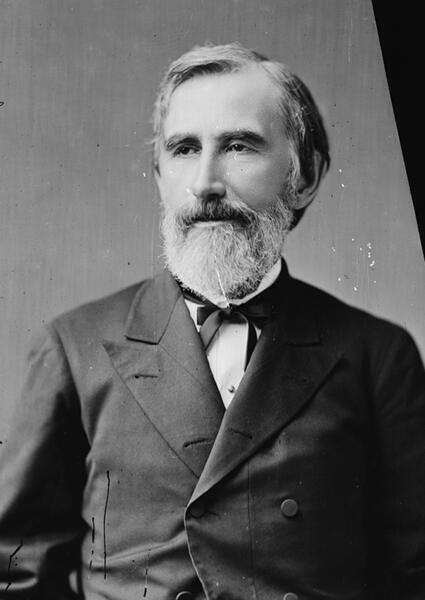
Here you will find contact information for Representative Benjamin Tucker Eames, including email address, phone number, and mailing address.
| Name | Benjamin Tucker Eames |
| Position | Representative |
| State | Rhode Island |
| District | 1 |
| Party | Republican |
| Status | Former Representative |
| Term Start | March 4, 1871 |
| Term End | March 3, 1879 |
| Terms Served | 4 |
| Born | June 4, 1818 |
| Gender | Male |
| Bioguide ID | E000005 |
About Representative Benjamin Tucker Eames
Benjamin Tucker Eames (June 4, 1818 – October 6, 1901) was a Republican U.S. Representative from Rhode Island who served four consecutive terms in the United States Congress from 1871 to 1879. Over the course of a long career in law and public service, he held multiple positions in the Rhode Island General Assembly and participated actively in the legislative life of his state and nation during a transformative period in American history.
Eames was born in Dedham, Massachusetts, on June 4, 1818. During his youth his family connections and opportunities drew him to Rhode Island, and he attended the common schools of Providence. He continued his education at academies in Massachusetts and Connecticut, gaining a broad preparatory education typical of New England in the early nineteenth century. Before entering professional life, he was employed for several years as a bookkeeper, work that provided him with practical experience in business and finance and helped prepare him for later responsibilities in public administration and legislative service.
Pursuing higher education, Eames enrolled at Yale College, from which he graduated in 1843. While at Yale he was a member of the Skull and Bones society, an affiliation that placed him among a network of contemporaries who would go on to careers in law, politics, and public life. After graduation he engaged as a teacher in an academy at North Attleboro, Massachusetts, where he simultaneously studied law. This period of teaching and legal study reflected a common professional path of the era, combining education, self-directed legal training, and community involvement.
Eames was admitted to the bar in 1845 and commenced the practice of law in Providence, Rhode Island. Almost immediately he became involved in the workings of state government. From 1845 to 1850 he served as recording and reading clerk of the Rhode Island House of Representatives, a position that gave him detailed familiarity with legislative procedure and the drafting and recording of laws. Building on this experience, he entered elective office as a member of the Rhode Island Senate, serving from 1854 to 1857 and again in 1863 and 1864. In 1857 he was appointed one of the commissioners on the revision of the public laws of the State of Rhode Island, a significant responsibility that placed him at the center of efforts to modernize and systematize the state’s legal code. He also served in the Rhode Island House of Representatives in 1859, 1860, 1868, and 1869, further consolidating his reputation as an experienced legislator.
On the strength of this extensive state legislative record, Eames was elected as a Republican to the Forty-second Congress and to the three succeeding Congresses, serving in the U.S. House of Representatives from March 4, 1871, to March 4, 1879. His service in Congress occurred during the later years of Reconstruction and the beginning of the Gilded Age, a period marked by debates over civil rights, federal-state relations, economic development, and westward expansion. As a member of the House of Representatives, he participated in the democratic process at the national level and represented the interests of his Rhode Island constituents. During the Forty-third Congress he served as chairman of the Committee on Private Land Claims, where he played a role in adjudicating and overseeing disputes and legislative measures related to land titles and property rights, particularly in territories and states where historical claims required federal action. After four terms in office, he was not a candidate for renomination in 1878.
Following his departure from Congress, Eames returned to state politics and continued his legislative career in Rhode Island. He again became a member of the Rhode Island House of Representatives from 1879 to 1881, contributing his congressional experience to state affairs. He later served once more in the Rhode Island Senate in 1884 and 1885, underscoring his long-standing commitment to public service and his enduring influence in Rhode Island’s political life. Throughout these years he remained identified with the Republican Party and with the legislative work that had defined his career.
Benjamin Tucker Eames died in East Greenwich, Rhode Island, on October 6, 1901. He was interred in Swan Point Cemetery in Providence, Rhode Island, a resting place for many of the state’s prominent political and civic leaders. His life and career spanned much of the nineteenth century, and his repeated service in both state and national legislatures reflected a sustained engagement with the evolving legal and political framework of Rhode Island and the United States.