Representative Benjamin A. Gilman
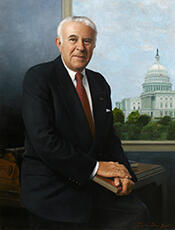
Here you will find contact information for Representative Benjamin A. Gilman, including email address, phone number, and mailing address.
| Name | Benjamin A. Gilman |
| Position | Representative |
| State | New York |
| District | 20 |
| Party | Republican |
| Status | Former Representative |
| Term Start | January 3, 1973 |
| Term End | January 3, 2003 |
| Terms Served | 15 |
| Born | December 6, 1922 |
| Gender | Male |
| Bioguide ID | G000212 |
About Representative Benjamin A. Gilman
Benjamin Arthur Gilman (December 6, 1922 – December 17, 2016) was an American politician and Republican member of the United States House of Representatives from Middletown, New York, who served 15 consecutive terms in Congress from January 3, 1973, to January 3, 2003. A moderate Republican in the tradition often associated with New York’s Nelson Rockefeller, he became particularly prominent in the fields of foreign affairs, human rights, and international education, and was widely recognized for his long tenure and influence in the House of Representatives.
Gilman was born on December 6, 1922, and grew up in New York in a Jewish family, a background that later informed his interest in human rights and international issues. He came of age during the Great Depression and the Second World War, experiences that shaped his views on public service and global engagement. His early life in New York provided the foundation for a political career rooted in close attention to his constituents while maintaining a strong international focus.
Gilman pursued higher education in New York before entering public life, and his academic training prepared him for the complex legislative and diplomatic work that would characterize his congressional career. His education, combined with his wartime generation’s sense of responsibility, contributed to his interest in international law, diplomacy, and the mechanisms of global governance, which later became central themes of his committee work in Congress.
Gilman first won election to Congress in 1972, in the wake of a major reapportionment of New York’s congressional districts. Running as a Republican, he was elected to represent New York’s 26th congressional district. In the general election he defeated incumbent Democrat John G. Dow, who had been serving in New York’s 27th congressional district, much of whose territory and population were incorporated into the newly drawn 26th district. Gilman subsequently served in the House of Representatives from January 3, 1973, until January 3, 2003, during a significant period in American history that spanned the end of the Vietnam War, the Cold War’s conclusion, and the post–Cold War realignment. Over the course of his 15 terms, he represented evolving districts in the Hudson Valley region, including what became New York’s 20th congressional district, and he consistently participated in the democratic process and represented the interests of his constituents.
Throughout his years in Congress, Gilman held a series of influential committee assignments. He was a long-serving member of the House Post Office and Civil Service Committee, which in the 1990s evolved into the Government Reform and Oversight Committee, reflecting broader changes in federal oversight and administrative reform. He co-founded the House Select Committee on Narcotics and served as a senior member of that committee from 1977 to 1989, continuing as a member until the committee was abolished in 1993. In this capacity he became deeply involved in efforts to combat narcotic abuse and trafficking, work that later contributed to his recognition as a champion in the fight against drug abuse. He also served as a member of the House Committee on International Relations, later known as the House Committee on Foreign Affairs, where he would eventually rise to the chairmanship.
Gilman’s congressional career was especially distinguished by his leadership on foreign policy. He served as chair of the House Committee on International Relations (also known as the House Committee on Foreign Affairs) during the 104th through 106th Congresses, from 1995 to 2002. In this role he was active on a wide range of international issues, including human rights, global security, and international development. He served as a congressional delegate to the United Nations, working under U.S. Ambassador Jeane Kirkpatrick in 1981, and acted as a congressional adviser to the U.N. Law of the Sea Conference, reflecting his interest in international legal frameworks. He was a member of the Ukraine Famine Commission, participated in U.S.–European, Canadian, and Mexican interparliamentary conferences, and served as co-chair of the Committee on Irish Affairs. His work on these bodies underscored his commitment to transatlantic relations, historical justice, and conflict resolution. In recognition of his contributions to foreign policy, he received the Secretary’s Distinguished Service Award, the highest civilian honor bestowed by the U.S. Department of State.
During the 1970s, Gilman became closely identified with the issue of Prisoners of War and Missing in Action (POW/MIA) in Southeast Asia. He served on the Select Congressional Committee on that problem and was one of only two Members of Congress to vote against “closing the book” on the POW/MIA situation, reflecting his insistence on full accounting for missing servicemembers. At the same time, he became involved with the global problem of hunger, authoring legislation that created a presidential Commission Against Hunger. President Jimmy Carter subsequently appointed him to that commission, enabling him to pursue policy responses to world hunger at the highest levels of government. These efforts reinforced his reputation as a legislator deeply engaged with humanitarian concerns.
As chair of the House Committee on Foreign Affairs in the mid-1990s and early 2000s, Gilman consistently advocated stronger ties between the United States and India, viewing India as a strategic counterweight to Chinese influence in South Asia, particularly in relation to Pakistan. During the 1999 Kargil War between India and Pakistan, he urged American lawmakers to press the Pakistani government to withdraw from the conflict and publicly stated that he held Pakistan solely responsible for the hostilities. He also spoke out on behalf of Tibet, and during an April 2000 hearing on negotiations between China and Tibet he emphasized Tibet’s historic role as a buffer state between India and China and characterized the Tibetan struggle as a courageous effort by a people seeking to regain what he described as their rightful autonomy after repression and colonization. In recognition of his role in strengthening U.S.–India relations, the Government of India awarded him the Padma Vibhushan, its second-highest civilian honor, in 2001. He was one of only 12 foreigners, and one of only three Americans not of Indian origin, ever to receive this distinction. In his later years in Congress, he was also a frequent and vocal critic of President Bill Clinton, particularly on matters of American foreign policy, reflecting his strong views on the conduct of international relations.
Gilman also left a lasting legacy in the field of international education. He helped secure passage of the International Academic Opportunity Act of 2000, which established exchange programs for American students to study abroad. From this legislation emerged the Benjamin A. Gilman International Scholarship Program, administered by the U.S. Department of State, which provides scholarships for Pell Grant–eligible American college students to study or intern abroad. The program was named in his honor and reflects his belief that study abroad offers students a transformative experience, exposing them to different cultures and perspectives and encouraging them to return home with a deeper understanding of their place in the world and a commitment to active participation in the international community.
Congressman Gilman retired from Congress in 2003 after New York’s 20th congressional district, which he had been representing, was broken up and dispersed among the 17th, 18th, 19th, and 22nd congressional districts in the redistricting that followed the 2000 census and reapportionment. At the time of his retirement, he was the oldest sitting member of the U.S. House of Representatives; in all of Congress, only Senators Strom Thurmond and Robert Byrd were older. He was the senior Republican representing New York and the second-most senior member of the New York delegation overall, behind only Representative Charles B. Rangel. In 2003, following his departure from Congress, the Dalai Lama presented him with the International Campaign for Tibet’s Light of Truth Award, further recognizing his advocacy on behalf of the Tibetan people.
In his later years, Gilman continued to be honored for his work in international affairs, human rights, and education. On March 28, 2008, he participated in the ribbon-cutting ceremony for the Gilman Center for International Education in his hometown of Middletown, New York, on the campus of SUNY Orange (Orange County Community College). This modern facility for international studies was designed to attract students from around the world and houses Gilman’s public papers from his 36 years in elective office, along with photographs and memorabilia from his long career. On June 14, 2011, he received the Top Honor Prize from the World Peace Prize Awarding Council, which recognized him as a lifelong champion of human rights and cited his efforts in fighting world hunger and narcotic abuse and trafficking.
Benjamin Arthur Gilman died on December 17, 2016, closing a public life that spanned more than three decades in Congress and numerous contributions to American foreign policy, international education, and humanitarian causes. His career in the House of Representatives, from 1973 to 2003, left a durable imprint on U.S. engagement with the world and on the lives of the constituents he represented from New York.