Representative Benjamin Franklin Howell
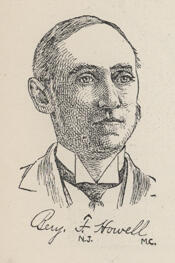
Here you will find contact information for Representative Benjamin Franklin Howell, including email address, phone number, and mailing address.
| Name | Benjamin Franklin Howell |
| Position | Representative |
| State | New Jersey |
| District | 3 |
| Party | Republican |
| Status | Former Representative |
| Term Start | December 2, 1895 |
| Term End | March 3, 1911 |
| Terms Served | 8 |
| Born | January 27, 1844 |
| Gender | Male |
| Bioguide ID | H000857 |
About Representative Benjamin Franklin Howell
Benjamin Franklin Howell (January 27, 1844 – February 1, 1933) was an American banker, Civil War veteran, and Republican politician who served eight consecutive terms as a Representative from New Jersey in the United States Congress from 1895 to 1911. Over the course of his sixteen years in the House of Representatives, he represented New Jersey’s 3rd congressional district and contributed to the legislative process during a significant period in American history, participating in the democratic process and representing the interests of his constituents.
Howell was born in Cedarville, New Jersey, on January 27, 1844. He attended the local common schools and pursued further education at the Fort Edward Institute in Fort Edward, New York, a well-regarded preparatory school of the period. His early life in rural New Jersey and his formal schooling in New York provided the foundation for his later careers in business, public service, and national politics.
During the American Civil War, Howell enlisted in the Twelfth Regiment, New Jersey Volunteers, in 1862. He served with this unit until the close of the war in 1865, gaining the experience and perspective of a Union Army veteran at a formative time in his life. His wartime service preceded and helped shape his subsequent engagement in civic affairs and public life.
After the war, in 1865, Howell settled in South Amboy, New Jersey, where he engaged in mercantile pursuits. He became active in local affairs and was named to the Township Committee, participating in the governance and development of the community. His growing prominence in Middlesex County led to his election as Surrogate of Middlesex County, a position he held from 1882 to 1892. In this role he was responsible for probate matters and the administration of estates, further establishing his reputation for public responsibility and administrative competence.
Parallel to his public offices, Howell developed a substantial career in banking. He served as president of the People’s National Bank of New Brunswick, New Jersey, and as vice president of the New Brunswick Savings Institution. He was also a founder and vice president of the First National Bank of South Amboy, an institution later known as Amboy Bank. These positions placed him at the center of regional financial activity and underscored his standing as a leading businessman in central New Jersey.
Howell entered national politics as a member of the Republican Party and was elected to the Fifty-fourth Congress and to the seven succeeding Congresses, serving in the U.S. House of Representatives from March 4, 1895, to March 3, 1911. Representing New Jersey’s 3rd congressional district, he served during a transformative era marked by industrial expansion, increased immigration, and the early stirrings of the Progressive movement. He was chosen as chairman of the House Committee on Immigration and Naturalization during the Fifty-eighth through the Sixty-first Congresses, giving him a central role in shaping federal policy on immigration at a time of heavy influx from Europe. In addition to his committee leadership, he served as a member of the United States Immigration Commission from 1907 to 1910, participating in the comprehensive study of immigration’s social and economic effects that informed subsequent legislative debates. He also took part in national party affairs as a delegate to the 1896 Republican National Convention. After eight terms in office, he was an unsuccessful candidate for reelection in 1910 to the Sixty-second Congress, concluding his formal congressional service in March 1911.
In his later years, Howell remained a respected figure in New Jersey’s civic and financial circles, associated particularly with New Brunswick and South Amboy. He lived in New Brunswick, New Jersey, where he continued to be identified with the banking institutions he had helped to lead and with the public service that had defined much of his life. Benjamin Franklin Howell died at his home in New Brunswick on February 1, 1933, at the age of 89. He was interred in Christ Cemetery in South Amboy, New Jersey, closing a life that spanned the Civil War, the Gilded Age, and the early twentieth-century evolution of the United States Congress.