Representative Benjamin Franklin James
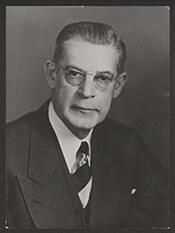
Here you will find contact information for Representative Benjamin Franklin James, including email address, phone number, and mailing address.
| Name | Benjamin Franklin James |
| Position | Representative |
| State | Pennsylvania |
| District | 7 |
| Party | Republican |
| Status | Former Representative |
| Term Start | January 3, 1949 |
| Term End | January 3, 1959 |
| Terms Served | 5 |
| Born | August 1, 1885 |
| Gender | Male |
| Bioguide ID | J000045 |
About Representative Benjamin Franklin James
Benjamin Franklin James (August 1, 1885 – January 26, 1961) was an American politician and businessman from Pennsylvania who served as a Republican member of the U.S. House of Representatives for Pennsylvania’s 7th congressional district from 1949 to 1959. Over five consecutive terms in Congress, he represented Delaware County during a significant period in American history, participating in the legislative process on major issues of the early Cold War era. Before his election to the national legislature, he served as a member of the Pennsylvania House of Representatives for Delaware County from 1939 to 1947.
James was born in Philadelphia, Pennsylvania, on August 1, 1885. He extensively studied graphic arts, training for a career in the printing and publishing field that would shape much of his professional life. In 1910 he moved from Philadelphia to Radnor Township in Delaware County, Pennsylvania, where he would establish both his business and political base. During World War I, he enlisted in the United States Army and was assigned to the Central Officers Training School. He was honorably discharged in November 1918 as a second lieutenant in the United States Army Reserves, returning to civilian life with both military and technical experience.
In his civilian career, James became a prominent figure in the printing industry. He served as president and chairman of the board of directors of the Franklin Printing Company of Philadelphia, a firm founded in 1728 by Benjamin Franklin and one of the oldest printing establishments in the United States. Within his profession, he was active in trade and civic organizations, serving as president of the Poor Richard Club, a well-known Philadelphia advertising and printing association, and becoming the first president of the Printing Industries of Philadelphia, an organization representing printers in the region. These roles reflected his leadership in the graphic arts community and helped establish his public reputation.
James’s entry into public office began at the local level in Radnor Township. He served as a member of the Radnor Township Board of Commissioners from 1929 to 1936, where he was credited with helping to reorganize the township’s lighting system and undertaking other municipal improvements. Building on this local service, he was elected to the Pennsylvania House of Representatives for Delaware County, serving from 1939 through 1946. As a state legislator, he introduced what became known as the “James bill,” which sought to prevent the City of Philadelphia from collecting its wage tax from suburban residents who worked in the city. Although the bill was ultimately defeated, it highlighted his advocacy for suburban taxpayers and his early involvement in regional tax and governance issues.
In 1948, James sought election to the U.S. House of Representatives from Pennsylvania’s 7th congressional district. Backed by the powerful Delaware County Republican organization led by John J. McClure and the county Board of Republican Supervisors, known as the “War Board,” he challenged the independent incumbent, E. Wallace Chadwick, in the Republican primary. James prevailed by approximately 7,600 votes and went on to defeat Democrat Arthur Snyder in the general election by a margin of 91,394 to 56,263, winning about 61.3 percent of the vote. He took office on January 3, 1949, and was elected as a Republican to the Eighty-first and four succeeding Congresses, serving until January 3, 1959. He was not a candidate for renomination in 1958, thus concluding a decade of service in the national legislature.
Upon entering Congress, James was initially appointed to the House Committees on the District of Columbia and House Administration, both relatively low-profile assignments. During his first term, he participated in key votes on postwar and early Cold War legislation. He supported the Marshall Plan to aid Western Europe, the Mundt–Nixon Anti-Communist Bill, legislation allowing refugees into the United States, the Agricultural Act of 1949 providing price supports, the Trade Agreements Extension Act, the Internal Security Act of 1950 (which he voted to pass over a presidential veto), and a weakened Fair Employment Practices measure without enforcement powers. He opposed the National Housing Act of 1949, proportional allocation of electoral votes, and early aid to NATO and to South Korea prior to the outbreak of the Korean War, even as he generally followed the Republican Party’s anti-Communist line. He also favored extending rent controls and, in a 1949 committee vote, was the only Republican to join six conservative southern Democrats in opposing an Anti-Poll Tax bill. In 1951, he introduced a bill to fix the authorized strength of the United States Marine Corps and to make the Commandant of the Marine Corps a member of the Joint Chiefs of Staff.
With the Republicans’ return to the majority in the 83rd Congress, James’s influence in the House increased. In 1953 he was appointed to the powerful Appropriations Committee, ranking thirty-seventh in party seniority. He served on subcommittees overseeing general government matters and the Treasury and Post Office departments, while continuing his work on the District of Columbia Committee. Local press accounts in the News of Delaware County described him as an active appropriator who paid close attention to government spending. During his tenure on the Appropriations Committee, the federal government recorded budget surpluses in 1956 and 1957. In 1957 he introduced legislation to include the “Ben Franklin” television series in the Archives of Congress and to initiate development of Independence National Historical Park in Philadelphia, reflecting his interest in American history and his home region. That same year, he voted in favor of the Civil Rights Act of 1957.
Throughout his congressional service, James compiled a moderately conservative voting record, broadly similar to that of his Republican predecessors from the district. In a comparison of 58 key roll calls between 1949 and 1958, he agreed with ultra-conservative Illinois Representative Noah Mason 74 percent of the time, though he diverged on issues such as civil rights and foreign aid. Congressional Quarterly data indicated that in his first term he voted with the majority of his party 87 percent of the time and supported the Eisenhower administration’s positions about 65 percent of the time, opposing them 15 percent of the time, with the remainder accounted for by missed votes. By the 1955–1956 term, he was 53 percent pro-Eisenhower and 28 percent opposed, with attendance at 73 percent of recorded votes. In the 1957–1958 term, as his health declined, his attendance fell to 52 percent.
James’s electoral record in Delaware County was consistently strong. In 1950, amid the Korean War and national Democratic difficulties, he was reelected with roughly 62.7 percent of the vote over Democrat Hubert P. Earle, reporting campaign expenses of only $237 compared with his opponent’s approximately $2,700. In 1952, he again won comfortably, receiving about 61.7 percent of the vote (127,918 to Democrat Murray Zealor’s 79,423), running in tandem with the popular Republican presidential nominee Dwight D. Eisenhower, who also carried Delaware County by a wide margin. In 1954, despite a vigorous Democratic challenge by O. Arthur Cappiello, who criticized James’s record on labor, housing, veterans’ benefits, and support for Eisenhower’s program, James was reelected with about 60.9 percent of the vote and a plurality of roughly 36,000. In 1956, facing Democrat William A. Welsh, who attacked Republican tax and housing policies and linked James to big business interests, he again prevailed decisively with about 62 percent of the vote, 137,764 to 84,764, reporting no campaign expenditures to Welsh’s $804. Over his five terms, his general-election majorities typically ranged from about 60.9 to 62.7 percent, reinforcing his reputation as a stable and popular representative in a strongly Republican county.
James’s congressional career also intersected with dramatic national events. On March 1, 1954, during an attack on the House of Representatives chamber by four Puerto Rican nationalists demanding independence for Puerto Rico, gunmen opened fire from the visitors’ gallery, wounding five members of Congress. James narrowly escaped injury when a bullet struck the wall behind him. In the charged political climate of the 1950s, he was an active participant in partisan battles in Pennsylvania, particularly in the 1956 campaign when he joined state Senator G. Robert Watkins in attacking Democratic U.S. Senate candidate Joseph S. Clark Jr., citing Clark’s membership in Americans for Democratic Action and accusing the group of providing “aid and comfort” to international communism. He also took part in local debates over the Philadelphia wage tax, annexation fears, and public housing, often aligning with the entrenched Delaware County Republican organization against Democratic reformers.
By the late 1950s, James’s health had begun to deteriorate. He was hospitalized twice in 1957 for an undisclosed illness and underwent surgery in May of that year. His declining physical condition contributed to his reduced attendance on roll-call votes and, in June 1958, led him to resign his seat on the Appropriations Committee. On February 15, 1958, he announced that he would not be a candidate for a sixth term in Congress, stating that at the conclusion of the 85th Congress he would have served ten years, and that his decision to forgo further public office had been made “regretfully, and only after carefully weighing the demands of such service against the inevitable changes, of personal concern, that come with the passing of time.” He left office at the end of his fifth term on January 3, 1959.
Benjamin Franklin James died on January 26, 1961, at the age of seventy-five. Remembered as a businessman turned legislator who rose from local township government to the state legislature and then to the U.S. House of Representatives, he represented Pennsylvania’s 7th congressional district during a transformative decade in American politics. His career combined leadership in the historic Franklin Printing Company and the regional printing industry with a long record of public service at the local, state, and national levels.