Representative Benjamin Franklin Murphy
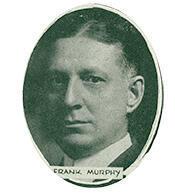
Here you will find contact information for Representative Benjamin Franklin Murphy, including email address, phone number, and mailing address.
| Name | Benjamin Franklin Murphy |
| Position | Representative |
| State | Ohio |
| District | 18 |
| Party | Republican |
| Status | Former Representative |
| Term Start | May 19, 1919 |
| Term End | March 3, 1933 |
| Terms Served | 7 |
| Born | December 24, 1867 |
| Gender | Male |
| Bioguide ID | M001089 |
About Representative Benjamin Franklin Murphy
Benjamin Franklin Murphy (December 24, 1867 – March 6, 1938) was a Republican U.S. Representative from Ohio who served seven consecutive terms in the United States Congress from 1919 to 1933. Over the course of his legislative career, he represented his Ohio constituents during a period of significant political and economic change in the United States, participating actively in the work of the House of Representatives and contributing to the federal legislative process.
Murphy was born in Steubenville, Ohio, on December 24, 1867, to Charles F. Murphy and Mary E. (née Beasley) Murphy. He was educated in the Steubenville public schools, receiving the basic education that prepared him for a varied early working life. After leaving school, he learned the glassworker’s trade, entering an important regional industry at a time when manufacturing and skilled labor were central to the local economy of eastern Ohio.
Building on his experience in industry, Murphy later broadened his business interests. He engaged in the retail shoe business and subsequently entered the fields of banking and real estate. His growing prominence in local commercial affairs was reflected in his service as vice president of the Peoples National Bank, a position that underscored his standing in the community and provided him with experience in finance and management that would later inform his public service. During the First World War, in 1917 and 1918, he contributed to the national war effort by serving with the Young Men’s Christian Association (YMCA), stationed at Camp Sheridan in Montgomery, Alabama, where he supported the welfare and morale of soldiers in training.
Murphy’s national political career began with his election as a Republican to the Sixty-sixth Congress. He was subsequently reelected to the six succeeding Congresses, serving continuously from March 4, 1919, to March 3, 1933. As a member of the House of Representatives, he represented Ohio during the post–World War I era, the 1920s, and the onset of the Great Depression. In Congress, he took part in debates and votes on the major issues of the day and worked to represent the interests of his district. During the Sixty-seventh Congress, he served as chairman of the Committee on Expenditures in the Department of Commerce, a role that placed him at the center of oversight of federal spending within that department and reflected the confidence of his colleagues in his judgment and administrative experience.
Murphy’s congressional service came to an end amid the shifting political climate of the early 1930s. He was an unsuccessful candidate for reelection in 1932 to the Seventy-third Congress, a year marked by widespread electoral gains for Democrats during the depths of the Great Depression. He sought a return to the House two years later but was again unsuccessful in his bid for election in 1934 to the Seventy-fourth Congress. These defeats concluded his formal legislative career after fourteen years in the national legislature.
In his personal life, Murphy married three times and was widowed twice. His second wife, Mame M. (née Barcus) Murphy, died in an automobile accident in Florida in April 1929, a sudden loss that occurred while he was still serving in Congress. Approximately a year later, he married Marie E. (née Williams) Clerk, a local divorcee, in Washington, D.C. The ceremony took place at her home and was presided over by her brother-in-law, the Reverend William Clews, reflecting Murphy’s established residence and social ties in the nation’s capital during and after his years in office.
Following his departure from Congress, Murphy continued to reside in Washington, D.C., maintaining his connection to the city where he had spent much of his public career. He died in nearby Takoma Park, Maryland, on March 6, 1938. His remains were returned to his native Ohio, and he was interred in Union Cemetery in Steubenville, thus closing a life that had begun and ended in the same community, despite his long service on the national stage.