Representative Benjamin Randall
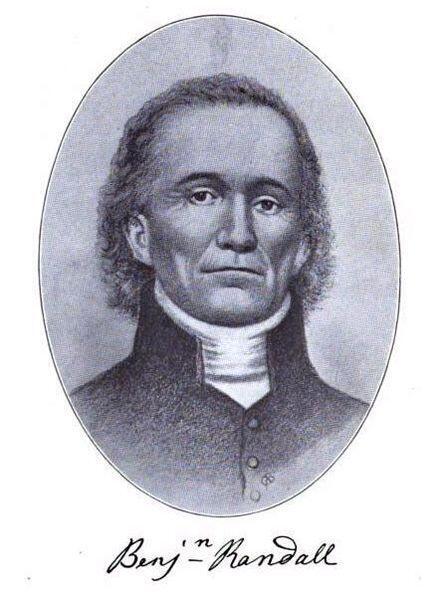
Here you will find contact information for Representative Benjamin Randall, including email address, phone number, and mailing address.
| Name | Benjamin Randall |
| Position | Representative |
| State | Maine |
| District | 3 |
| Party | Whig |
| Status | Former Representative |
| Term Start | December 2, 1839 |
| Term End | March 3, 1843 |
| Terms Served | 2 |
| Born | November 14, 1789 |
| Gender | Male |
| Bioguide ID | R000035 |
About Representative Benjamin Randall
Benjamin Randall (February 7, 1749 – October 22, 1808) was an American Baptist minister and the main organizer of the Free Will Baptists (Randall Line) in the northeastern United States. As a member of the Whig Party representing Maine, Benjamin Randall contributed to the legislative process during two terms in office, serving in Congress during a significant period in American history and participating in the democratic process while representing the interests of his constituents.
Benjamin Randall III was born on February 7, 1749, at New Castle in the Province of New Hampshire, to sea captain Benjamin Randall Jr. (born 1712) and his wife, the former Margaret Mordantt. He was the eldest of nine children, and both parents were of English ancestry. Raised in a maritime family, Randall spent a considerable part of his youth as a cabin boy aboard his father’s ship. Sensitive and pious by temperament, he read the Bible daily and was uncomfortable with the rough life at sea. He received what contemporaries described as a “good commercial education” in the rudimentary public schools of the period, which he supplemented with extensive personal reading.
At the age of seventeen, Randall was apprenticed to a sailmaker in Portsmouth, New Hampshire, with whom he remained until he turned twenty-one. The sewing and fabrication skills he acquired in this trade enabled him to transition into the profession of tailoring, in which he became proficient, and he occasionally took on related work such as tent-making when such employment was available. During 1771 he worked in Marblehead and Salem, Massachusetts, before returning to his native New Castle in the fall of that year to establish himself as a sailmaker. In November 1771 he married Joanna Oram (born 1748) of Kittery, Maine, the daughter of another sea captain, thereby further strengthening his ties to the seafaring communities of northern New England.
Randall’s religious life was decisively shaped by the evangelical currents of the Great Awakening. On September 23, 1770, the renowned evangelist George Whitefield visited Portsmouth on his final preaching tour. Randall heard Whitefield speak several times and was deeply affected by both the sermons and the news of Whitefield’s death shortly thereafter. This experience prompted an intense period of religious reflection that awakened Randall’s piety and stirred in him a strong desire to evangelize. In 1772 he and his wife joined the Congregational church in New Castle, but he soon found the spiritual life of the congregation unsatisfying. Possessed of a zealous determination to “save souls,” he advocated in the spring of 1774 for open religious meetings that would be accessible to the broader public, featuring the reading of printed sermons, public prayer, and hymn singing. These lay-led gatherings aroused suspicion and resentment from the local pastor, who came to regard Randall as a rival, though the growing conflict was interrupted by the onset of the American Revolutionary War.
During the revolutionary crisis of 1775–1776, Randall was an ardent patriot. With the outbreak of hostilities he briefly enlisted in the Massachusetts militia, serving in Captain John Parsons’s company at New Castle during the first half of 1775, until the immediate emergency passed and the company was dismissed. After another scare in the fall of 1775, he enlisted for two months as an assistant commissary. In September 1776 he reenlisted as a sergeant in a regiment commanded by Colonel Pierce Lang, ultimately serving about a year and a half in the militia. Throughout his military service, Randall remained intensely devout, later recalling that he “never lived nearer to God than during that campaign experience.” He regularly visited the sick and informally performed chaplain-like duties, offering spiritual consolation to fellow soldiers. Although some mocked his religious fervor, his commanding officer defended him and threatened severe punishment for continued derision, which eased tensions within the ranks.
Randall’s theological development during these years led him toward the Calvinistic Baptists. In 1776 he found himself in fundamental agreement with their emphasis on active evangelism and baptism by immersion, and he joined this small and often unpopular sect. By 1777 he was reading published sermons and preaching as a layman, holding public meetings day and night and sometimes preaching four times a week. His revival meetings, unconventional in form and style, resulted in the conversion of some thirty people but also provoked hostility in the community. Randall later recounted that “persecution grew very hot,” and he once narrowly escaped serious injury when a piece of brick thrown at him in the street grazed his hair. Undeterred, he spent the summer of 1777 traveling more widely on preaching tours across New England.
In March 1778 Randall moved with his family from New Castle to New Durham, New Hampshire, where he would reside for the remainder of his life. There he became the only resident preacher after the previous minister resigned over a salary dispute. The townspeople built a meetinghouse for him, and he supported himself through voluntary contributions from his congregation, supplemented by work as a tailor and by tending a small farm. From New Durham he continued to travel and preach in surrounding communities. Over time, Randall’s preaching emphasized the availability of rapid and free salvation to all who sincerely repented and believed, a view that increasingly conflicted with the Calvinist doctrine of predestination that prevailed among the Baptists. Accused of teaching anti-Calvinist doctrines, he separated from the Baptist church in 1780.
On April 5, 1780, Randall was ordained at New Durham by the laying on of hands by two ordained ministers in good standing, thereby formally entering the ministry and acquiring the title “Elder,” then commonly used for gospel ministers. In June 1780 he drafted new Articles of Faith and a Church Covenant for the New Durham congregation, and the first Free Baptist church was established, though for roughly two decades it did not employ a distinctive prefix to the Baptist name. By the end of that year the church comprised seven men and thirteen women. Randall’s doctrine stressed that human beings possessed free will and that God stood ready to forgive sins arising from the misuse of that freedom, provided there was genuine repentance. He held that complete atonement was available to all and that believers had a duty to exhort others and proclaim the availability of free salvation. His followers, often derided by contemporaries as “Randallites,” “General Provisioners,” “New-Lights,” and “Freewillers,” nonetheless formed the nucleus of what became known as the Free Will Baptists (Randall Line), a movement associated with Arminian theology and later recognized as a distinct current within the broader American Baptist tradition.
From the beginning of his lay preaching until his death, Randall was instrumental in planting many Free Will Baptist churches throughout New England, extending the influence of his theological convictions and organizational efforts. His work helped establish a durable denominational presence that emphasized free grace, human responsibility, and evangelistic zeal. Benjamin Randall died of tuberculosis on October 22, 1808, in New Durham, New Hampshire.