Representative Benjamin Reifel
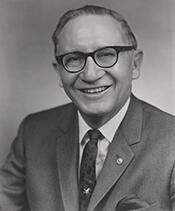
Here you will find contact information for Representative Benjamin Reifel, including email address, phone number, and mailing address.
| Name | Benjamin Reifel |
| Position | Representative |
| State | South Dakota |
| District | 1 |
| Party | Republican |
| Status | Former Representative |
| Term Start | January 3, 1961 |
| Term End | January 3, 1971 |
| Terms Served | 5 |
| Born | September 19, 1906 |
| Gender | Male |
| Bioguide ID | R000152 |
About Representative Benjamin Reifel
Benjamin Reifel (RIFLE; September 19, 1906 – January 2, 1990), also known as Lone Feather (Lakota: Wíyaka Waŋžíla), was a Sicangu Lakota public administrator and politician who became the first person of Lakota or Sioux descent to serve in the United States House of Representatives. An enrolled citizen of the Rosebud Sioux Tribe of the Rosebud Indian Reservation, he served five terms as a Republican Representative from South Dakota’s now-obsolete First Congressional District from 1961 to 1971, representing the East River region of the state and contributing to the legislative process during a significant period in American history.
Reifel was born in a log cabin near Parmelee, South Dakota, on the Rosebud Indian Reservation. He was the son of Lucy Burning Breast, a Sicangu Lakota, and William Reifel, who was of German descent. His Lakota name, Wíyaka Waŋžíla, translates as “Lone Feather” in English. As a child he attended a Todd County school and the Rosebud Reservation boarding school, completing the eighth grade at the age of sixteen and becoming fluent in both English and Lakota. After graduation he worked for three years on his family’s farm, gaining firsthand experience with agricultural life on the Great Plains that would later inform his professional and political work.
Seeking further education, Reifel entered the School of Agriculture, a vocational high school in Brookings, South Dakota, and finished his studies there in 1928. He then enrolled at South Dakota State College (now South Dakota State University), where he paid his own tuition for his first four years before obtaining one of the first loans offered to Native American students under an Indian education program recommended by the 1928 Meriam Report. He graduated in 1932 with a Bachelor of Science degree in agriculture and was elected president of the Students’ Association during his senior year, an early indication of his leadership abilities and interest in public service.
Following his graduation in 1932, Reifel accepted a position at Hare’s School in Mission, South Dakota, serving as an adviser for boys. In 1933 he began what would become a long and influential career with the Bureau of Indian Affairs (BIA), initially assigned to the Pine Ridge Indian Reservation as a farm agent to the Oglala Lakota. After a year he was promoted to field agent at the BIA’s regional headquarters in Pierre, South Dakota. In this role he was responsible for promoting and implementing the provisions of the Indian Reorganization Act of 1934, which ended the allotment of reservation lands, encouraged tribal self-government, and supported the drafting of written constitutions and elected forms of government. Working first at Pine Ridge and then on other reservations in South Dakota during the hardships of the Great Depression and Dust Bowl, he was largely successful in garnering support for the new policies and ensuring that federal programs were effective on the state’s reservations.
Reifel’s public service was interrupted by World War II. Commissioned as a second lieutenant in the United States Army Reserve in 1931, he was ordered to active duty in March 1942 and served until July 1946. During the war he rose to the rank of lieutenant colonel. After his discharge he returned to the BIA, where he was appointed Tribal Relations Officer at Pine Ridge and later promoted to Superintendent of the Fort Berthold Indian Reservation in North Dakota. Recognized for his administrative talent, he was awarded a scholarship in 1949 to study public administration at Harvard University under a Civil Service Commission program for the development of career government officials. He earned his master’s degree in 1949 and, with support from a John Hay Whitney Foundation Opportunity Fellowship, completed his Doctorate in Public Administration in 1952. He then briefly served at BIA headquarters in Washington, D.C., before returning to Fort Berthold as Superintendent and later serving as Superintendent at the Pine Ridge Indian Reservation. In 1955 he was promoted to Area Director of the Aberdeen Area Office in Aberdeen, South Dakota, where he oversaw numerous employees and administered federal programs and policies for American Indians in a three-state region encompassing Nebraska, North Dakota, and South Dakota. He retired from the BIA in 1960 as area administrator.
In 1960, after nearly three decades in federal Indian administration, Reifel ran for Congress from South Dakota’s First Congressional District, which at that time included all the counties east of the Missouri River, commonly known as East River. The district, originally redrawn in 1931 to include 21 counties in the southeastern part of the state, elected him by a substantial margin. A member of the Republican Party, he was regarded as a conservative Republican and, during the 1960s, was the only American Indian serving in Congress. He served five consecutive terms in the House of Representatives from January 3, 1961, to January 3, 1971, representing the interests of his constituents and participating actively in the democratic process during a period marked by the civil rights movement, the Great Society programs, and the Vietnam War.
In Congress, Reifel received several important committee assignments. In his first term he was appointed to the House Committee on Agriculture, and in his second term he joined the House Committee on Appropriations. He eventually became the ranking Republican on the Appropriations Subcommittee on Interior Department Affairs. Drawing on his agricultural background and his familiarity with the Great Plains, he worked diligently for farming interests in South Dakota and the broader region, opposing cuts in farm support programs and advocating for projects such as the Oahe Dam to provide irrigation water. At the same time, he remained a strong advocate for American Indian education and social advancement. Opposing segregation, he believed that the isolation of Native Americans could best be overcome through integrated, modern educational programs that enrolled both Native and non-Native students, in keeping with the recommendations of the Meriam Report, rather than through Indian-only boarding schools. In the broader legislative arena he supported the Civil Rights Act of 1968 and backed an increase in the federal minimum wage. He was instrumental in securing the location of the U.S. Geological Survey’s Center for Earth Resources Observation and Science (EROS) in South Dakota and in obtaining support to keep Ellsworth Air Force Base active. Nationally, he played a key role in the passage of legislation establishing the National Endowment for the Humanities and the National Arts Council.
Reifel chose not to seek reelection in 1970 and left Congress at the conclusion of his fifth term in January 1971. Although he had intended to retire, he remained active in public affairs. President Richard Nixon appointed him chair of the National Capital Planning Commission, which oversees federal development projects in the Washington, D.C., metropolitan area. He subsequently served as Special Assistant for Indian Programs to the Director of the National Park Service in the Department of the Interior, where he helped shape policy affecting Native American sites and interpretation within the national parks. During the final two months of President Gerald Ford’s administration, he also served as Interim Commissioner of Indian Affairs, returning briefly to the leadership of the agency where he had spent much of his career.
Throughout the 1960s and 1970s, Reifel participated in a wide range of civic, religious, and service organizations. He was a member of the Masons, the Rotary Club, and the Elks, and he served on the National Council of the Protestant Episcopal Church and the National Council of the Boy Scouts of America. Within Scouting he received numerous honors, including the Silver Antelope Award in 1960 as well as the Gray Wolf, Silver Buffalo, and Silver Beaver Awards. He also served as national president of Arrow, Inc., a Native American service organization. In 1977 he became a trustee of the South Dakota Art Museum in Brookings, serving as board president in 1982–83. That same year he established the museum’s first Native American collection, donating most of his personal collection of Native art and artifacts.
Over the course of his life, Reifel received many awards and honors recognizing his leadership and contributions. In 1956 he was presented with the Outstanding American Indian Award, and in 1960 he received the Annual Indian Achievement Award from the Indian Council Fire. In 1961 the Department of the Interior awarded him its Distinguished Service Award for his long and effective career with the Bureau of Indian Affairs. He received honorary doctorates from South Dakota State University, the University of South Dakota, and Northern State College. The Ben Reifel Visitor Center in Badlands National Park was named in his honor, reflecting his impact on both conservation and Native American affairs. A residence hall on the South Dakota State University campus was named for him and opened in 2015, and in 2018 a new middle school in the Sioux Falls School District was named in his honor, underscoring his enduring legacy in his home state.
On December 26, 1933, Reifel married his college sweetheart, Alice Janet Johnson of Erwin, South Dakota. The couple had one daughter, Loyce Nadine Reifel, who later married Emery Andersen. Alice Reifel died of pneumonia on February 8, 1972. Later that year, on August 14, 1972, Reifel married Frances Colby of De Smet, South Dakota. Benjamin Reifel died of cancer on January 2, 1990. His life and career, spanning military service, federal administration, and a decade in Congress, marked him as a pioneering Native American leader in twentieth-century American public life.