Senator Ben Sasse
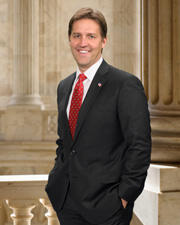
Here you will find contact information for Senator Ben Sasse, including email address, phone number, and mailing address.
| Name | Ben Sasse |
| Position | Senator |
| State | Nebraska |
| Party | Republican |
| Status | Former Representative |
| Term Start | January 6, 2015 |
| Term End | January 8, 2023 |
| Terms Served | 5 |
| Born | February 22, 1972 |
| Gender | Male |
| Bioguide ID | S001197 |
About Senator Ben Sasse
Benjamin Eric Sasse (born February 22, 1972) is an American politician and academic administrator who represented Nebraska in the United States Senate from January 6, 2015, to January 8, 2023. A member of the Republican Party, he served two terms in the Senate before resigning to become the 13th president of the University of Florida. Over the course of his public career, Sasse combined work in academia, federal administration, and elective office, and became known as a conservative critic of President Donald J. Trump.
Sasse was born in Plainview, Nebraska, and raised in a family with deep roots in the state. He attended Harvard University, where he earned his undergraduate degree, and later studied at St. John’s College in Annapolis, Maryland. He went on to complete graduate study at Yale University, where he received a Ph.D. in history. His academic work focused on American religious and intellectual history, and he began his professional career in higher education, including teaching at the University of Texas. These early academic posts helped establish his reputation as a scholar and educator before he entered full-time public service.
During the George W. Bush administration, Sasse joined the federal government and served in the U.S. Department of Health and Human Services (HHS). He rose to the position of assistant secretary at HHS, where he worked on health policy and administrative management. After his service in Washington, Sasse returned to Nebraska and, in 2010, was named the 15th president of Midland University in Fremont, Nebraska. At Midland, he was credited with helping to stabilize and grow the institution, further solidifying his profile as a conservative academic leader with administrative experience.
In October 2013, Sasse announced his candidacy for the U.S. Senate seat held by Republican Senator Mike Johanns, who was not seeking reelection. His campaign quickly drew national attention within conservative circles. By October 2013, Sasse had raised nearly $815,000 from individual donors in his first fundraising quarter, breaking Nebraska’s previous record of $526,000 in individual contributions set in 2007 by Johanns while serving as U.S. Secretary of Agriculture. Sasse ran as a strong opponent of the Affordable Care Act (ACA), though his primary opponent, former state treasurer Shane Osborn, sought to question the depth of his opposition by highlighting earlier articles and speeches in which Sasse had discussed the political durability of the law and the concept of an individual mandate. Sasse responded that he had been describing the political landscape rather than endorsing the ACA, and he maintained that he had consistently regarded “Obamacare” as a bad idea. In the May 13, 2014 Republican primary, he won 92 of Nebraska’s 93 counties and secured the nomination with 109,829 votes, or 49.4 percent of the total, ahead of banker Sid Dinsdale, who received 49,829 votes (22.4 percent), and Osborn, who received 46,850 votes (21.1 percent). In the November 4, 2014 general election, Sasse defeated Democratic nominee David Domina with 64.4 percent of the vote to Domina’s 31.5 percent.
Sasse was sworn in as a United States senator from Nebraska on January 6, 2015, beginning a congressional career that coincided with a period of intense national political polarization. He represented the interests of his Nebraska constituents while participating in the broader legislative and oversight responsibilities of the Senate. During his tenure, he served on the Committee on Finance, including its Subcommittees on International Trade, Customs and Global Competitiveness; Social Security, Pensions and Family Policy; and Taxation and IRS Oversight. He also served on the Select Committee on Intelligence; the Committee on the Budget; and the Committee on the Judiciary. Within the Judiciary Committee, he sat on the Subcommittees on Federal Courts, Oversight, Agency Action and Federal Rights; Human Rights and the Law; the Constitution; and the Subcommittee on Privacy, Technology and the Law, where he served as ranking member. Sasse was reelected in 2020, winning 62.7 percent of the vote against Democratic nominee Chris Janicek, who had secured the Democratic primary, and Preston Love Jr., who ran with the support of the state Democratic Party.
As a senator, Sasse participated in major debates over executive power, judicial appointments, and national security. In February 2019, he was one of 16 senators to vote against legislation designed to prevent a partial government shutdown that included $1.375 billion for barriers along the U.S.–Mexico border and 55 miles of fencing, reflecting his concerns about the structure of the compromise. In March 2019, he was one of 12 senators to cosponsor a proposed constitutional amendment to limit the Supreme Court of the United States to nine justices, a measure introduced amid discussion by some Democratic presidential candidates about expanding the Court. During President Trump’s first impeachment trial, Sasse joined almost all Republican senators on February 5, 2020, in voting to acquit the president on both articles of impeachment.
Sasse’s relationship with President Trump grew increasingly strained, and he emerged as a prominent Republican critic of the president’s conduct. He voted to certify the electoral votes from Arizona and Pennsylvania in the 2020 presidential election. On January 6, 2021, he was present in the Senate chamber for the certification of the Electoral College vote when a mob of Trump supporters stormed the U.S. Capitol. In the aftermath, Sasse publicly held Trump responsible for the attack, stating that the president had “delighted” in the events and describing him as a “broken man.” After the House of Representatives impeached Trump for a second time on a charge of incitement of insurrection, Sasse was one of seven Republican senators who, on February 13, 2021, voted to convict the former president. His vote underscored his willingness to break with most of his party on questions of presidential accountability.
On January 8, 2023, Sasse resigned from the U.S. Senate to assume the presidency of the University of Florida, becoming the institution’s 13th president. His move marked a return to academic leadership after nearly a decade in national elective office. As president, he oversaw the university during a period of heightened political scrutiny of higher education in Florida. On July 18, 2024, Sasse announced that he would resign from the University of Florida presidency effective July 31, 2024, citing his wife’s health issues as the reason for his departure. In December 2025, he disclosed that he had been diagnosed with terminal pancreatic cancer, a development that brought renewed public attention to his career in public service and higher education.