Representative Benjamin Sterling Turner
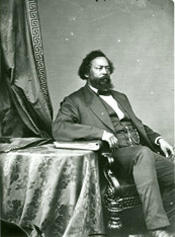
Here you will find contact information for Representative Benjamin Sterling Turner, including email address, phone number, and mailing address.
| Name | Benjamin Sterling Turner |
| Position | Representative |
| State | Alabama |
| District | 1 |
| Party | Republican |
| Status | Former Representative |
| Term Start | March 4, 1871 |
| Term End | March 3, 1873 |
| Terms Served | 1 |
| Born | March 17, 1825 |
| Gender | Male |
| Bioguide ID | T000414 |
About Representative Benjamin Sterling Turner
Benjamin Sterling Turner (March 17, 1825 – March 21, 1894) was an American businessman and politician who served as a Representative from Alabama in the United States Congress from 1871 to 1873. A member of the Republican Party, he represented Alabama’s 1st congressional district in the Forty-second Congress and contributed to the legislative process during one term in office. Although elected as a Republican, he later ran as an independent for re-election after losing the party’s nomination, and in that race he received more votes than the Republican nominee; however, the division of support among Republican factions enabled the Democratic candidate to prevail.
Turner was born into slavery in Halifax County, North Carolina, near the town of Weldon. His parents were enslaved, and when he was about five years old he was taken by his owner, Elizabeth Turner, with his mother to Alabama as part of the forced migration associated with the internal slave trade. Growing up enslaved, he managed to obtain an education informally, most likely by sitting in as a playmate during lessons given to the white children of the household. Despite these limited and unofficial opportunities, he acquired basic literacy and numeracy, skills that would later underpin his business and political career. He appears to have remained enslaved until the end of the Civil War.
At about age twenty, Turner was sold to Major W. H. Gee, the husband of his owner’s stepdaughter, in Selma, Alabama. Gee owned a hotel and a livery stable, and he permitted Turner to manage these businesses and to keep part of the profits, an arrangement that allowed Turner to develop significant entrepreneurial experience and to accumulate some personal capital even while enslaved. After Major Gee’s death, Turner was inherited by Gee’s brother, James Gee, and continued to manage the family’s hotel. Turner married a Black woman during this period, but she was later purchased by a white man as his mistress; Turner never remarried. The 1870 federal census indicates that he cared for a nine-year-old boy named Osceola, suggesting that he maintained family responsibilities despite the disruptions of slavery.
By the time the Civil War began, Turner had saved enough money to purchase some property in and around Selma. When James Gee left to serve in the Confederate Army, Turner looked after his owner’s land and businesses, further consolidating his managerial role. Selma became a major hub for Confederate weapons manufacturing, and in the spring of 1865 Union cavalry forces overran the city, burning roughly two-thirds of it. Turner, like many of his white neighbors, suffered great financial loss in the destruction. He later sought $8,000 in compensation from the Southern Claims Commission for wartime damages, though it is unclear whether he ever received payment. After the war, as a free man, he resumed work as a merchant and farmer, gradually replenishing much of his capital. Eager to extend to other freedpeople the opportunities that education had given him, he founded a school for African Americans in Selma in 1865.
Turner joined the Republican Party during Reconstruction. In 1867 he attended the Republican state convention in Alabama, where he attracted the attention of party leaders and local officials. That same year he was appointed tax collector for Dallas County, Alabama, marking his formal entry into public service. He engaged in mercantile pursuits and established his own livery stable in Selma, building on his prewar experience. In 1869 he was elected a Selma city councilman, but he resigned in protest after being offered compensation, believing that public officials should not be paid when local economic conditions were poor. By 1870 he had become a prominent businessman; in the 1870 Census he reported an estate valued at $10,000 (approximately $218,226 in 2024 dollars). He was also elected foreman of the Central City Fire Company in Selma in 1870, with William H. Blevins serving as first assistant foreman, further underscoring his leadership role in the community.
Following the extension of voting rights to freedmen after the Civil War, Turner emerged as a leading Black Republican in southwest Alabama. He was unanimously nominated as the Republican candidate for Alabama’s 1st congressional district, which then encompassed much of southwest Alabama. He was elected as a Republican to the Forty-second Congress and served from March 4, 1871, to March 3, 1873. During his term in the House of Representatives, Turner participated actively in the democratic process and represented the interests of his constituents during a critical period of Reconstruction. He complained that northern Republicans residing in his district had not given him sufficient support in his campaign. In Congress, he pursued a relatively moderate course: he worked to restore political and legal rights to former Confederates who had fought against the United States in the Civil War, and he advocated the repeal of the federal tax on cotton, arguing that it disproportionately harmed poor African Americans and impeded economic recovery in the South.
Turner’s congressional service occurred during a significant period in American history, as the nation grappled with reintegrating the former Confederate states and defining the civil and political status of millions of newly freed African Americans. In 1872 he was again put forward as the Republican nominee in the first district. However, his popularity had begun to erode in his Selma-based constituency. His relative conservatism, his refusal to dispense patronage appointments strictly on a partisan basis, and his inability to secure substantial economic revitalization measures for the district alienated some voters. Class tensions within the Black community also contributed to his decline. Members of the emerging Black elite criticized his background, referring disparagingly to his earlier work as a “barroom owner, livery stable keeper, and a man destitute of education,” and expressed concern that his modest origins and lack of formal schooling would embarrass them socially and politically. Many of these leaders rallied behind Philip Joseph, a freeborn African American newspaper editor, who ran as an independent candidate.
The 1872 election in Alabama’s 1st district thus became a three-way contest. Turner, having lost the formal Republican nomination, ran as an independent Republican, while Joseph also entered the race as an independent, and Frederick G. Bromberg ran on a combined Democratic and Liberal Republican ticket. The split among African American and Republican voters proved decisive. Although Turner received more votes than the official Republican-backed candidate and remained a significant political force, the division of the Republican and Black vote enabled Bromberg to win the general election with about 44 percent of the vote, compared to Turner’s 37 percent and Joseph’s 19 percent. By splitting support among Republican factions, Turner and Joseph effectively ceded the seat to the Democrat, ending Turner’s brief congressional career.
After leaving Congress, Turner largely withdrew from active politics. He continued to operate his livery stable and engage in business in Selma, but the national economic downturn of the late 1870s severely affected his fortunes, and he eventually lost his business. He did reemerge politically in 1880, attending the Alabama Labor Union Convention and serving as a delegate to the Republican National Convention in Chicago, demonstrating his continued interest in labor issues and national Republican politics. Thereafter he returned to a more private life, making his living primarily as a farmer in the Selma area. Once a prosperous businessman and officeholder, he spent his later years in increasingly straitened circumstances.
Benjamin Sterling Turner died in Selma, Alabama, on March 21, 1894, at the age of sixty-nine, nearly penniless after a lifetime that had spanned slavery, the Civil War, Reconstruction, and the retrenchment that followed. He was interred in Old Live Oak Cemetery in Selma. His career as one of the early African-American members of the United States House of Representatives, and as a formerly enslaved man who rose to public office during Reconstruction, has been noted in later historical works on Black officeholders and the political history of African Americans in the nineteenth century.