Representative Beriah Wilkins
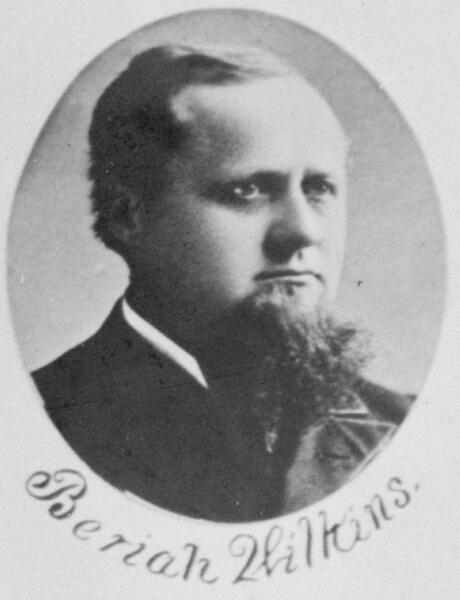
Here you will find contact information for Representative Beriah Wilkins, including email address, phone number, and mailing address.
| Name | Beriah Wilkins |
| Position | Representative |
| State | Ohio |
| District | 16 |
| Party | Democratic |
| Status | Former Representative |
| Term Start | December 3, 1883 |
| Term End | March 3, 1889 |
| Terms Served | 3 |
| Born | July 10, 1846 |
| Gender | Male |
| Bioguide ID | W000474 |
About Representative Beriah Wilkins
Beriah Wilkins (July 10, 1846 – June 7, 1905) was an American politician, banker, newspaper publisher, and Civil War veteran who served three terms as a U.S. Representative from Ohio from 1883 to 1889. A member of the Democratic Party, he contributed to the legislative process during a significant period in American history, representing the interests of his Ohio constituents in the House of Representatives.
Wilkins was born near Richwood, Union County, Ohio, on July 10, 1846. He attended the common schools in nearby Marysville, Ohio, receiving a basic education typical of mid-19th-century rural communities. His early life in central Ohio, in an area then developing agriculturally and commercially, provided the foundation for his later involvement in business and public affairs.
During the American Civil War, Wilkins enlisted as a private in Company H of the 136th Regiment, Ohio Volunteer Infantry, on May 2, 1864. He served in the Union Army until he was honorably discharged on August 31, 1864. Although his term of service was relatively brief and came late in the conflict, his participation as a Civil War veteran became an important part of his public identity and reflected the widespread mobilization of Ohioans in support of the Union cause.
After the war, Wilkins entered the banking business in Uhrichsville, Ohio. His work in banking placed him at the center of local economic life and helped establish his reputation as a businessman with expertise in finance and commerce. This professional background in financial matters would later inform his legislative interests and committee assignments when he entered public office.
Wilkins’s political career began at the state level. He was elected to the Ohio Senate, serving in 1880 and 1881. In this capacity, he participated in state legislative deliberations during a period of industrial growth and political realignment in Ohio. He further solidified his role in party affairs by serving as a member of the Democratic State central committee in 1882, helping to shape Democratic strategy and organization in the state.
Wilkins was elected as a Democrat to the Forty-eighth, Forty-ninth, and Fiftieth Congresses, serving in the U.S. House of Representatives from March 4, 1883, to March 3, 1889. As a Representative from Ohio, he participated in the democratic process and contributed to the legislative work of the House during a time marked by debates over economic policy, currency, and federal regulation. During the Fiftieth Congress he served as chairman of the Committee on Banking and Currency, a role that drew directly on his banking experience and placed him at the forefront of congressional consideration of financial and monetary issues.
After his congressional service concluded in 1889, Wilkins settled in Washington, D.C., where he embarked on a new career in journalism and publishing. That same year he became the majority owner and publisher of The Washington Post, then an emerging daily newspaper in the nation’s capital. In 1894 he acquired the entire stock ownership of the paper and assumed full control, serving as its editor as well as its proprietor. Under his leadership, The Washington Post continued to develop as an influential voice in Washington political and social life.
Wilkins remained active in the management and editorial direction of The Washington Post until his death in Washington, D.C., on June 7, 1905. He was interred in Rock Creek Cemetery in Washington. His career spanned military service, finance, state and national politics, and newspaper publishing, reflecting the diverse avenues of public influence available to late 19th-century American political figures.