Representative Berkeley Lloyd Bunker
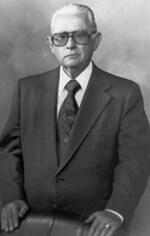
Here you will find contact information for Representative Berkeley Lloyd Bunker, including email address, phone number, and mailing address.
| Name | Berkeley Lloyd Bunker |
| Position | Representative |
| State | Nevada |
| District | At-Large |
| Party | Democratic |
| Status | Former Representative |
| Term Start | November 27, 1940 |
| Term End | January 3, 1947 |
| Terms Served | 3 |
| Born | August 12, 1906 |
| Gender | Male |
| Bioguide ID | B001061 |
About Representative Berkeley Lloyd Bunker
Berkeley Lloyd Bunker (August 12, 1906 – January 21, 1999) was an American businessman and Democratic politician who served as both an appointed United States senator and a member of the U.S. House of Representatives from Nevada in the mid‑20th century. He was born in St. Thomas, then in Clark County, Nevada—now submerged beneath a northern arm of Lake Mead—into a Latter-day Saint family that had settled in the region. He attended local public schools and graduated from Clark County High School in 1926. After high school he served a mission for the Church of Jesus Christ of Latter-day Saints in the southern United States, an experience that shaped his lifelong religious involvement and community leadership.
Following his mission, Bunker returned to Nevada and settled in Las Vegas. He married Lucile Whitehead, with whom he would share a long marriage until her death in 1988. In 1934 he entered the tire and oil business in Las Vegas, establishing himself as a businessman during a period when the city and southern Nevada were beginning to grow rapidly. His business activities and church service brought him increasing visibility in the community, and he soon moved into public life. A member of the Democratic Party, he was elected to the Nevada Assembly in 1936 and served there until 1941, rising to the position of speaker of the Assembly in 1939.
Bunker’s state legislative service coincided with a pivotal moment in Nevada and national politics. When United States Senator Key Pittman died shortly after his reelection in 1940, numerous candidates sought appointment to the vacancy. On November 26, 1940, Governor Edward P. Carville surprised much of the state by appointing Bunker as Pittman’s replacement for the unexpired term ending January 3, 1941, and also for the new term ending January 3, 1947. Bunker later said he was the “most surprised man in the state,” as he had not actively sought the office. He was the first southern Nevadan, and the first Nevadan who was a member of the Church of Jesus Christ of Latter-day Saints, to serve in federal office. As a young senator, he drew national attention by accusing Basic Magnesium, Inc., a major wartime industrial contractor, of having negotiated a government contract that would yield exorbitant profits. His appointment, widely seen as a compromise choice—one observer remarked that “nobody was mad at Berkeley Bunker”—nonetheless placed him at the center of wartime legislative activity. He served in the Senate until December 6, 1942, when a duly elected successor, former Governor James G. Scrugham, qualified for the office following a special election in which Bunker had lost to Scrugham in the Democratic primary.
After leaving the Senate, Bunker remained active in Nevada politics. In 1944 he sought election to Nevada’s at‑large seat in the U.S. House of Representatives. He defeated incumbent Democrat Maurice J. Sullivan in the primary and went on to win the general election against Republican candidate Rex Bell, a former actor, thereby securing Nevada’s only House seat. According to existing accounts, Berkeley Lloyd Bunker served as a Representative from Nevada in the United States Congress from 1940 to 1947, and he contributed to the legislative process during three terms in office; contemporaneous congressional records, however, identify his formal House service as encompassing a single term from January 3, 1945, to January 3, 1947, during which he participated in the democratic process and represented the interests of his Nevada constituents. During his House tenure, in 1946 he introduced a bill to incorporate Boulder City, Nevada, and remove it from federal control, though the legislation did not advance out of committee.
Bunker’s House service unfolded during a significant period in American history, encompassing the final stages of World War II and the early postwar transition. When Senator Scrugham died in 1945, Governor Carville resigned so that Lieutenant Governor Vail Pittman could succeed him and appoint Carville to the resulting Senate vacancy. In what Bunker later described as “the biggest mistake of my political career,” he chose not to seek reelection to the House in 1946 and instead challenged Carville in the Democratic primary for the Senate seat. Bunker won the primary, but many Democrats viewed his challenge as an act of disloyalty to the governor who had originally elevated him to the Senate. The Las Vegas Review‑Journal later characterized this as a “heinous crime of political ingratitude,” and Bunker became something of a pariah within his own party. Although observers initially expected him to defeat Republican George W. Malone in the general election, divisions among Democrats contributed to Malone’s victory, ending Bunker’s congressional career.
After his defeat, Bunker returned to private life in Nevada. He became a hotel manager and later joined his brother in founding the Bunker Brothers mortuary, which became a well‑known funeral business in the Las Vegas area. He remained engaged in public affairs and continued to seek elective office. In 1962 he ran for lieutenant governor of Nevada as a Democrat but lost to Republican Paul Laxalt, a setback attributed in part to lingering resentment among former Carville supporters over the events of 1946. Alongside his business and political activities, Bunker deepened his service within the Church of Jesus Christ of Latter-day Saints. After his time in the Senate he served as bishop of an LDS ward in Las Vegas and played a role in efforts associated with the eventual construction of the Las Vegas Nevada Temple, reflecting his prominence in both civic and religious life in the city.
In his later years, Bunker experienced personal as well as public transitions. His first wife, Lucile Bunker, died in 1988 after more than five decades of marriage. The following year, in 1989, he married Della Lee. Bunker lived to an advanced age and remained a figure of historical interest in Nevada and national political circles. He died on January 21, 1999, and was interred in Bunker’s Eden Vale Cemetery in Las Vegas, a burial ground associated with his family’s mortuary business. At the time of his death, he was recognized as the last living United States senator who had been serving when Congress declared war on Japan in December 1941, initiating full American participation in World War II, and the last living person who had served in the Senate during the presidency of Franklin D. Roosevelt. His legacy in Nevada is commemorated, among other honors, by Berkeley L. Bunker Elementary School in Las Vegas, named in recognition of his long service to the state and its communities.