Representative B. F. Sisk
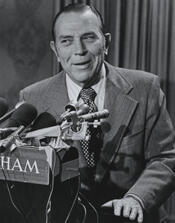
Here you will find contact information for Representative B. F. Sisk, including email address, phone number, and mailing address.
| Name | B. F. Sisk |
| Position | Representative |
| State | California |
| District | 15 |
| Party | Democratic |
| Status | Former Representative |
| Term Start | January 5, 1955 |
| Term End | January 3, 1979 |
| Terms Served | 12 |
| Born | December 14, 1910 |
| Gender | Male |
| Bioguide ID | S000454 |
About Representative B. F. Sisk
Bernice Frederic Sisk (December 14, 1910 – October 25, 1995) was an American politician who served as a Democratic Representative from California in the United States House of Representatives from 1955 to 1979. Over the course of 12 consecutive terms, he became a significant legislative figure, particularly on agricultural and water issues affecting California’s Central Valley.
Sisk was born on December 14, 1910, in Montague, Texas, the son of Arthur Lee Sisk and Lavina (Thomas) Sisk. He spent his early years in Texas before eventually making his way to California, where he would build his political career and long-standing ties to the communities he later represented. His early life in a rural environment informed his understanding of agricultural concerns, which became central to his work in Congress.
Sisk’s formal education and early employment laid the groundwork for his later public service, though it was his move to California’s Central Valley that proved decisive in shaping his political trajectory. Settling in an area dominated by farming and related industries, he became closely acquainted with the economic and social needs of growers, workers, and small communities. This experience helped prepare him for elective office and gave him a practical perspective on the policies he would later champion in Washington.
Sisk was elected to the U.S. House of Representatives in the 1954 midterm elections, taking office on January 3, 1955. He represented a district that included the cities of Fresno, Merced, and Modesto in California’s Central Valley. His victory was considered one of the major upsets of the 1954 elections, as he defeated Republican incumbent Oakley Hunter in a district that had been in Republican hands for all but ten years since its creation in 1913. A member of the Democratic Party, Sisk contributed consistently to the legislative process during his 12 terms in office, participating in the democratic process and representing the interests of his constituents in a period marked by the Cold War, the civil rights movement, and significant domestic policy change. The seat he first captured in 1954 remained in Democratic hands for decades after his tenure, not returning to Republican control until the election of John Duarte to Congress in 2022.
During his congressional service, Sisk became a long-time member of the influential House Rules Committee, which controls the flow of legislation to the floor, and the House Agriculture Committee, where he emerged as a key voice on farm and resource policy. As chairman of the Cotton Subcommittee, he played a central role in healing a long-standing rift between southern and western cotton producers, helping to forge a more unified national policy for the industry. He was a proponent of production inducements rather than direct farm subsidies and backed legislation designed to bolster a range of agricultural sectors critical to California and the nation, including the dairy, wine, sugar, fig, and raisin industries. His work reflected a broader effort to stabilize farm incomes while encouraging efficient production and market-oriented solutions.
Sisk was also a major political force in the United States Congress in the development and expansion of the Central Valley Project, a vast federal water system that transformed California’s 400-mile-long Central Valley. He strongly supported the creation and growth of this project, which evolved into a multibillion-dollar network of dams, canals, and reservoirs—eventually valued at approximately $37 billion—that continues to provide water for irrigation, cities, and industry throughout the region. His advocacy for water infrastructure and resource management helped secure the economic foundation of the Central Valley and cemented his reputation as a champion of his district’s agricultural and developmental needs.
After more than two decades in Congress, Sisk retired from the House at the end of his 12th term, leaving office on January 3, 1979. He had announced his decision not to seek reelection in 1978, and he was succeeded by his former chief of staff, Tony Coelho, ensuring continuity of representation for his district. In retirement, Sisk remained a respected figure in Fresno and the broader Central Valley, recognized for his long service and the tangible impact of the projects and policies he had helped to shape.
Beyond his public career, Sisk was active in his local religious community as a member of the Palm Avenue Church of Christ in Fresno. He continued to reside in Fresno in his later years. Bernice Frederic Sisk died in Fresno, California, on October 25, 1995, closing a life marked by sustained public service and a lasting influence on California’s agricultural and water policy.