Representative Bill Barrett
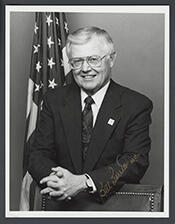
Here you will find contact information for Representative Bill Barrett, including email address, phone number, and mailing address.
| Name | Bill Barrett |
| Position | Representative |
| State | Nebraska |
| District | 3 |
| Party | Republican |
| Status | Former Representative |
| Term Start | January 3, 1991 |
| Term End | January 3, 2001 |
| Terms Served | 5 |
| Born | February 9, 1929 |
| Gender | Male |
| Bioguide ID | B000179 |
About Representative Bill Barrett
William Emery Barrett (February 9, 1929 – September 20, 2016) was an American Republican politician from Nebraska who served five terms in the United States House of Representatives from 1991 to 2001 as the congressman for Nebraska’s third congressional district. A member of the Republican Party, he represented a vast, largely rural district and contributed to the legislative process during a significant period in American history, participating in the democratic process and representing the interests of his constituents over a decade in Congress.
Barrett was born on February 9, 1929, in Lexington, Dawson County, Nebraska. He grew up in central Nebraska and maintained close ties to his hometown throughout his life. After completing his early education in Nebraska, he attended Hastings College in Hastings, Nebraska. Following his studies, he earned his license to become a real estate broker, a credential that would support his long career in real estate and inform his understanding of land use, property, and agricultural issues that were central to his later public service.
Before seeking elective office, Barrett served in the United States Navy, contributing to the post–World War II military establishment. After his naval service, he embarked on a career as a real estate agent and became a longtime Republican activist in Nebraska. He also returned to his alma mater, Hastings College, where he served as an administrator, gaining experience in higher education administration and institutional governance. During the 1960s, Barrett became increasingly involved in party politics, serving as a member of the Nebraska Republican State Executive Committee. His prominence within the party grew, and in 1976 he chaired the Nebraska arm of President Gerald Ford’s campaign, further solidifying his reputation as a key Republican organizer in the state.
Barrett entered elective office in 1978, when he was elected to the unicameral Nebraska Legislature. He served in the Nebraska Legislature from 1979 until his election to Congress in 1990. During his tenure, he rose to a position of leadership and was elected speaker of the legislature, serving in that role from 1987 to 1991. As speaker, he presided over the state’s unique nonpartisan, unicameral body during a period that included contentious state budget negotiations, during which he generated some controversy but also demonstrated his capacity to manage complex legislative processes and competing fiscal priorities.
In 1990, after eight-term incumbent Virginia D. Smith announced her retirement from the U.S. House of Representatives, Barrett entered the Republican primary for Nebraska’s 3rd congressional district. Although he was the highest-profile candidate in a five-way primary, he secured the nomination by a relatively narrow margin of about 2,000 votes. In the general election, he faced fellow state senator Sandra Scofield, a Democrat. Despite the district’s strong Republican leanings and early expectations that Barrett would be a prohibitive favorite, the race proved to be extremely competitive, with Barrett ultimately prevailing by approximately 4,400 votes. This contest was the closest a Democrat had come to winning the 3rd District since Virginia Smith’s first election in 1974, when she won by only 737 votes.
Barrett took office as a Representative from Nebraska in the United States Congress on January 3, 1991, and served until January 3, 2001, completing five consecutive terms. In Congress, he was generally regarded as a low-key member who supported the priorities of Republican leaders while focusing on the interests of his largely agricultural district. He served on the House Agriculture Committee, where he played a role in shaping major farm policy and helped write the Freedom to Farm Act of 1996, legislation that significantly restructured federal farm programs and moved toward greater market orientation in agriculture. Over time he rose to become vice chairman of the Agriculture Committee. Barrett also served on the House Committee on Education and the Workforce, where he participated in deliberations on federal education policy and labor issues. Throughout his decade in the House, he was consistently reelected by wide margins—often with more than 70 percent of the vote—and in 1998 the Democratic Party did not field a challenger against him, reflecting his strong political standing in the district.
Barrett retired from Congress at the end of his fifth term, choosing not to seek reelection in 2000. After leaving federal office, he returned to Lexington, Nebraska, where he remained active in his community and maintained his long-standing connections to the region he had represented. He resided in Lexington during his later years, reflecting the continuity of his personal and professional life in central Nebraska. William Emery Barrett died on September 20, 2016, at the age of 87, at an assisted living facility in Lexington, Nebraska, closing a public career that had spanned service in the Navy, state government, and the United States Congress.