Representative Bill Pascrell, Jr.
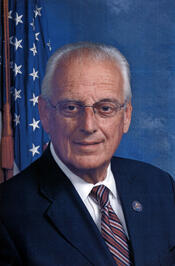
Here you will find contact information for Representative Bill Pascrell, Jr., including email address, phone number, and mailing address.
| Name | Bill Pascrell, Jr. |
| Position | Representative |
| State | New Jersey |
| District | 9 |
| Party | Democratic |
| Status | Former Representative |
| Term Start | January 7, 1997 |
| Term End | August 21, 2024 |
| Terms Served | 14 |
| Born | January 25, 1937 |
| Gender | Male |
| Bioguide ID | P000096 |
About Representative Bill Pascrell, Jr.
William James Pascrell Jr. (January 25, 1937 – August 21, 2024) was an American politician who represented New Jersey in the United States House of Representatives from January 3, 1997, until his death in 2024. A member of the Democratic Party and a native of Paterson, New Jersey, he served 14 terms in Congress during a significant period in American history, participating actively in the legislative process and representing the interests of his constituents. Over the course of his long public career, he also served four terms in the New Jersey General Assembly beginning in 1988 and was elected to two terms as mayor of Paterson before entering Congress.
Pascrell was born in Paterson, Passaic County, New Jersey, on January 25, 1937, to an Italian American family. He grew up in the city’s working-class neighborhoods, an experience that shaped his political identity and his later focus on urban issues, labor, and public safety. Proud of his Italian heritage, he was outspoken about the stereotypical representation of Italian Americans in popular culture, notably criticizing portrayals in television programs such as HBO’s “The Sopranos.” His heritage even became a point of humorous public discussion when comedian Stephen Colbert, on “The Colbert Report,” jokingly questioned whether he could truly be of Italian descent because his surname did not end in a vowel; Pascrell responded by citing “Sole” as an example of an Italian surname ending in a consonant.
Before his election to Congress, Pascrell built a substantial career in New Jersey state and local government. He was elected to the New Jersey General Assembly in 1987, taking office in 1988, and served four terms. In the Assembly he developed a reputation as an advocate for his home city and for issues affecting working families. While serving in the legislature, he successfully ran for mayor of Paterson, winning election to two terms. As mayor, he worked to address urban redevelopment, public safety, and economic challenges in one of New Jersey’s largest and historically industrial cities. His leadership in Paterson and in the General Assembly laid the foundation for his subsequent bid for federal office.
Pascrell was first elected to the U.S. House of Representatives in November 1996, winning the seat for New Jersey’s 8th congressional district and taking office on January 3, 1997. He would go on to serve continuously in Congress until his death on August 21, 2024, completing 14 terms. His tenure in the House spanned administrations from President Bill Clinton through President Joe Biden and encompassed major national events, including the September 11 attacks, the wars in Iraq and Afghanistan, the Great Recession, and the COVID-19 pandemic. On October 10, 2002, he was among 81 Democratic House members to vote to authorize the invasion of Iraq, reflecting the complex and often contentious debates in Congress over national security in the post-9/11 era. Over time, he became known as a “blunt progressive Democrat,” as described by The New York Times, combining an assertive style with a focus on progressive policy goals.
Redistricting following the 2010 census significantly reshaped Pascrell’s congressional career. After the existing 8th district was eliminated in 2012, his home in Paterson was placed in the newly redrawn 9th congressional district. Fellow Democratic congressman Steve Rothman, whose home in Fair Lawn had been drawn into a more Republican-leaning district against Republican Scott Garrett, chose instead to move into the reconfigured 9th district and challenge Pascrell in the Democratic primary. Geographically, the new 9th district contained about 53 percent of Rothman’s former territory and 43 percent of Pascrell’s, making the contest particularly competitive. The primary evolved into a high-profile and contentious race, including a proxy debate over U.S. policy toward Israel and the political influence of Arab American and Jewish American communities. Commentary in the press highlighted accusations and counteraccusations about dual loyalty and ethnic politics, with Pascrell criticized by some for not more forcefully condemning certain attacks on Rothman. On June 5, 2012, Pascrell defeated Rothman decisively, winning 31,435 to 19,947, or about 61 percent of the vote. In the general election that year, he faced Rabbi Shmuley Boteach and raised approximately $2.6 million—more than any other congressional candidate in the nation in 2012 and roughly ten times Boteach’s total. In a district where Democrats outnumbered Republicans by about three to one, Pascrell won a ninth term by a margin of 73.6 percent to 25.4 percent and thereafter represented the 9th district until his death.
In Congress, Pascrell developed particular expertise in homeland security, transportation, public safety, and brain injury policy. He was one of the original members of the House Committee on Homeland Security, eventually rising to the position of ranking member on its Emergency Preparedness Subcommittee. He had a long-standing interest in fire safety and authored the legislation creating the Assistance to Firefighters Grant Program, which provided federal grants directly to fire departments, including volunteer departments he described as “the forgotten part of the public safety equation.” He also served on the House Transportation and Infrastructure Committee, where he worked to modernize roads, bridges, airports, and mass transit systems. He secured funding for the reconstruction of dangerous New Jersey roads and bridges, including the Route 46 corridor, and helped craft legislation to renew federal surface transportation programs that supported New Jersey Transit. These efforts included projects for rail expansion between Passaic and Bergen counties, bridge construction along Route 46, and the establishment of a bike-pedestrian path in South Orange.
Pascrell was a prominent advocate for consumer protection and fair practices in the entertainment ticketing industry. During Bruce Springsteen and the E Street Band’s 2009 “Working on a Dream” tour, he asked the Federal Trade Commission and the U.S. Department of Justice to investigate Ticketmaster and TicketsNow over their handling of ticket sales for New Jersey shows. He subsequently introduced the “BOSS ACT” (Better Oversight of Secondary Sales and Accountability in Concert Ticketing), legislation designed to require primary ticket sellers to disclose how many tickets were held back from public sale, to prohibit ticket brokers from purchasing tickets during the first 48 hours of sales, and to bar primary ticket sellers, promoters, and artists from participating in the secondary market. When similar problems arose during Springsteen’s 2012 “Wrecking Ball” tour—Ticketmaster reported web traffic 2.5 times its highest level of the year, with shows selling out in minutes and tickets quickly appearing on resale sites at much higher prices—Pascrell announced that he would reintroduce the BOSS ACT.
Another central focus of Pascrell’s congressional work was traumatic brain injury and concussion policy. In October 2008, following the death of a young boy in his district who had returned to playing football before fully recovering from a concussion, he introduced the Concussion Treatment and Care Tools Act (ConTACT). The bill, endorsed by the National Football League, the NFL Players Association, and the Brain Injury Association of America, sought to convene experts to develop guidelines for the treatment and care of concussions in middle- and high-school students and to provide funding for schools to adopt baseline and post-injury neuropsychological testing technologies. In 2001, he co-founded and later co-chaired the Congressional Brain Injury Task Force, which grew to include more than 100 members of Congress. On March 12, 2013, he introduced the Traumatic Brain Injury Reauthorization Act of 2013 (H.R. 1098; 113th Congress), to reauthorize appropriations for Centers for Disease Control and Prevention projects aimed at reducing the incidence of traumatic brain injury and improving tracking and monitoring of such injuries.
Throughout his congressional service, Pascrell was also active on issues of national parks, civil discourse, and constitutional governance. In 2009, he played an instrumental role in the protection and designation of the Paterson Great Falls National Historical Park, preserving one of the nation’s important early industrial sites and a landmark in his hometown. In January 2011, following the shooting of Representative Gabrielle Giffords in Arizona, he publicly criticized the tone of national political rhetoric, stating that “there’s an aura of hate and elected politicians feed it. Certain people on Fox News feed it.” In December 2020, after the 2020 presidential election, he cited Section 3 of the 14th Amendment in calling on Speaker Nancy Pelosi not to seat Republican members who had signed an amicus curiae brief supporting Texas v. Pennsylvania, a lawsuit seeking to overturn the election results. He argued that attempting to overturn a democratic election and “install a dictator” constituted a form of rebellion against the United States barred by the Constitution.
Pascrell’s positions on social issues, particularly abortion, evolved over his time in Congress. In 1997, he was one of 77 House Democrats to vote in favor of the Partial-Birth Abortion Ban Act, and he again supported similar legislation in 2003, when it was signed into law by President George W. Bush. He consistently stated that he opposed government funding of abortion. In later years, however, he adopted a more supportive stance toward abortion rights. In 2013, he voted against the Pain-Capable Unborn Child Protection Act, and after the Supreme Court overturned Roe v. Wade in 2022, he wrote that “it is not the place for a judge or politician to interfere with a woman’s bodily decision.” He also voted against the Born-Alive Abortion Survivors Protection Act in January 2023. His broader voting record reflected strong alignment with Democratic leadership in the Biden era; according to an analysis by FiveThirtyEight, he voted with President Joe Biden’s stated position 100 percent of the time in the 117th Congress. In December 2022, he voted in favor of the Puerto Rico Status Act (H.R. 8393), bipartisan legislation giving the people of Puerto Rico the ability to decide their political future through a binding plebiscite.
Bill Pascrell Jr. remained in office and active in legislative affairs until his death on August 21, 2024, while serving as the U.S. representative for New Jersey’s 9th congressional district. Over nearly three decades in the House of Representatives, he contributed to the legislative process on issues ranging from homeland security and transportation to brain injury research, consumer protection, and civil rights. His long tenure, rooted in his Paterson upbringing and New Jersey political career, made him a prominent and enduring figure in the state’s modern political history.