Representative Binger Hermann
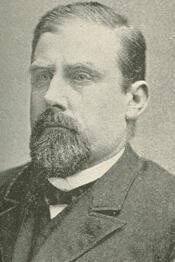
Here you will find contact information for Representative Binger Hermann, including email address, phone number, and mailing address.
| Name | Binger Hermann |
| Position | Representative |
| State | Oregon |
| District | 1 |
| Party | Republican |
| Status | Former Representative |
| Term Start | December 7, 1885 |
| Term End | March 3, 1907 |
| Terms Served | 8 |
| Born | February 19, 1843 |
| Gender | Male |
| Bioguide ID | H000531 |
About Representative Binger Hermann
Binger Hermann (February 19, 1843 – April 15, 1926) was an American attorney and Republican politician from Oregon who served in both houses of the Oregon Legislative Assembly and as a Representative from Oregon in the United States Congress from 1885 to 1907. A native of Maryland, he was born near Lonaconing in Allegany County and immigrated as a child with his parents to the Oregon Territory as part of the Baltimore Colony, a group of settlers from Maryland who moved west in the 1850s. Growing up in the developing Pacific Northwest, Hermann was shaped by the frontier environment and the political and legal questions surrounding land, settlement, and relations with Native American tribes that would later define much of his public career.
Hermann studied law in Oregon and was admitted to the Oregon State Bar in 1866. That same year, he entered public life when he was elected to the Oregon House of Representatives, serving one term. He then served a single term in the Oregon State Senate from 1868 to 1870, marking the beginning of a long career in public office. In addition to his legislative service, Hermann held several federal and state appointments in the 1860s and 1870s. He served as deputy collector of internal revenue for southern Oregon from 1868 to 1871, and from 1871 to 1873 he was receiver of public moneys at the United States land office in Roseburg, Oregon. He also held a commission in the Oregon State Militia, serving as a colonel from 1882 to 1884. These roles, particularly his work in the land office, gave him detailed familiarity with federal land policy and administration that would later influence his work in Congress and in the General Land Office.
In 1884, Hermann was elected to the United States House of Representatives as a Republican, representing Oregon’s at-large congressional district. He took his seat in March 1885 and went on to serve eight terms in the House, with his congressional service extending, in two major periods, from 1885 to 1907. During his early years in Congress, he was repeatedly returned to office by Oregon voters, and in the 1890 election he defeated Democrat Robert A. Miller to win another term even as Democrats gained 78 seats nationally in the U.S. House of Representatives. Following the 1890 census, Oregon was granted an additional congressional district, and beginning in 1893 Hermann continued his service in Congress as the Representative for Oregon’s newly created 1st congressional district. As a member of the House of Representatives during a significant period in American history marked by rapid western development, economic change, and debates over land and resource policy, Hermann participated in the legislative process and represented the interests of his constituents in Oregon.
Hermann’s legislative work reflected his background in land and resource issues. He was instrumental in securing river and harbor appropriations for Oregon and in promoting the establishment of lighthouses along the Oregon Coast, measures that supported maritime commerce and regional development. He was also the author of the Indian Depredation law, which provided for payment to settlers and others for property damage committed by hostile Indians during the Indian Wars, addressing longstanding claims arising from frontier conflicts. His experience and influence in Congress made him a key figure in shaping federal policy affecting the Pacific Northwest and the public domain.
Hermann did not seek reelection to Congress in 1896. Instead, he was appointed by President William McKinley as Commissioner of the United States General Land Office (GLO) in Washington, D.C., a position he held from March 27, 1897, to January 25, 1903. As Commissioner, he oversaw federal administration of vast areas of public land at a time of intense pressure from settlers, railroads, mining interests, and timber companies. During his tenure he soon clashed with Secretary of the Interior Ethan A. Hitchcock over land matters, including the handling of fraud investigations and the interpretation of land laws. Hermann’s administration of the GLO became particularly associated with a controversial set of directives regarding mineral surveys, later known as the “Binger Hermann Policy.”
The Binger Hermann Policy arose from General Land Office Departmental Letter “N” (mineral division), indexed 2980 and dated May 20, 1899, signed by Hermann as Commissioner. The letter concerned mineral surveys in Colorado—specifically the Portia, Silver Pine, and Edison lodes, Survey No. 12577, and the Hood Lode, Survey No. 540—and took the U.S. Surveyor General for Colorado, C. C. Goodale, to task for attempting to amend an approved survey based on alleged errors reported by another deputy surveyor. The new policy required that a prior official survey, when in conflict with a mining claim being surveyed, must be shown on the plat in its patented position rather than where the monuments on the ground actually marked it. This approach elevated the sanctity of patent descriptions over original, undisturbed monuments or their perpetuations. The policy, further articulated in a follow-up Departmental Letter “N” indexed 3125 and dated June 17, 1899, governed GLO practice for about five years between June 1899 and August 1904 and was later described by critics as causing “cadastral mayhem” or “cadastral vandalism” of official field notes, approved plats, and patents.
Under the Binger Hermann Policy, mineral claimants in several lode mining districts, including companies such as the Lucky Strike Gold Mining Company and others in places like Cripple Creek, Colorado, suffered from survey inconsistencies and misconstruction of mineral surveys. Official plats issued during this period often gave a very erroneous idea of actual conditions on the ground, as claims were figured according to their patented positions regardless of the existence or position of monuments. Surveyors in Colorado and other mining states sometimes calculated short ties to conflicting surveys through section corner ties, further compounding errors. Surveyor General Edward H. Anderson of Utah, in his annual reports for 1901, 1902, and 1903, criticized the Interior Department’s insistence that courses and distances in patents must be recognized in all subsequent surveys “notwithstanding actual conditions on the ground to the contrary,” noting that courts held that monuments and markings on the ground should govern. Many locators seeking relief from these problems had to wait until August 8, 1904, when Paragraph 147 of the Mining Circular was revised under the authority of the Act of April 28, 1904, effectively ending the core of the policy, although its effects and applications continued to be felt in other mining districts beyond that date.
When Hermann’s successor in Congress, Representative Thomas H. Tongue of Oregon’s 1st district, died in 1903, Hermann resigned as Commissioner of the General Land Office and returned to Oregon politics. He ran in the special election to fill Tongue’s vacant seat and won, returning to the House of Representatives. He was subsequently reelected in 1904, defeating Democratic challenger Robert M. Veatch, and continued his service in Congress until 1907. During this second stint in the House, however, his career became entangled in what came to be known as the Oregon land fraud scandal, a wide-ranging investigation into fraudulent acquisition of public lands in Oregon that implicated nearly all of the state’s congressional delegation as well as land speculators and officials connected to schemes such as those associated with the Benson Syndicate.
During the scandal, Secretary of the Interior Ethan A. Hitchcock accused Hermann of fraud against the government, alleging that information on land fraud in Oregon had been sent to him while he was Commissioner of the General Land Office and had been ignored, and further claiming that Hermann might have removed or disposed of several files and letters from the GLO concerning certain fraud investigations. Hermann was indicted and brought to trial on charges of destroying public documents. In 1907 he was found not guilty of that charge, but he remained under indictment for alleged collusion in a land deal involving the Blue Mountain Forest Reserve in Oregon. A trial on that charge was held in 1910 and ended in a hung jury. United States District Attorney Francis J. Heney declined to refile the charges, and Hermann was never retried. Although the immediate legal proceedings ended without a conviction, the scandal effectively ended his active political career.
In the years following his departure from Congress, Hermann lived in Oregon and remained a figure associated with the contentious history of federal land policy, mineral surveys, and public land administration in the late nineteenth and early twentieth centuries. His actions as Commissioner of the General Land Office continued to be debated by surveyors, lawyers, and historians concerned with the Public Land Survey System, mineral patents, and the administration of the General Mining Act of 1872. In 1932, several years after his death, President Franklin D. Roosevelt’s Secretary of the Interior, Harold L. Ickes, formally exonerated Hermann of wrongdoing in connection with the Oregon land fraud scandal, providing a posthumous vindication of his conduct in office. Binger Hermann died on April 15, 1926, leaving a complex legacy as a long-serving Oregon legislator and congressman, a federal land administrator whose policies had far-reaching technical and legal consequences, and a central figure in some of the most significant public land controversies of his era.