Representative Blackburn Barrett Dovener
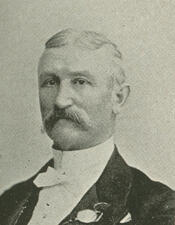
Here you will find contact information for Representative Blackburn Barrett Dovener, including email address, phone number, and mailing address.
| Name | Blackburn Barrett Dovener |
| Position | Representative |
| State | West Virginia |
| District | 1 |
| Party | Republican |
| Status | Former Representative |
| Term Start | December 2, 1895 |
| Term End | March 3, 1907 |
| Terms Served | 6 |
| Born | April 20, 1842 |
| Gender | Male |
| Bioguide ID | D000461 |
About Representative Blackburn Barrett Dovener
Blackburn Barrett Dovener (April 20, 1842 – May 9, 1914) was a Republican politician from West Virginia who served as a United States Representative from 1895 to 1907. A member of the Republican Party, he represented his state in the 54th, 55th, 56th, 57th, 58th, and 59th United States Congresses, contributing to the legislative process during six consecutive terms in office. His congressional service occurred during a significant period in American history, as the nation grappled with the legacy of the Civil War, industrial expansion, and the early stirrings of the Progressive Era.
Dovener was born in Tays Valley, Virginia, in Cabell County (now in West Virginia) on April 20, 1842. He grew up in what was then western Virginia, a region with strong Unionist sentiment that would become the state of West Virginia during the Civil War. Before the outbreak of the war, he taught school from 1858 to 1861, beginning his working life as an educator while still a young man. This early experience in the classroom preceded his transition to military service and later to the law and politics.
At the commencement of the Civil War, when he was nineteen years old, Dovener raised a company of loyal Virginians and entered the Union Army. He served as captain of Company A, 15th West Virginia Volunteer Infantry Regiment, and remained in the Union service for the duration of the war. His Union allegiance was shared by the family of Margaret Lynch, a native of Pittsburgh, Pennsylvania, whose parents had moved to Wheeling, then in Virginia and now in West Virginia. Her father was known as a Union man “when it cost something in Virginia to be a Union man,” a stance that paralleled Dovener’s own. Dovener first met Margaret Lynch in Wheeling when he came there to be mustered in; she was then a seventeen-year-old young woman. They corresponded throughout the war and were married after its close. The couple had at least two sons: their younger son, Robert, who died in his twenty-second year, and their elder son, William, who followed his father into the legal profession and was regarded as a talented lawyer.
After the war, Dovener turned to civilian pursuits on the Ohio River. In 1867 he became captain of an Ohio River steamboat, a position that reflected both the importance of river commerce to the region and his own adaptability in postwar life. He later decided to study law, and after completing his legal studies he was admitted to the bar in 1873. He established his law practice in Wheeling, West Virginia, which became his professional and political base. As an attorney, he gained particular prominence as counsel for Taylor Strauder, an African American defendant in a murder case. Dovener carried Strauder v. West Virginia to the Supreme Court of the United States, where he secured an important decision for the civil rights of freedmen, challenging racial discrimination in jury selection and contributing to the early body of federal civil rights jurisprudence.
Dovener’s legal career led naturally into public service and elective office. He served as a member of the West Virginia House of Delegates in 1883 and 1884, participating in state-level legislation during a period when West Virginia was consolidating its postwar political and economic identity. He later sought federal office and became a candidate for election to the Fifty-second Congress, though this early bid for a seat in the U.S. House of Representatives was unsuccessful. Undeterred, he remained active in Republican politics and continued his legal practice in Wheeling while building his reputation as a lawyer and public figure.
In 1894, Dovener won election as a Republican to the Fifty-fourth Congress and to the five succeeding Congresses, serving from March 4, 1895, to March 3, 1907. During these twelve years in the House of Representatives, he participated in the democratic process at the national level and represented the interests of his West Virginia constituents at a time of rapid industrialization, labor unrest, and expanding federal authority. His tenure spanned the administrations of Presidents Grover Cleveland, William McKinley, and Theodore Roosevelt, and placed him in the midst of debates over tariffs, economic policy, and the nation’s emerging role on the world stage. Although specific committee assignments and legislative initiatives are less prominently recorded, his repeated reelection testified to sustained support from his district. His candidacy for renomination at the close of the Fifty-ninth Congress was unsuccessful, bringing his congressional career to an end in 1907.
Following his departure from Congress, Dovener returned to his legal practice in Wheeling, resuming the profession that had first brought him public recognition. In his later years he retired from active practice and moved to Glen Echo, Maryland, a suburban community near Washington, D.C., which at the time attracted many retired federal officials and professionals. He lived there until his death on May 9, 1914. In recognition of his military service and national office, Blackburn Barrett Dovener was buried in Arlington National Cemetery, closing a life that had spanned the antebellum era, the Civil War, Reconstruction, and the early twentieth century.