Senator Blanche Kelso Bruce
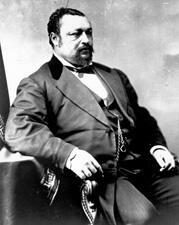
Here you will find contact information for Senator Blanche Kelso Bruce, including email address, phone number, and mailing address.
| Name | Blanche Kelso Bruce |
| Position | Senator |
| State | Mississippi |
| Party | Republican |
| Status | Former Representative |
| Term Start | December 6, 1875 |
| Term End | March 3, 1881 |
| Terms Served | 1 |
| Born | March 1, 1841 |
| Gender | Male |
| Bioguide ID | B000968 |
About Senator Blanche Kelso Bruce
Blanche Kelso Bruce (March 1, 1841 – March 17, 1898) was an American politician who represented Mississippi as a Republican in the United States Senate from 1875 to 1881. Born into slavery in Prince Edward County, Virginia, near Farmville, he became the first elected African-American senator to serve a full term; Hiram R. Revels, also of Mississippi, was the first African American to serve in the U.S. Senate but did not complete a full term. Bruce’s service in Congress occurred during a significant period in American history, the Reconstruction and post-Reconstruction eras, during which he participated in the legislative process and represented the interests of his Mississippi constituents.
Bruce was born to Polly Bruce, an African-American woman who served as a domestic slave, and her owner, Pettis Perkinson, a white Virginia planter. He was treated comparatively well by his father, who arranged for him to be educated alongside a legitimate white half-brother, and as a child he played with this half-brother. Some accounts state that Perkinson legally freed Bruce and arranged an apprenticeship so that he could learn a trade, while in an 1886 newspaper interview Bruce himself said that he gained his freedom by moving to Kansas as soon as hostilities broke out in the Civil War. Leaving slavery behind, he began the transition from bondage to independent life in the context of the national conflict that would end chattel slavery in the United States.
After securing his freedom, Bruce pursued further education and work across several states. He attended Oberlin College in Oberlin, Ohio, for two years, an institution known for its early commitment to coeducation and African-American education. He later worked as a steamboat porter on the Mississippi River, gaining familiarity with the river economy and the communities along its banks. In 1864 he moved to Hannibal, Missouri, where he established a school for Black children, reflecting his early commitment to education and advancement for African Americans in the immediate wartime and postwar years.
In 1868, during Reconstruction, Bruce relocated to Bolivar near Cleveland in northwestern Mississippi, where he purchased a plantation in the Mississippi Delta. He became a wealthy landowner, accumulating several thousand acres in the region. His economic success was accompanied by rapid political advancement. He was appointed Tallahatchie County registrar of voters and tax assessor, positions central to the reorganization of political life in the postwar South. He then won election as sheriff of Bolivar County and subsequently held other county offices, including tax collector and supervisor of education, while also editing a local newspaper. In 1870 he became sergeant-at-arms of the Mississippi State Senate, further solidifying his role in state politics and Republican Party organization.
In February 1874, the Mississippi legislature elected Bruce to the United States Senate, making him the second African American to serve in the upper house of Congress and the first to serve a full term. He took his seat on March 4, 1875, and served until March 3, 1881, completing one full term in office. A member of the Republican Party, he contributed to the legislative process during a period marked by the end of Reconstruction and the rise of “Redeemer” governments in the South. On February 14, 1879, he presided over the U.S. Senate, becoming the first African American—and the only former slave—to do so. During his tenure he advocated for the civil and political rights of African Americans, worked on issues affecting the Mississippi River and national finance, and built alliances with influential Republican leaders. At the 1880 Republican National Convention in Chicago, Bruce became the first African American to receive votes for national office at a major party’s nominating convention, garnering eight votes for Vice President while James A. Garfield of Ohio secured the presidential nomination. In 1880, Democrat James Z. George, a Confederate Army veteran, was elected by the Mississippi legislature to succeed him in the Senate.
After his Senate term expired in 1881, Bruce remained in Washington, D.C., where he secured a succession of Republican patronage positions and became a prominent figure in the capital’s Black elite. President James A. Garfield appointed him Register of the Treasury in 1881, making him the first African American whose signature appeared on U.S. paper currency. He used his visibility to stump for Republican candidates across the country and to advocate for African-American advancement. In early 1889, politically connected Black leaders lobbied for Bruce to receive a Cabinet appointment in President Benjamin Harrison’s administration, and contemporary newspapers noted that he enjoyed the respect of many of his former congressional colleagues. Although he did not receive a Cabinet post, he was appointed Recorder of Deeds for the District of Columbia during Harrison’s presidency, serving from 1890 to 1893. A Philadelphia newspaper reported on this appointment, though later claims that the position paid him $30,000 a year are not substantiated by primary records. Bruce also served on the District of Columbia Board of Trustees of Public Schools from 1892 to 1895, furthering his long-standing interest in education.
Bruce’s personal life was closely intertwined with his public prominence. On June 24, 1878, he married Josephine Beall Willson (1853–1923), a fair‑skinned socialite from Cleveland, Ohio, in a wedding that attracted considerable public attention. The couple embarked on a four‑month honeymoon in Europe, reflecting their rising social status. Their only child, Roscoe Conkling Bruce, was born in 1879 and named for Senator Roscoe Conkling of New York, Bruce’s mentor in the Senate. In Washington, Bruce acquired a large townhouse and a summer home and became a leading figure in Black high society. He was known for his pride in his racial identity; one newspaper reported that he rejected the term “colored men,” often saying, “I am a Negro and proud of it.”
In his final years, Bruce remained active in public and intellectual life. He participated in the March 5, 1897 meeting in Washington, D.C., convened to honor the memory of Frederick Douglass and to support the American Negro Academy, led by Alexander Crummell. That same year, President William McKinley appointed him Register of the Treasury for a second time, a post he held until his death. Bruce died in Washington, D.C., on March 17, 1898, from complications of diabetes while still in office. His legacy was quickly recognized in the nation’s capital: in July 1898, the District of Columbia public school trustees ordered that a new public school building on Marshall Street in the Park View neighborhood be named the Bruce School in his honor.
Over the twentieth and twenty-first centuries, Bruce’s life and career continued to receive formal commemoration and scholarly attention. In 1975, his Washington, D.C., residence was declared a National Historic Landmark and formally named the Blanche K. Bruce House. In October 1999, the U.S. Senate commissioned an official portrait of Bruce; African-American Washington artist Simmie Knox was selected in 2000 to paint it, based on a photograph by Mathew Brady, and the portrait was unveiled in the Capitol in 2001. Bruce is listed in Molefi Kete Asante’s 2002 volume, “100 Greatest African Americans.” On March 1, 2006, the African American Heritage Preservation Foundation dedicated a historical highway marker noting his birthplace at the intersection of Virginia Highways 360 and 623 near Green Bay in Prince Edward County. That same year, Lawrence Otis Graham published a historical study of Bruce and his family, “The Senator and the Socialite: The True Story of America’s First Black Dynasty,” further cementing his place in the history of African-American political leadership. His life story was also dramatized in the 1949 radio program “The Saga of Senator Blanche K. Bruce,” part of the series Destination Freedom, reflecting his enduring significance in American political and cultural history.