Representative Bob Franks
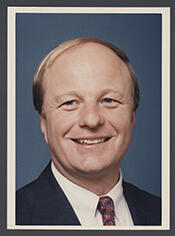
Here you will find contact information for Representative Bob Franks, including email address, phone number, and mailing address.
| Name | Bob Franks |
| Position | Representative |
| State | New Jersey |
| District | 7 |
| Party | Republican |
| Status | Former Representative |
| Term Start | January 5, 1993 |
| Term End | January 3, 2001 |
| Terms Served | 4 |
| Born | September 21, 1951 |
| Gender | Male |
| Bioguide ID | F000349 |
About Representative Bob Franks
Robert Douglas Franks (September 21, 1951 – April 9, 2010) was an American Republican politician who served as a U.S. Representative from New Jersey from 1993 to 2001. Over four terms in Congress, he represented central New Jersey and was known as a fiscal conservative and budget “hawk,” playing an active role in the legislative process and in advancing the Republican Party’s national agenda during a significant period in American political history.
Franks was born on September 21, 1951, in Hackensack, New Jersey, the son of Norman A. Franks (1921–2000) and June E. Franks. He spent his early years in Glen Rock, New Jersey, before his family moved to suburban Chicago. The family later returned to New Jersey, where Franks attended Summit High School in Summit. From an early age he developed an interest in Republican politics, becoming involved in campaigns such as those of U.S. Senator Charles H. Percy while living in the Midwest. As a teenager back in New Jersey, he became active in local Republican organizations, including the Young Republicans and the “Kean for Assembly” races, and he helped to found the Union County Young Republicans, signaling the start of a lifelong engagement in party politics.
Franks pursued higher education at DePauw University in Greencastle, Indiana, graduating in 1973. While at DePauw he was elected president of the Student Senate, an early indication of his leadership abilities and political ambition. He went on to study law at the Dedman School of Law at Southern Methodist University in Dallas, Texas, earning his law degree in 1976. After law school, he returned to New Jersey and became deeply involved in Republican politics as an aide, consultant, and campaign manager to several prominent figures, including U.S. Representatives Jim Courter and Dean Gallo and Governor Thomas H. Kean. Although he built his reputation as a political strategist and operative, his primary profession outside elective office was that of a newspaper publisher, giving him additional experience in communications and public affairs.
Franks’s own electoral career began in county and state politics. In 1979, he initially sought a seat on the Union County Board of Chosen Freeholders when State Senator Peter J. McDonough resigned and Assemblyman Donald DiFrancesco pursued the Senate seat. Franks switched to the race for the New Jersey General Assembly and, at the Republican convention, defeated Berkeley Heights Mayor Marie Kissebeth for the nomination. He won election to the Assembly and, after redistricting in 1981 placed him in the 22nd Legislative District, a Union/Essex district, he survived an internal party struggle in which Essex County Republicans demanded an Assembly seat; Union County Republicans instead chose to drop another incumbent, William J. Maguire, allowing Franks to remain on the ticket. He was re-elected to the Assembly in 1981, 1983, 1985, 1987, 1989, and 1991, building a record as a reliable Republican legislator. During his tenure in the Assembly he also served two terms as chairman of the New Jersey Republican State Committee, from 1987 to 1989 and again from 1990 to 1992. In his second term as state party chairman, he capitalized on widespread voter discontent with Governor Jim Florio’s tax increases and led New Jersey Republicans to veto-proof majorities in both houses of the state legislature. He was succeeded in the Assembly by Alan Augustine.
In addition to his state legislative work, Franks played an active role in national Republican politics. He served as New Jersey campaign chairman for U.S. Representative Jack Kemp’s 1988 bid for the Republican presidential nomination. He later endorsed New Jersey publisher Steve Forbes in the 1996 Republican presidential primaries and supported his House colleague John Kasich in 2000. Franks and Kasich served together on the House Budget Committee and developed a close personal friendship; Kasich became the godfather of Franks’s eldest daughter, Kelly, and later delivered a eulogy at Franks’s funeral in 2010. These activities underscored Franks’s standing within the national party as a committed advocate of fiscal conservatism and supply-side economic policies.
In 1992, Franks was elected to the U.S. House of Representatives from New Jersey, succeeding Representative Matt Rinaldo, and he took office on January 3, 1993. He served four consecutive terms, remaining in the House until January 3, 2001. As a member of the House of Representatives, he participated fully in the democratic process and represented the interests of his central New Jersey constituents during a period marked by debates over federal spending, taxation, and government reform. Franks served on the House Transportation and Infrastructure Committee, where he focused on transportation issues important to his district and state. He became known as a budget “hawk” and was a strong supporter of the 1994 Republican “Contract with America,” including its emphasis on fiscal restraint and its advocacy of voluntary term limits for members of Congress. True to his public commitment to term limits, he chose not to seek re-election to the House in 2000.
Instead, in 2000 Franks became the Republican candidate for the open United States Senate seat from New Jersey. He faced Democrat Jon Corzine, a former chief executive officer of Goldman Sachs, in a high-profile and costly campaign. Although Franks was far outspent—Corzine’s spending exceeded his by approximately $48 million—he mounted a competitive race. Corzine ultimately defeated Franks by fewer than 100,000 votes, with 51.1 percent of the vote to Franks’s 47.1 percent in the 2000 Senate election. Despite the loss, Franks’s performance was notable; it was the closest Republicans had come to winning a New Jersey U.S. Senate seat since Clifford P. Case won re-election to a fourth term in 1972.
Franks remained a significant figure in New Jersey politics after leaving Congress. In 2001, he sought the Republican nomination for governor of New Jersey but was defeated in the primary by Bret Schundler, who ran on a more conservative platform. Franks entered the race only after former Governor Donald DiFrancesco withdrew from contention, having previously announced that he would not be a candidate. His late entry into the campaign, after Schundler had already gained a substantial advantage in organization and fundraising, was widely believed to have contributed to his defeat. Lobbyist Jack Abramoff later stated that he helped Schundler raise funds against Franks in retaliation for Franks’s refusal to delay introduction of a “Made in the USA” bill affecting Abramoff’s clients in the Northern Mariana Islands; Abramoff claimed that after assurances the bill would be held, it was introduced the next day, prompting him to work actively against Franks’s gubernatorial bid. Although he was often mentioned in subsequent years as a potential candidate for high office, Franks generally discouraged such speculation, and many observers believed that any future public role he might accept would likely be appointive rather than elective.
In his post-congressional career, Franks became president of the HealthCare Institute of New Jersey, representing the interests of the state’s research-based pharmaceutical and medical technology companies. He continued to be consulted on political matters and remained a respected voice within the Republican Party. When his congressional successor, Representative Mike Ferguson, announced in 2007 that he would not seek re-election in 2008, there was considerable speculation that Franks might run again for his former House seat. Franks declined, stating that representing the people of central New Jersey in the House of Representatives from 1993 to 2001 had been one of the most important and rewarding experiences of his life, but that he found his work at the HealthCare Institute of New Jersey very fulfilling and was enjoying evenings and weekends with his family; he declared that he had no desire to run for Congress again.
Franks was a resident of Warren Township, New Jersey, in his later years. He died of cancer at Memorial Sloan Kettering Cancer Center in New York City on April 9, 2010. On September 24, 2013, at the dedication of a rail station in Union, New Jersey, named in his honor, Governor Chris Christie revealed that he had offered Franks the Republican nomination for lieutenant governor on his ticket in 2009, but that Franks had declined the offer. Christie then selected Kim Guadagno as his running mate. The dedication of the station and the recollections shared there reflected the lasting impact of Bob Franks’s decades of service to New Jersey and to the nation.