Representative Brazilla Carroll Reece
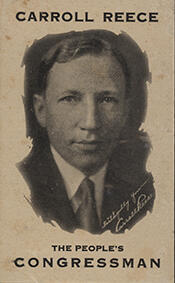
Here you will find contact information for Representative Brazilla Carroll Reece, including email address, phone number, and mailing address.
| Name | Brazilla Carroll Reece |
| Position | Representative |
| State | Tennessee |
| District | 1 |
| Party | Republican |
| Status | Former Representative |
| Term Start | April 11, 1921 |
| Term End | January 3, 1963 |
| Terms Served | 18 |
| Born | December 22, 1889 |
| Gender | Male |
| Bioguide ID | R000108 |
About Representative Brazilla Carroll Reece
Brazilla Carroll Reece (December 22, 1889 – March 19, 1961) was an American Republican Party politician from Tennessee who represented eastern Tennessee in the United States House of Representatives for all but six years from 1921 to 1961. Over the course of 18 terms in office, he became one of the most enduring Republican figures in the South, serving as chair of the Republican National Committee from 1946 to 1948 and emerging as a leading spokesman for the party’s conservative Old Right wing. A staunch opponent of interventionism, communism, and the Progressive policies of the Franklin D. Roosevelt and Harry S. Truman administrations, he played a prominent role in shaping mid‑twentieth‑century Republican strategy and ideology.
Reece was born on a farm near Butler, Johnson County, Tennessee, as one of thirteen children of John Isaac Reece and Sarah Maples Reece. He was named for Brazilla Carroll McBride, an ancestor who had served in the War of 1812, though he never used his first name and was known publicly as Carroll Reece. His family background was modest; he later recalled peddling butter and eggs from his parents’ log cabin to the back door of the stately home of Sam R. Sells, the man he would eventually defeat for Congress. One of his brothers, Raleigh Valentine Reece, became a reporter for the Nashville Tennessean and later gained local prominence as the teacher who replaced John Thomas Scopes at Rhea County High School in Dayton, Tennessee, following the famous “Monkey Trial” of 1925.
Reece attended Watauga Academy in Butler before enrolling at Carson-Newman College in Jefferson City, Tennessee. At Carson-Newman he distinguished himself both academically and athletically, playing basketball and football and graduating in 1914 as class valedictorian. After college he served for a year as a high school principal, then moved to New York City to pursue graduate study. He enrolled at New York University, where he earned a master’s degree in economics and finance in 1916, and he also undertook additional study at the University of London. At NYU he served as an assistant secretary and instructor in 1916 and 1917, and by 1919–1920 he was director of the university’s School of Business Administration, during which time he also studied law.
With the American entry into World War I, Reece enlisted in April 1917 and attended officer training at Plattsburgh, New York. He initially served with the 166th Infantry Regiment of the 42nd “Rainbow” Division and later transferred to the 102nd Infantry Regiment of the 26th Infantry Division. Rising to the rank of captain, he commanded a company and subsequently the regiment’s 3rd Battalion. He saw heavy combat, was wounded in action, and was discharged in 1919. For his wartime service he received the Distinguished Service Cross, the Distinguished Service Medal, the Purple Heart, and the French Croix de Guerre with Palm, decorations that later became central to his public image and early political campaigns.
After the war Reece returned briefly to academic life at New York University, serving as director of the School of Business Administration in 1919 and 1920 while completing his legal studies. He passed the bar examination and returned to Tennessee, where he opened a successful law practice in Johnson City. In addition to practicing law, he became active in local business as a banker and publisher, building both financial security and a network of regional influence. He married Louise Goff, daughter of United States Senator Guy Despard Goff of West Virginia, a union that connected him to an established Republican political family and provided him with independent wealth that later enabled him to serve in national party leadership without drawing a salary.
Reece first sought national office in 1920, challenging incumbent Republican Representative Sam R. Sells in the primary for Tennessee’s 1st Congressional District, a strongly Republican area that had opposed secession in 1861 and had sent Republicans to Congress for all but four years since 1859. Initially dismissed by Sells’s supporters as a political novice with little chance of success, Reece ran an energetic, populist campaign that emphasized his World War I record and his humble origins. He traveled to all the counties in the district, promising to serve no more than ten years in Congress—a pledge he later broke—and attacked Sells, a lumber businessman, for alleged conflicts of interest, particularly his vote to exempt excess corporate profits from taxation. Reece contrasted Sells’s wealth with his own background, recalling how he had once come to Sells’s home “peddling butter and eggs.” He defeated Sells in an upset for the Republican nomination and then easily won the general election, taking office in March 1921.
Once in Congress, Reece quickly developed a reputation for attentive constituent service, focusing on both large and small problems brought to him by residents of eastern Tennessee. He was re‑elected four consecutive times after his initial victory. In 1922 he joined the majority of House Republicans in voting for the Dyer Anti-Lynching Bill, reflecting his support for federal civil rights measures; throughout his career he advocated anti-lynching and anti–poll tax legislation. Nonetheless, his conservative economic views and opposition to certain federal development initiatives eventually cost him politically. In the 1930 midterm elections he lost his seat to Independent Republican Oscar Lovette amid local backlash over President Herbert Hoover’s veto of the George W. Norris Muscle Shoals bill, a precursor to the Tennessee Valley Authority. Reece had supported private enterprise solutions for Muscle Shoals and opposed the larger federal role envisioned by Norris, even asserting that the bill “originated in Red Russia.” Many constituents, angered by the failure to secure the Cove Creek Dam and attracted to Lovette’s support for the government project, turned against him.
Out of office but still influential, Reece maintained strong ties to the Hoover administration, and federal patronage in the district often flowed through him rather than Lovette. In 1932 he ran to reclaim his seat, criticizing Lovette for his inconsistent Republican affiliation—Lovette again ran as an “Independent Republican”—and campaigning as the more reliable party standard-bearer. The election was close, and Lovette alleged fraud after Reece’s narrow victory. A House subcommittee investigation uncovered some “questionable” election practices, but Reece was ultimately seated. The national Democratic landslide of 1932 ushered in the New Deal era, yet Reece managed to hold his seat and was re‑elected repeatedly in the years that followed. According to Tennessee historian Ray Hill, Reece never forgot that his 1930 defeat had stemmed largely from his opposition to the Muscle Shoals project; after returning to Congress, he became a supporter of the Tennessee Valley Authority and frequently voted with Democrats to back TVA initiatives, even when most Republicans opposed the agency. He explained his stance bluntly, observing that no politician in Tennessee could survive by opposing the TVA.
Throughout his long congressional career, Reece remained a consistent conservative critic of the New Deal and later Fair Deal programs. He opposed expansive federal economic regulation, including wage and price controls, and was a leading voice of the Republican Old Guard. Before the United States entered World War II, he was an isolationist and non‑interventionist and voted against the Lend-Lease Act, reflecting his skepticism about deep foreign entanglements. Within the Republican Party he aligned closely with Senator Robert A. Taft of Ohio, the principal leader of the conservative wing. Reece was a key supporter of Taft’s presidential bids in 1948 and 1952, backing him against more moderate Republicans from New York who ultimately secured the nominations. At the same time, he continued to serve his district, helping constituents navigate federal programs and maintaining a strong electoral base in a region that remained one of the few reliably Republican enclaves in the former Confederacy.
Reece’s prominence in national Republican politics grew steadily. He served as a delegate to the Republican National Conventions in 1928, 1932, 1936, 1940, 1944, and 1948, and in 1945 and 1946 he was a member of the Board of Regents of the Smithsonian Institution. In early April 1946 he succeeded Herbert Brownell Jr. as chair of the Republican National Committee. As RNC chair, he presided over the party’s successful 1946 midterm campaign, which returned Republicans to control of both houses of Congress for the first time since the Hoover administration. Allied with Taft, he opposed President Truman’s anti‑inflation program and positioned the GOP as a conservative alternative to Democratic domestic policy. Owing to the independent wealth he had inherited through his marriage into the Goff family, Reece declined to accept a salary for his work as party chair. His tenure placed him at the center of internal party struggles, as he and other conservatives clashed with liberal and moderate Republicans such as Harold Stassen of Minnesota and George Aiken of Vermont. In February 1948 he publicly called for the purging of communists from the United States, underscoring his strong anti‑communist stance. He stepped down from Congress in 1947 to devote his full energies to the RNC chairmanship, which he held until 1948, and then returned to the House afterward.
In 1948 Reece sought higher office as the Republican nominee for an open United States Senate seat from Tennessee. He faced Democratic Representative Estes Kefauver, who had defeated incumbent Senator Tom Stewart in the Democratic primary. Kefauver enjoyed the backing of influential Memphis Press-Scimitar editor Edward J. Meeman, a persistent foe of the Edward “Boss” Crump political machine, while Crump supported Stewart. In the general election, Kefauver defeated Reece, and Reece’s bid for the Senate ended unsuccessfully. He soon returned to the House, however, and continued to represent his East Tennessee district, reinforcing his status as a fixture of the state’s Republican politics. According to later commentary, including a 1981 pamphlet by Stephen Alan Sampson of Anti-Communist Crusade republished by Liberty University, Reece was derided by intraparty moderates as an “Old Guard reactionary,” a label that reflected his unwavering conservatism and opposition to both domestic liberalism and internationalist foreign policy.
During the 1950s Reece remained an influential figure in Congress. From 1953 to 1954 he chaired the House Select Committee to Investigate Tax-Exempt Foundations and Comparable Organizations, commonly known as the Reece Committee. Under his leadership, the committee examined the activities of major philanthropic and educational foundations, focusing on alleged Communist influence and efforts to promote socialist and collectivist ideologies through tax‑exempt organizations, particularly educational institutions and charitable foundations. The Reece Committee concluded that some foundations were actively involved in promoting such ideologies, findings that reinforced his reputation as a vigorous anti‑communist. Throughout these years he continued to participate in the legislative process as a conservative Republican, representing the interests of his eastern Tennessee constituents while engaging in national debates over the scope of federal power, foreign policy, and the role of private institutions in American life.
Reece’s congressional service extended, with only brief interruptions, from 1921 until his death in 1961, encompassing a transformative period in American history that included the Great Depression, World War II, the early Cold War, and the beginnings of the civil rights movement. He died in office on March 19, 1961. Over four decades in public life, he combined a strong commitment to his district with a prominent role in national Republican politics, leaving a legacy as one of the leading conservative voices of his era and a central figure in the Old Right opposition to New Deal and postwar liberalism.