Senator Bronson Murray Cutting
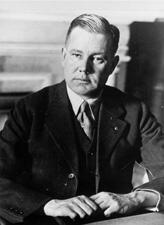
Here you will find contact information for Senator Bronson Murray Cutting, including email address, phone number, and mailing address.
| Name | Bronson Murray Cutting |
| Position | Senator |
| State | New Mexico |
| Party | Republican |
| Status | Former Representative |
| Term Start | December 29, 1927 |
| Term End | May 6, 1935 |
| Terms Served | 3 |
| Born | June 23, 1888 |
| Gender | Male |
| Bioguide ID | C001028 |
About Senator Bronson Murray Cutting
Bronson Murray Cutting (June 23, 1888 – May 6, 1935) was a United States senator from New Mexico, a prominent progressive Republican, newspaper publisher, and military attaché whose congressional service from 1927 to 1935 coincided with a transformative period in American political and economic history. He served in the United States Congress as a Senator from New Mexico from 1927 to 1935, contributing to the legislative process during three terms in office and representing the interests of his constituents during the late 1920s and the Great Depression.
Cutting was born in Great River, Long Island, New York, on June 23, 1888, at his family’s country seat of Westbrook. He was the third of four children of William Bayard Cutting (1850–1912), a prominent New York lawyer and financier, and Olivia Peyton Murray (1855–1949), who came from an established Southern family. Raised in an affluent and socially prominent environment, he attended common schools and then the Groton School in Massachusetts, one of the leading preparatory schools in the country. He went on to Harvard University, where he graduated in 1910 and was a member of the Delphic Club, reflecting his integration into the social and intellectual life of the university.
Shortly after his graduation from Harvard, Cutting’s life and career trajectory were altered by recurrent tuberculosis, which left him an invalid for a time. On medical advice he moved to Santa Fe, New Mexico, seeking a drier climate to restore his health. In New Mexico he embarked on a new career in journalism and publishing. In 1912 he became a newspaper publisher, acquiring and publishing the Santa Fe New Mexican and the Spanish-language paper El Nuevo Mexicano. From 1912 to 1918 he served as president of the New Mexican Printing Company, and from 1920 until his death he was president of the Santa Fe New Mexican Publishing Corporation. Through these roles he became an influential voice in New Mexico public life, using the press to shape opinion on territorial and then state issues and to advance progressive reforms.
During World War I, Cutting entered national service. In 1917 he was commissioned a captain in the United States Army and served as an assistant military attaché at the American Embassy in London in 1917 and 1918. This diplomatic and military posting gave him experience in international affairs and exposed him to the complexities of wartime policy and alliance management. Returning to New Mexico after the war, he remained active in public affairs. In 1920 he served as a regent of the New Mexico Military Institute, helping oversee the governance of the state’s military educational institution. In 1925 he was appointed chairman of the board of commissioners of the New Mexico State Penitentiary, where he participated in the administration and reform of the state’s correctional system, further establishing his reputation as a progressive-minded civic leader.
Cutting’s federal legislative career began with an appointment rather than an election. On December 29, 1927, he was appointed as a Republican to the United States Senate from New Mexico to fill the vacancy caused by the death of Senator Andrieus A. Jones. He served in this appointed capacity until December 6, 1928, when Octaviano Ambrosio Larrazolo, elected in a special election held November 6, 1928, qualified to serve the remainder of Jones’s term, which expired March 3, 1929. Cutting was not a candidate in that special election, which was held on the same day as the general election for the full six-year term beginning March 4, 1929. Larrazolo did not run for the full term, and Cutting stood for that seat instead. He was elected to the full term and returned to the Senate after only a three‑month absence. A prominent progressive Republican, he distinguished himself by his independence from party orthodoxy and his willingness to cross party lines on major issues. He was re‑elected in 1934 in a very close race, receiving 76,226 votes to Democrat Dennis Chavez’s 74,944, an especially notable achievement in a year generally unfavorable to Republicans.
In the Senate, Cutting played a significant role in both domestic and international legislation. He was a co‑sponsor of the Hare–Hawes–Cutting Independence Act, which sought to grant the Philippine Islands a ten‑year commonwealth period with virtually full autonomy, to be followed by formal recognition of Philippine independence. The bill passed Congress and was enacted over President Herbert Hoover’s veto, underscoring the strength of congressional support for eventual Philippine independence. However, the Philippine legislature rejected the law, and Congress later passed the Tydings–McDuffie Act, sponsored by Senator Millard Tydings of Maryland, which ultimately provided the framework for Philippine independence and was accepted by the Philippine legislature. Cutting also became a leading Senate voice on civil liberties and government censorship. In debates over a 1929 tariff bill, he challenged Section 305, which allowed the U.S. Customs Service to confiscate “obscene” materials and which was to be expanded to bar printed materials suggesting treason or threatening the life of the president. Inspired by a constituent’s complaint, he denounced Section 305 as “irrational, unsound, and un-American” and called for its elimination. Although he was compelled to compromise, he successfully introduced an amendment removing the references to treason, which passed by only two votes. His stand drew widespread praise from publishers, librarians, booksellers, authors, and civil liberties organizations. While the broader legislation became known primarily as the Smoot–Hawley Tariff Act, his efforts helped spark a national debate over the limits of government censorship.
Cutting’s progressive orientation also shaped his response to the Great Depression and the New Deal. Crossing party lines, he supported Democrat Franklin D. Roosevelt in the 1932 presidential election, reflecting his reformist priorities over strict party loyalty. Roosevelt, recognizing his abilities and independence, offered him a cabinet post as Secretary of the Interior, a position Cutting ultimately declined because of his unstable health; the post went instead to Harold L. Ickes. In the Senate, Cutting played a key role in the political struggles over banking reform undertaken by the Roosevelt administration. He was an advocate of far‑reaching structural change to the financial system and supported the “Chicago plan” advanced by economist Irving Fisher and others at the University of Chicago, which proposed a 100 percent reserve requirement for bank credit creation to limit private banks’ control over the money supply. As one of a small group of influential senators sympathetic to these ideas, he was involved in the debates that produced the Banking Acts of 1933 and 1935. His death cut short what some contemporaries and later observers viewed as the possibility of a more radical restructuring of American banking policy.
On May 6, 1935, while traveling from Albuquerque, New Mexico, to Washington, D.C., to resume his Senate duties, Cutting died in the crash of TWA Flight 6, a Douglas DC‑2 airliner, in bad weather near Atlanta, Missouri. His sudden death in office had national repercussions and led Congress to commission the Copeland Committee investigation into air traffic safety, a highly controversial inquiry that examined airline operations, federal oversight, and aviation standards during a formative period in commercial air travel. Following his death, New Mexico Governor Clyde Tingley appointed Dennis Chavez, Cutting’s Democratic opponent in the closely contested 1934 election, to fill the vacant Senate seat. Bronson Murray Cutting was interred in Green‑Wood Cemetery in Brooklyn, New York, bringing him back to his native state at the end of a career that had been centered in the Southwest and on the national stage.