Representative Bruce Foster Sterling
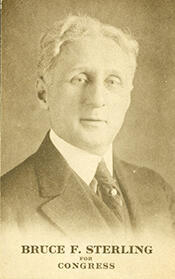
Here you will find contact information for Representative Bruce Foster Sterling, including email address, phone number, and mailing address.
| Name | Bruce Foster Sterling |
| Position | Representative |
| State | Pennsylvania |
| District | 23 |
| Party | Democratic |
| Status | Former Representative |
| Term Start | April 2, 1917 |
| Term End | March 3, 1919 |
| Terms Served | 1 |
| Born | September 28, 1870 |
| Gender | Male |
| Bioguide ID | S000869 |
About Representative Bruce Foster Sterling
Bruce Foster Sterling (September 28, 1870 – April 26, 1945) was a Democratic member of the U.S. House of Representatives from Pennsylvania who served one term in Congress from 1917 to 1919. Over the course of his career he was active in state and national Democratic politics, practiced law in Fayette County, Pennsylvania, and later held important county offices, including register of wills and clerk of the orphans’ court.
Sterling was born on September 28, 1870, in Masontown, Fayette County, Pennsylvania. He attended the public schools of Masontown, reflecting the typical educational path of a late nineteenth-century small-town Pennsylvanian. Seeking further training, he enrolled at the California State Normal School in California, Pennsylvania, an institution focused on preparing teachers and other professionals for public service in the region.
Pursuing higher education beyond his home state, Sterling attended West Virginia University in Morgantown, West Virginia, from which he graduated in 1895. After completing his university studies, he turned to the law, studying in preparation for the bar. He was admitted to the bar in 1896 and commenced the practice of law in Uniontown, Pennsylvania, the county seat of Fayette County. His legal career established him as a prominent local attorney and provided the foundation for his subsequent involvement in public affairs.
Sterling entered elective office at the state level when he served as a member of the Pennsylvania House of Representatives in 1906. His role in the state legislature marked his emergence as a Democratic leader in southwestern Pennsylvania. He also became active in national party politics, serving as a delegate to the Democratic National Conventions in 1912, 1920, and 1924, where he participated in the selection of presidential nominees and the shaping of the party platform.
Sterling’s congressional service came during a significant period in American history. Elected as a Democrat to the Sixty-fifth Congress, he represented Pennsylvania in the U.S. House of Representatives from March 4, 1917, to March 3, 1919. As a member of the House of Representatives, he participated in the legislative process during the World War I era and represented the interests of his Pennsylvania constituents. His single term in office reflected both the competitive political climate of the time and the shifting partisan alignments associated with wartime policies. He was an unsuccessful candidate for reelection in 1918, ending his service in Congress after one term.
After leaving Congress, Sterling resumed the practice of law in Uniontown, continuing his long-standing professional engagement with the legal community of Fayette County. He remained active in public life and, drawing on his legal expertise and political experience, was elected register of wills and clerk of the orphans’ court of Fayette County, Pennsylvania, in 1935. He was reelected to these county offices in 1939 and again in 1943, underscoring the continued confidence of local voters in his abilities and integrity.
Bruce Foster Sterling died in Uniontown, Pennsylvania, on April 26, 1945, at the age of 75. He was interred in Oak Grove Cemetery, bringing to a close a life marked by service at the local, state, and national levels, including his term in the U.S. House of Representatives and his long association with the Democratic Party in Pennsylvania.