Representative Burr Powell Harrison
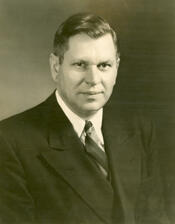
Here you will find contact information for Representative Burr Powell Harrison, including email address, phone number, and mailing address.
| Name | Burr Powell Harrison |
| Position | Representative |
| State | Virginia |
| District | 7 |
| Party | Democratic |
| Status | Former Representative |
| Term Start | November 5, 1946 |
| Term End | January 3, 1963 |
| Terms Served | 9 |
| Born | July 2, 1904 |
| Gender | Male |
| Bioguide ID | H000264 |
About Representative Burr Powell Harrison
Burr Powell Harrison (July 2, 1904 – December 29, 1973) was a Virginia lawyer, judge, and Democratic politician who was a member of the Byrd Organization and served as a U.S. Representative from Virginia in the United States Congress from 1946 to 1963. He represented Virginia’s 7th congressional district, a seat that had also been held by his father, and became a notable figure in mid‑twentieth‑century Virginia politics during a period of significant national and regional change.
Harrison was born on July 2, 1904, in Winchester, Virginia, into a politically prominent family. His father, Thomas W. Harrison, served as a U.S. Representative from Virginia, and the family’s longstanding involvement in public affairs helped shape his early interest in law and politics. Growing up in the Shenandoah Valley, he was exposed to both the legal profession and the workings of government from an early age, experiences that would later inform his own public service.
Harrison received his early education in the schools of Winchester before pursuing higher education and legal training. He studied law and was admitted to the bar, establishing himself as an attorney in Virginia. His legal practice in Winchester and the surrounding area provided him with a detailed understanding of local concerns and the practical application of state and federal law, laying the groundwork for his later judicial and legislative responsibilities.
Before entering Congress, Harrison built a career in the legal and judicial fields in Virginia. He served as a judge, gaining experience on the bench that enhanced his reputation as a careful and knowledgeable interpreter of the law. His judicial service, combined with his legal practice, positioned him as a respected figure within the state’s legal community and brought him into close association with the dominant Democratic political network in Virginia, known as the Byrd Organization, led by Senator Harry F. Byrd Sr. As a member of this organization, Harrison aligned himself with its emphasis on fiscal conservatism and its influential role in state and regional politics.
Harrison’s congressional career began in 1946, when he was elected as a Democrat to the United States House of Representatives from Virginia’s 7th congressional district. He took office in the post–World War II era, a time marked by economic adjustment, the onset of the Cold War, and the early stages of the modern civil rights movement. A member of the Democratic Party, he contributed to the legislative process during nine consecutive terms in office, serving in the Eightieth through the Eighty‑seventh Congresses. Throughout this period, he participated in the democratic process and represented the interests of his constituents, working within the framework of the Byrd Organization’s influence and the broader Southern Democratic coalition.
During his seventeen years in the House of Representatives, Harrison’s service coincided with major national debates over foreign policy, defense, domestic spending, and civil rights. As a Virginia Democrat associated with the Byrd Organization, he reflected the conservative fiscal outlook and states’‑rights orientation characteristic of that political faction. He took part in deliberations on legislation affecting his largely rural and small‑town district, advocating for the concerns of his constituents while navigating the evolving political landscape of mid‑century America. His tenure extended through the administrations of Presidents Harry S. Truman, Dwight D. Eisenhower, and John F. Kennedy, encompassing the Korean War, the early Cold War, and the initial federal responses to desegregation.
Harrison left Congress at the conclusion of his service in 1963, after nine terms in the House. In his later years, he returned to private life in Virginia, drawing on his long experience as a lawyer, judge, and legislator. Remaining identified with the political traditions of the Byrd Organization and the public service legacy of his family, he lived quietly away from national office. Burr Powell Harrison died on December 29, 1973, in Winchester, Virginia, the city of his birth, closing a career that had spanned the courtroom, the bench, and the halls of Congress during a transformative era in both Virginia and American history.