Representative Burwell Boykin Lewis
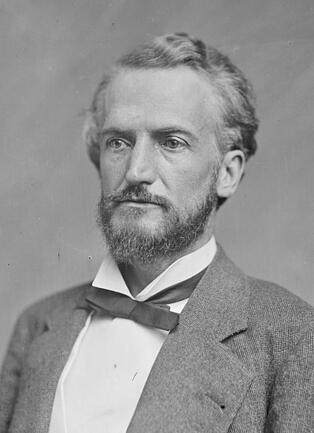
Here you will find contact information for Representative Burwell Boykin Lewis, including email address, phone number, and mailing address.
| Name | Burwell Boykin Lewis |
| Position | Representative |
| State | Alabama |
| District | 6 |
| Party | Democratic |
| Status | Former Representative |
| Term Start | December 6, 1875 |
| Term End | March 3, 1881 |
| Terms Served | 2 |
| Born | July 7, 1838 |
| Gender | Male |
| Bioguide ID | L000272 |
About Representative Burwell Boykin Lewis
Burwell Boykin Lewis (July 7, 1838 – October 11, 1885) was an American lawyer, legislator, educator, and Democratic politician who represented Alabama in the United States House of Representatives from 1875 to 1881. Over the course of his congressional career, he served both Alabama’s at-large congressional district and its 6th congressional district, participating in the legislative process during a significant period in American history and representing the interests of his constituents during the post–Civil War and Reconstruction era.
Lewis was born in Montgomery, Alabama, on July 7, 1838. Shortly after his birth, he moved with his parents to Mobile, Alabama. Both of his parents died while the family was living in Mobile, and as a young boy he relocated to Montevallo in Shelby County, Alabama, to live with an uncle. In Montevallo he attended private schools, receiving the foundational education that prepared him for advanced study. After completing his early schooling, he moved to Tuscaloosa to attend the University of Alabama, furthering his education in the state’s principal institution of higher learning.
Upon leaving the University of Alabama, Lewis moved to Selma, Alabama, where he studied law. He was admitted to the bar in 1859 and began the practice of law in Montevallo. His legal career was interrupted by the outbreak of the American Civil War. Lewis enlisted in the Confederate States Army and served in the Second Alabama Cavalry, in which he attained the rank of captain. His wartime service placed him among the many Southern professionals whose careers were reshaped by the conflict and its aftermath.
Following the Civil War, Lewis resumed civilian life and entered public service. He was elected to the Alabama House of Representatives, serving from 1870 to 1872, a period marked by the political and social adjustments of Reconstruction in the state. After his legislative service at the state level, he moved to Tuscaloosa, where he engaged in business activities while maintaining his standing in the legal and political communities.
Lewis’s national political career began when he was elected as a Democrat to an at-large seat in the United States House of Representatives, taking office in 1875. This at-large seat was associated with representation that would later be apportioned as Alabama’s 8th congressional district following the 1880 census. He served in Congress from 1875 to 1881, contributing to the legislative process during two terms in office and participating in the democratic governance of the nation during a transformative era. He was an unsuccessful candidate for reelection in 1876 but returned to Congress when he was elected to represent Alabama’s 6th congressional district in 1878. He began this term on March 4, 1879, continuing his service in the House of Representatives until October 1880, when he resigned to accept an academic leadership position.
In 1880, Lewis resigned from Congress to become president of the University of Alabama in Tuscaloosa. As president of the institution, he led the university during a critical period of rebuilding and reorganization in the decades following the Civil War, helping to guide its academic and administrative development. He served as president of the University of Alabama for just over five years, remaining in that office until his death.
Burwell Boykin Lewis died in Tuscaloosa, Alabama, on October 11, 1885, while still serving as president of the University of Alabama. His career encompassed service as a Confederate officer, state legislator, United States Representative for both an at-large seat and the 6th congressional district of Alabama, and university president, reflecting a life deeply intertwined with the legal, political, and educational history of Alabama in the nineteenth century.