Representative Byron M. Cutcheon
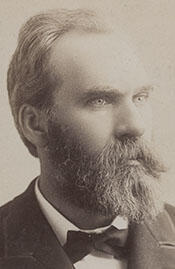
Here you will find contact information for Representative Byron M. Cutcheon, including email address, phone number, and mailing address.
| Name | Byron M. Cutcheon |
| Position | Representative |
| State | Michigan |
| District | 9 |
| Party | Republican |
| Status | Former Representative |
| Term Start | December 3, 1883 |
| Term End | March 3, 1891 |
| Terms Served | 4 |
| Born | May 11, 1836 |
| Gender | Male |
| Bioguide ID | C001022 |
About Representative Byron M. Cutcheon
Byron Mac Cutcheon (May 11, 1836 – April 12, 1908) was an American Civil War officer, Medal of Honor recipient, lawyer, and Republican politician who represented Michigan in the United States House of Representatives from March 4, 1883, to March 3, 1891. His four consecutive terms in Congress, during which he contributed to the legislative process and represented the interests of his constituents, coincided with a significant period in American political and economic development in the late nineteenth century. A member of the Republican Party, he became particularly associated with military affairs in the House, reflecting his distinguished wartime service.
Cutcheon was born in Pembroke, Merrimack County, New Hampshire, on May 11, 1836. Orphaned at a young age, he supported himself by working in a cotton mill in Pembroke to earn money for schooling. At age thirteen he entered Pembroke Academy, and by seventeen he was teaching there, demonstrating early both academic ability and a commitment to education. In 1855 he moved west to Ypsilanti, Michigan, where he continued to study and teach. The following year he was invited to serve as principal of Birmingham Academy in Oakland County, Michigan, intending to remain only long enough to secure the means to advance his own education.
In the spring of 1858 Cutcheon entered the University of Michigan, but to support himself he alternated periods of study with teaching. In the fall of 1859 he became principal of Oak Grove Academy in Lenawee County, Michigan, while continuing his studies. Once he had accumulated sufficient funds, he returned to the university and graduated in 1861. Even before completing his degree, he had been appointed principal and professor at Ypsilanti High School, where in 1861 and 1862 he taught ancient languages, higher mathematics, and mental and moral philosophy. On June 22, 1863, during the Civil War, he married Marie A. Warner of Ann Arbor at Dexter, Michigan; the couple would raise five children—four sons, Frank Warner, Charles Tripp, Max Hart, and Frederick Richard, and one daughter, Marie Louise.
Following the outbreak of the American Civil War, Cutcheon resigned his school post and enlisted in the Union Army, raising a company for the 20th Michigan Infantry. He was mustered in as a second lieutenant and was promoted to captain on July 29, 1862, and to major on October 14, 1862. On November 16, 1863, he became lieutenant colonel of the 20th Michigan, and by order of the U.S. War Department he was made colonel on November 21, 1863. On November 12, 1864, he was transferred and made colonel of the 27th Michigan Infantry, and was mustered into United States service in that rank on December 19, 1864. He was brevetted colonel of U.S. Volunteers on August 18, 1864, for gallant services at the Battles of the Wilderness and Spotsylvania Court House, and was later brevetted brigadier general of U.S. Volunteers on March 13, 1865, for conspicuous gallantry on the field of battle. His combat record was extensive, including Fredericksburg, Virginia; Horseshoe Bend, Kentucky; the siege of Vicksburg and the assault on Jackson, Mississippi; Blue Springs, London, Campbell’s Station, and the siege and assault at Fort Sanders, Knoxville, Tennessee; Thurley’s Ford, Strawberry Plains, and Chuckey Bend, Tennessee; the Wilderness, Ny River, and Spotsylvania Court House, where he was wounded while leading a charge of the 20th Michigan and 51st Pennsylvania; and later operations at Petersburg, the Weldon Railroad, Reams Station, Poplar Spring Church, Boydton Plank Road, Hatcher’s Run, and the prolonged siege of Petersburg from November 1864 to March 1865. On October 16, 1864, he was assigned command of the Second Brigade, Fifteenth Division, Ninth Army Corps, a command he held until March 6, 1865, when he resigned on account of sickness in his family.
After the war Cutcheon returned to Michigan and entered the law office of his brother, Sullivan M. Cutcheon, in Ypsilanti. Sullivan, then Speaker of the Michigan House of Representatives and later U.S. Attorney for the Eastern District of Michigan, provided an early model of public service. Byron Cutcheon enrolled in the University of Michigan Law School in 1865, was admitted to practice in Washtenaw County in January 1866, and graduated from the law department in March 1866. That spring he was appointed state agent of the Michigan Soldiers’ Monumental Association, traveling throughout the state to solicit public support for a monument honoring Michigan’s Civil War soldiers. In the fall of 1866 he moved to Ionia, Michigan, to resume the practice of law, and in July 1867 he relocated to Manistee, Michigan, which would remain his principal home for many years. He served as city attorney of Manistee from 1870 to 1873, prosecuting attorney of Manistee County in 1873 and 1874, and postmaster of Manistee from 1877 to 1883. He was appointed to the State Board of Railroad Commissioners in 1867 and served there until 1883, and in 1866 he was also appointed president of the Michigan Soldiers’ Home Commission by Governor Henry H. Crapo. In 1868 he served as a presidential elector from Michigan, casting his electoral vote for Ulysses S. Grant and Schuyler Colfax. He was elected to the Board of Regents of the University of Michigan in 1875 and served until 1883, further cementing his long association with higher education in the state.
In 1882 Cutcheon was elected as a Republican from Michigan’s 9th congressional district to the Forty-ninth Congress and was re-elected to the Fiftieth, Fifty-first, and Fifty-second Congresses, serving from March 4, 1883, to March 3, 1891. During these four terms in the United States House of Representatives, he participated actively in the legislative process and represented the interests of his Michigan constituents at a time of industrial expansion and postwar adjustment. Reflecting his military background, he served as chairman of the House Committee on Military Affairs in the Fifty-first Congress. His tenure in Congress formed part of a significant period in American history, as the nation grappled with veterans’ issues, economic development, and the evolving role of the federal government. In the 1890 general election he was defeated for re-election by Democrat Harrison H. Wheeler, ending his congressional service after eight years.
In later life Cutcheon continued to combine public service, professional work, and veterans’ advocacy. On June 29, 1891, he was awarded the Medal of Honor “for distinguished gallantry at the Battle of the Wilderness,” Virginia, on May 7, 1864, formally recognizing the valor that had marked his Civil War service. In July 1891 President Benjamin Harrison appointed him the civilian member of the Board of Ordnance and Fortifications, on which he served until March 25, 1895. From 1895 to 1897 he worked as an editorial writer for the Detroit Daily Tribune and the Detroit Journal, and he later resumed the practice of law in Grand Rapids, Michigan. Active in religious and hereditary organizations, he served as moderator of the Congregationalists’ General Association of Michigan at its 1887 annual meeting in Lansing, was a companion of the District of Columbia Commandery of the Military Order of the Loyal Legion of the United States, and a compatriot of the Sons of the American Revolution. He also co-authored, with Henry M. Utley, the historical work “Michigan as a Province, Territory and State: The Twenty-sixth Member of the Federal Union,” published in 1906 by the Publishing Society of Michigan. Byron Mac Cutcheon died in Ypsilanti, Michigan, on April 12, 1908, and was interred in Highland Cemetery there, closing a life that spanned from New England orphanhood to national service as a soldier, legislator, and public figure.