Representative Byron Giles Rogers
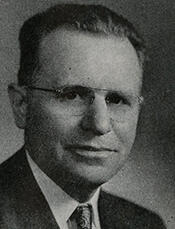
Here you will find contact information for Representative Byron Giles Rogers, including email address, phone number, and mailing address.
| Name | Byron Giles Rogers |
| Position | Representative |
| State | Colorado |
| District | 1 |
| Party | Democratic |
| Status | Former Representative |
| Term Start | January 3, 1951 |
| Term End | January 3, 1971 |
| Terms Served | 10 |
| Born | August 1, 1900 |
| Gender | Male |
| Bioguide ID | R000389 |
About Representative Byron Giles Rogers
Byron Giles Rogers (August 1, 1900 – December 31, 1983) was an American lawyer, politician, and World War I veteran from Colorado who served as a Democratic Representative in the United States House of Representatives from 1951 to 1971. He was born in Greenville, Texas, the son of Peter and Minnie May Rogers. In April 1902 he moved with his parents to Oklahoma, where he attended the public schools of Checotah. During the First World War, Rogers served as a private in the Infantry of the United States Army, an experience that preceded his long career in law and public service.
After the war, Rogers pursued higher education at several institutions. He attended the University of Arkansas in 1918, then studied at the University of Oklahoma from 1919 to 1922. He later moved to Colorado and attended the University of Colorado in 1923 and 1924. Rogers completed his formal legal training at the Sturm College of Law at the University of Denver, where he earned his LL.B. in 1925. Following his admission to the bar, he commenced the practice of law in Las Animas, Colorado, establishing the professional foundation for his subsequent political career.
Rogers quickly became active in local government and legal affairs. He served as city attorney of Las Animas from 1929 to 1933, and in 1933 he also held the position of county attorney of Bent County, Colorado. At the state level, he was elected to the Colorado House of Representatives, serving from 1932 to 1935; during this period he rose to the influential post of speaker of the House in 1933. His expertise in public law brought him to Washington, D.C., where he served on the legal staff of the Agricultural Adjustment Administration and the National Recovery Administration in 1933 and 1934, participating in New Deal–era federal programs during the Great Depression.
Rogers continued to advance in public legal service through the mid-1930s and early 1940s. He served as assistant United States Attorney for Colorado from 1934 to 1936, and then as Attorney General of Colorado from 1936 to 1941. In November 1942 he sought a seat on the Colorado Supreme Court but was defeated by Republican Frank B. Goudy. During World War II, Rogers contributed to the home-front war effort as a public member of the War Labor Board from 1942 to 1945, helping to address labor disputes and economic stabilization issues during the conflict. In his personal life, he married his secretary, Helen Kepler, in 1933; the couple had two children, Shirley Ann and Byron Jr.
In national politics, Rogers became best known for his two decades of service in Congress. A member of the Democratic Party, he was elected to the Eighty-second Congress and to ten succeeding Congresses, serving ten consecutive terms from January 3, 1951, to January 3, 1971, as a Representative from Colorado. His service in Congress occurred during a significant period in American history, encompassing the Cold War, the civil rights movement, and the early years of U.S. involvement in Vietnam. As a member of the House of Representatives, Byron Giles Rogers participated in the democratic process, contributed to the legislative work of the chamber, and represented the interests of his Colorado constituents. Among his recorded votes, he supported major civil rights legislation, including voting in favor of the Civil Rights Act of 1957.
Rogers’s long tenure ended in a closely contested Democratic primary in 1970. That year he was challenged by Craig Barnes, who, along with his supporters, accused Rogers of supporting the Vietnam War. In the primary election Rogers was narrowly defeated by 30 votes, 27,218 to 27,188. Rogers and his supporters alleged that University of Denver students who were non-residents from other states had illegally voted in the primary, but a recount overseen by the U.S. Federal Election Commission did not change the results. The primary was widely regarded as controversial in Denver political circles.
The aftermath of the 1970 primary had significant repercussions in Colorado’s First Congressional District. According to multiple Denver media outlets, following the disputed primary and prior to the general election, approximately 30,000 registered Denver County Democrats rescinded their Democratic Party affiliation. Many of these voters, along with other Rogers supporters who remained on the Denver County Democratic rolls, actively campaigned for the Republican nominee, Denver County District Attorney Mike McKevitt. Their efforts helped elect McKevitt to his only term in Congress by a margin of more than 10,000 votes. In 1972 McKevitt was defeated by Democratic candidate Patricia Schroeder, who went on to hold the First Congressional District seat through her retirement in 1996.
In his later years, Rogers remained a resident of Denver, Colorado. He lived there until his death on December 31, 1983. He was interred in Mount Lindo Cemetery near Tiny Town, Colorado. In recognition of his long public service and his two decades in the House of Representatives, the Byron G. Rogers Federal Building and United States Courthouse in Denver was named in his honor in 1984, commemorating his role in Colorado and national public life.