Representative C. Norris Poulson
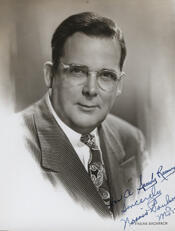
Here you will find contact information for Representative C. Norris Poulson, including email address, phone number, and mailing address.
| Name | C. Norris Poulson |
| Position | Representative |
| State | California |
| District | 24 |
| Party | Republican |
| Status | Former Representative |
| Term Start | January 6, 1943 |
| Term End | January 3, 1955 |
| Terms Served | 5 |
| Born | July 23, 1895 |
| Gender | Male |
| Bioguide ID | P000475 |
About Representative C. Norris Poulson
Charles Norris Poulson (July 23, 1895 – September 25, 1982) was an American politician who represented Southern California in public office at the local, state, and federal levels. A member of the Republican Party, he served as a California State Assemblyman, a United States Representative from California, and the 36th Mayor of Los Angeles. Over the course of his career he became a prominent figure in regional water policy, urban development, and Cold War–era municipal politics.
Poulson was born on July 23, 1895, in Baker County, Oregon, the son of Peter Skovo Poulson (1843–1928), an immigrant from Denmark. He spent his early years in Oregon and attended Oregon State University for two years. On December 25, 1916, he married Erna June Loennig. In 1923, the couple moved to Los Angeles, California, where Poulson began to build the professional and political base that would support his later public career.
After settling in Los Angeles, Poulson pursued training in accounting, becoming a certified public accountant through correspondence courses and night classes at Southwestern Law School, which at that time maintained a business school. His work as an accountant brought him into contact with the city’s growing business community and helped establish his reputation for fiscal competence and administrative skill. These experiences laid the groundwork for his entry into elective office during a period of rapid growth and political change in Southern California.
Poulson’s formal political career began at the state level. In 1938, he was elected to the California State Assembly from the 56th District, representing a portion of Southern California. Building on this experience, he successfully ran for the United States House of Representatives four years later. He was first elected as a Republican to the Seventy-eighth Congress and served as a Representative from California beginning in 1943. Although he lost his seat in the 1944 election, he returned to the United States Congress following the 1946 elections and continued to serve through successive terms until 1955, contributing to the legislative process during five terms in office. During his years as a congressman, Poulson became a leading figure in California’s long-running dispute with Arizona over rights to Colorado River water, and, by the time of his departure from Congress, he was chairman of the House Committee on Interior and Insular Affairs. His congressional service thus coincided with a significant period in American history marked by World War II, the early Cold War, and major developments in Western resource policy, during which he participated in the democratic process and represented the interests of his Southern California constituents.
In 1953, while still a member of Congress, Poulson successfully sought the nonpartisan office of Mayor of Los Angeles, defeating incumbent mayor Fletcher Bowron in a contentious campaign. Bowron charged that the Los Angeles Times, which endorsed Poulson, sought to control city government and would have a “puppet” in the mayor’s office if Poulson were elected. Poulson, in turn, attacked Bowron’s support for large-scale public housing projects, focusing in particular on a proposed development in the Chavez Ravine area of Elysian Park Heights, the site on which Dodger Stadium would later be built. With the backing of the organization Citizens Against Socialist Housing (CASH) and drawing on the anti-communist atmosphere of the early 1950s, Poulson pledged to end support for what he characterized as “un-American” housing projects and promised to dismiss city employees who were communists or who refused to answer questions about their political activities. He took office in 1953 as the 36th Mayor of Los Angeles and served until 1961.
During Poulson’s eight years as mayor, Los Angeles grew to become the third largest city in the United States. His administration was instrumental in major infrastructure and development initiatives, including the construction and expansion of Los Angeles International Airport and the enlargement of the Los Angeles Harbor, both of which strengthened the city’s position as a national and international transportation hub. Poulson is perhaps most widely remembered for leading the effort to bring the Brooklyn Dodgers baseball franchise to Los Angeles, a move that culminated in the construction of Dodger Stadium on the site of Chavez Ravine. This process, often referred to as the Battle of Chavez Ravine, involved the displacement and removal of Hispanic residents from the area and became one of the most controversial episodes of his mayoralty. He also supported measures to integrate the city’s fire and police departments and initiated a municipal garbage recycling program, an innovation that, while forward-looking, proved unpopular and contributed to political opposition that would later factor into his defeat for reelection.
Poulson’s prominence extended beyond Los Angeles city politics. In 1958 and 1959, he served as president of the United States Conference of Mayors, giving him a national platform on urban and intergovernmental issues. One of the most memorable public moments of his mayoral career occurred on September 21, 1959, during the visit of Soviet Premier Nikita Khrushchev to Los Angeles. After Khrushchev repeatedly extolled Soviet superiority during his tour of the city, Poulson publicly responded by invoking the Soviet leader’s earlier phrase, “We will bury you.” Addressing Khrushchev at a public ceremony, Poulson declared, “You shall not bury us and we shall not bury you. We tell you in the friendliest terms possible we are planning no funerals, yours or our own.” The exchange resonated strongly with the American public during the Cold War; Poulson received more than 3,600 letters afterward, many of them praising his remarks.
In 1961, Poulson sought reelection as mayor but was defeated by challenger Sam Yorty. His campaign was hampered by mounting criticism over the financial and political costs associated with the Dodgers’ relocation and stadium construction, as well as by controversy surrounding Chavez Ravine. Efforts to counter these attacks were further limited when Poulson suffered a severe case of laryngitis during the campaign. The illness prevented him from accepting an invitation from local television personality George Putnam to debate Yorty on his show, depriving him of a key opportunity to defend his record before a wide audience. Poulson did not recover his voice in time, and his campaign never fully recovered from this setback.
After leaving office in 1961, Poulson briefly returned to his earlier profession in accounting. In 1962, he retired to La Jolla, in San Diego, California. He remained largely out of public life in his later years, though his legacy in water policy and municipal development continued to shape Southern California. Poulson died on September 25, 1982, at a hospital in Orange, California, following a colostomy operation. His family remained connected to public policy issues; his grandson Norris Brandt became a nationally recognized expert on water policy, reflecting the enduring influence of Poulson’s long engagement with Western water and resource questions.