Representative Caleb Cushing
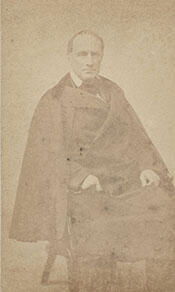
Here you will find contact information for Representative Caleb Cushing, including email address, phone number, and mailing address.
| Name | Caleb Cushing |
| Position | Representative |
| State | Massachusetts |
| District | 3 |
| Party | Whig |
| Status | Former Representative |
| Term Start | December 7, 1835 |
| Term End | March 3, 1843 |
| Terms Served | 4 |
| Born | January 17, 1800 |
| Gender | Male |
| Bioguide ID | C001016 |
About Representative Caleb Cushing
Caleb Cushing (January 17, 1800 – January 2, 1879) was an American Democratic politician, lawyer, author, and diplomat who served as a Member of the U.S. House of Representatives from Massachusetts, the 23rd Attorney General of the United States under President Franklin Pierce, and United States Minister to Spain from 1874 to 1877. A prominent figure in mid‑19th‑century public life, he was an eager proponent of American territorial and commercial expansion and played a central role in shaping U.S. relations with China, Spain, and several Latin American nations. Earlier in his career, he served as a Whig Representative from Massachusetts in the United States Congress from 1835 to 1843, completing four terms in the House of Representatives.
Cushing was born in Salisbury, Massachusetts, on January 17, 1800, the son of John Newmarch Cushing, a wealthy shipbuilder and merchant, and Lydia Dow of Seabrook, New Hampshire. In 1802 the family moved across the Merrimack River to Newburyport, Massachusetts, then a prosperous shipping town whose maritime commerce and civic life strongly influenced his outlook. His mother died when he was about ten years old, an early loss that left a lasting personal impression. Precocious and intellectually gifted, Cushing entered Harvard University at the age of thirteen and graduated in 1817. He remained at Harvard as a teacher of mathematics from 1820 to 1821, then read law and was admitted to practice in the Massachusetts Court of Common Pleas in December 1821. He began practicing law in Newburyport in 1824, where he also attended the First Presbyterian Church. On November 23, 1824, he married Caroline Elizabeth Wilde, daughter of Judge Samuel Sumner Wilde of the Massachusetts Supreme Judicial Court; she died about a decade later, and the marriage produced no children. Cushing never remarried.
Cushing’s public career began in Massachusetts state politics. In 1825 he served as a Democratic‑Republican member of the Massachusetts House of Representatives, entered the Massachusetts Senate in 1826, and returned to the state House in 1828. From 1829 to 1831 he traveled and studied in Europe, broadening his knowledge of international affairs and European politics. After returning to Massachusetts, he again served in the lower house of the state legislature in 1833 and 1834. During this early period he also established himself as a writer and orator, publishing works such as “To the members of the senior class, Harvard University” (1821), “An oration, delivered in Newburyport: on the forty-fifth anniversary of American independence, July 4, 1821,” and the substantial “History and Present State of the Town of Newburyport, Mass.” (1826). These and later addresses—including orations on American independence in 1832 and 1833, and an introductory discourse before the American Institute of Instruction in 1834—helped build his reputation as a learned commentator on American history, politics, and civic life.
In late 1834 Cushing was elected as a Whig to the United States House of Representatives, where he served from March 4, 1835, to March 3, 1843, encompassing the 24th, 25th, 26th, and 27th Congresses. Representing Massachusetts during a significant period in American history, he participated actively in the legislative process and represented the interests of his New England constituents. During the 27th Congress he served as chairman of the House Committee on Foreign Affairs, a position that foreshadowed his later diplomatic career. His congressional record reflected both his Whig affiliations and the marked inconsistency that contemporaries often noted in his public life. When John Tyler, elected as a Whig vice president, assumed the presidency and broke with the Whig Party by vetoing key Whig measures, including a tariff bill that Cushing had supported, Cushing first defended Tyler’s vetoes and then voted again for the same bills. In 1843 President Tyler nominated him three times in one day to be Secretary of the Treasury, but the U.S. Senate rejected him on each occasion; John Canfield Spencer was ultimately confirmed instead. During his House service he also delivered notable speeches, including his 1841 address on the case of Alexander McLeod, and he published works such as “Oration on the Material Growth and Territorial Progress of the United States” (1839) and “Life and Public Services of William H. Harrison” (1840).
After leaving Congress in 1843, Cushing entered national diplomacy. That year President Tyler appointed him commissioner and United States Minister to China, a post he held until March 4, 1845. Intent on impressing the Qing court and securing commercial advantages, he arrived at Macau in February 1844 at the head of a mission that included four American warships and gifts highlighting American scientific and industrial achievements, such as revolvers, a telescope, and an encyclopedia. Facing Chinese reluctance to extend “most favored nation” status beyond Britain, Cushing employed a combination of pressure and persuasion, warning that refusal to receive an American envoy would be a national insult and threatening, against the backdrop of his warships, to seek direct access to the Emperor. The Emperor ultimately dispatched an envoy, and on July 3, 1844, in the village of Wanghia (Wangxia), Cushing concluded the Treaty of Wangxia, the first formal treaty between the United States and China. The treaty granted American merchants trading rights in five Chinese ports, secured most favored nation status, and provided for extraterritoriality for American citizens. The agreement helped spur the rapid growth of American trade with China, carried largely by high‑speed clipper ships transporting high‑value cargoes such as ginseng and silk, and it facilitated the arrival of American Protestant missionaries, even as popular Chinese reaction to foreign presence was often hostile. While in East Asia he was also empowered to negotiate a treaty of navigation and commerce with Japan, though that effort did not bear immediate fruit.
Returning to Massachusetts, Cushing resumed his involvement in state and national affairs. In 1847, while again a representative in the Massachusetts state legislature, he introduced a bill to appropriate funds for equipping a regiment to serve in the Mexican–American War; when the bill failed, he raised the necessary funds privately. He entered the Army as colonel of the 1st Massachusetts Volunteer Regiment on January 15, 1847, and was promoted to brigadier general of volunteers on April 14, 1847. Although he did not see combat, he entered Mexico City with his reserve battalion several months after the city had been pacified and was discharged from the Army on July 20, 1848. The Democratic Party nominated him for Governor of Massachusetts in 1847 and 1848, but he was defeated in both elections. He continued to publish and speak widely, issuing works such as “Reminiscences of Spain” (1833), a two‑volume “Review, historical and political, of the late revolution in France, and of the consequent events in Belgium, Poland, Great Britain, and other parts of Europe” (1833), and a series of public addresses on civic and agricultural topics in the 1850s.
Cushing’s prominence in Massachusetts politics grew in the early 1850s. He served again in the state legislature in 1851, was offered but declined the post of Massachusetts Attorney General that year, and served as mayor of Newburyport in 1851 and 1852. He had earlier written a major history of the town, underscoring his close identification with his home community. In 1852 he became an associate justice of the Massachusetts Supreme Judicial Court, serving until 1853. Under President Franklin Pierce, Cushing entered the federal Cabinet as Attorney General of the United States, serving from March 7, 1853, to March 3, 1857. In that role he provided legal opinions on a wide range of constitutional and administrative questions and supported the Supreme Court’s March 1857 Dred Scott decision, which denied citizenship to African Americans and heightened sectional tensions. He remained active in Massachusetts politics, serving again in the state House of Representatives in 1858, 1859, 1862, and 1863. During this period he also founded the Cushing Land Agency in St. Croix Falls, Wisconsin; the building that housed the agency, later known as the Cushing Land Agency Building, was eventually listed on the National Register of Historic Places. His many speeches from these years included addresses at Faneuil Hall and in Newburyport in 1857, an oration before the Tammany Society in 1858, and a series of Unionist and Democratic campaign speeches in 1859 and 1860.
On the eve of the Civil War, Cushing occupied a pivotal position within the Democratic Party. In 1860 he presided over the Democratic National Convention, which first met at Charleston, South Carolina, and later reconvened at Baltimore, Maryland. When deep divisions over slavery and territorial policy led many Southern delegates to secede from the regular convention, Cushing ultimately joined the seceding group and presided over their separate convention, which nominated John C. Breckinridge for the presidency. Also in 1860 President James Buchanan sent him to Charleston as a confidential commissioner to the secessionists of South Carolina in an effort to avert disunion. Although he had long favored states’ rights and opposed the abolition of slavery, once the Civil War began Cushing supported the Union. After the war, President Andrew Johnson appointed him one of three commissioners charged with revising and codifying the laws of the United States; he served in this capacity from 1866 to 1870, contributing to the systematic organization of federal statutes.
Cushing remained deeply involved in foreign affairs during the Reconstruction era. In 1868, working in concert with the U.S. Minister Resident to Colombia, he was sent to Bogotá to negotiate a right‑of‑way treaty for a ship canal across the Isthmus of Panama, reflecting his long‑standing interest in expanding American commercial reach. He was appointed one of the counsel for the United States before the Geneva Tribunal of Arbitration on the Alabama Claims in 1871–1872, helping to secure a favorable settlement of American claims against Great Britain arising from Confederate commerce raiders built in British shipyards. In 1873 he published “The Treaty of Washington,” an analysis of the diplomatic settlement that had produced the Geneva arbitration. On January 9, 1874, President Ulysses S. Grant nominated Cushing to be Chief Justice of the United States Supreme Court, following the withdrawal of the nomination of George Henry Williams. The nomination surprised many observers, including Cushing himself. Radical Republicans in the Senate questioned his loyalty because of his close personal relationship with Andrew Johnson and alleged pre‑Civil War Copperhead sympathies, and their opposition intensified when a non‑political letter he had written in 1861 to Confederate President Jefferson Davis came to light. Amid mounting controversy, Grant withdrew the nomination on January 13, 1874, and Cushing never joined the Court.
Despite this setback, Cushing continued to serve in high diplomatic office. From January 6, 1874, to April 9, 1877, he was United States Minister to Spain. In Madrid he worked to defuse tensions over the Virginius Affair, a crisis stemming from the capture and execution of Americans and others by Spanish authorities in Cuba, and he proved personally popular in Spanish circles. His broader diplomatic record also included efforts after the Civil War to negotiate a treaty with Colombia for a trans‑oceanic canal right‑of‑way and his earlier advocacy of American expansion into Texas, Oregon, and Cuba. He believed that enlarging the American sphere of influence would fulfill what he called “the great destiny reserved for this exemplar American Republic,” a conviction that informed both his domestic politics and his foreign policy initiatives.
Caleb Cushing died in Newburyport, Massachusetts, on January 2, 1879, and was buried in Highland Cemetery in that town. His name was commemorated during his lifetime by the United States Revenue Cutter Caleb Cushing, which served during the American Civil War and was destroyed by Confederate raiders during the Battle of Portland Harbor on June 27, 1863. Over the course of his long career he left a substantial written legacy, including numerous orations and political tracts such as his addresses on American independence, his 1836 oration before the literary societies of Amherst College, his 1850 addresses at the laying of the Newburyport town hall cornerstone and before the Essex Agricultural Society, his 1859 Unionist speech “The Union and the Constitution” at Faneuil Hall, and his 1860 campaign speech in Bangor, Maine, before the Democracy of that state. Through his legislative service, diplomatic missions, legal work, and prolific writings, he exerted a wide‑ranging influence on American law, politics, and foreign relations in the mid‑19th century.