Representative Caleb Powers
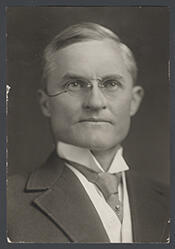
Here you will find contact information for Representative Caleb Powers, including email address, phone number, and mailing address.
| Name | Caleb Powers |
| Position | Representative |
| State | Kentucky |
| District | 11 |
| Party | Republican |
| Status | Former Representative |
| Term Start | April 4, 1911 |
| Term End | March 3, 1919 |
| Terms Served | 4 |
| Born | February 1, 1869 |
| Gender | Male |
| Bioguide ID | P000487 |
About Representative Caleb Powers
Caleb Powers (February 1, 1869 – July 25, 1932) was a United States Representative from Kentucky and a prominent Republican politician who became the first Secretary of State of Kentucky to be convicted as an accessory to murder. He later served four consecutive terms in the U.S. House of Representatives from 1911 to 1919, representing a largely Republican constituency during a period of significant political and social change in the United States.
Powers was born on February 1, 1869, in Whitley County, Kentucky, into a rural Appalachian community whose political and social life was shaped by the aftermath of the Civil War and the rise of partisan factionalism in the state. Raised in modest circumstances, he worked on the family farm in his youth and attended local common schools. His early life in southeastern Kentucky exposed him to the intense political rivalries that would later define his public career and the broader struggle between Democratic and Republican factions in the state.
After his early schooling, Powers pursued higher education and legal training, studying at Union College in Barbourville, Kentucky, and at the University of Kentucky (then State College of Kentucky). He also attended West Point Military Academy for a period, although he did not complete the course there. Powers subsequently studied law, was admitted to the bar, and began practicing as an attorney in Kentucky. His legal training and oratorical skills quickly brought him into Republican Party politics, where he became known as a forceful advocate for his party in a state dominated at the time by Democrats.
Powers’s rise in state politics culminated in his election as Secretary of State of Kentucky, a position he assumed in 1899. His tenure coincided with one of the most turbulent episodes in Kentucky political history: the contested 1899 gubernatorial election and the subsequent assassination of Governor William Goebel in 1900. Powers, a Republican and ally of Republican claimant to the governorship William S. Taylor, was accused of participating in a conspiracy that led to Goebel’s shooting near the State House in Frankfort. He was charged and ultimately became the first Secretary of State of Kentucky convicted as an accessory to murder. Powers was tried multiple times; his convictions and the surrounding proceedings were widely publicized and deeply controversial, with many contemporaries and later commentators regarding him as a political prisoner or the victim of a wrongful conviction. After years of legal battles, he was eventually pardoned by Governor Augustus E. Willson in 1908, a decision that reflected both doubts about the evidence against him and the intense partisan divisions of the era.
Following his release and political rehabilitation, Powers reentered public life and successfully sought national office. A member of the Republican Party, he was elected to the U.S. House of Representatives from Kentucky and served from March 4, 1911, to March 3, 1919, encompassing the Sixty-second through the Sixty-fifth Congresses. During these four terms in office, he contributed to the legislative process and participated in the democratic governance of the nation at a time that included the Progressive Era and the First World War. As a Representative, Powers represented the interests of his Kentucky constituents, aligning with Republican positions on national issues and engaging in debates over economic policy, federal power, and wartime measures, though he never fully escaped the notoriety of the Goebel case that had defined his earlier career.
Powers’s congressional service occurred during a significant period in American history, marked by the presidencies of William Howard Taft and Woodrow Wilson, the expansion of federal regulatory power, and the U.S. entry into World War I in 1917. Within this context, he participated in the work of the House of Representatives as the nation grappled with questions of preparedness, civil liberties, and postwar adjustment. After four terms, he left Congress in 1919 and returned to private life, resuming legal and political activities in Kentucky while remaining a figure of enduring interest because of his role in the state’s most famous political assassination controversy.
In his later years, Powers continued to be associated with debates over the Goebel assassination and the broader question of political violence and justice in Kentucky. His case has been cited in discussions of wrongful convictions in the United States and remains a subject of historical inquiry, as reflected in scholarly works such as R. Elliot’s “Assassination at the State House: The Unsolved Mystery of Kentucky’s Governor Goebel” and in legal and historical collections, including the Caleb Powers papers at the University of Kentucky Libraries Special Collections Research Center. Caleb Powers died on July 25, 1932. His life and career, spanning rural beginnings, high state office, criminal conviction and pardon, and service in the national legislature, left a complex legacy in both Kentucky and American political history.