

On This Page
One’s Struggle is a Shared Struggle
I have a vivid memory of my mother cleaning motel rooms at the L Motel, just off of Milton Road, and south of the railroad tracks, in Flagstaff, Arizona. I was preschool age and Mom couldn’t afford childcare, so I tagged along. That’s when I was first introduced to what working class looks like and gathered how it impacted my mother. Of course, it wasn’t until I was older that I appreciated the broader picture of what that meant to us and everyday Americans who have done the same. However, in these unprecedented times of billionaire-led oligarchy, what that means now is something new altogether.
I grew up watching my mother do whatever she needed to do in order to put herself through nursing school, at the local community college and, eventually, Arizona State University. And boy, was she put through the wringer. Late nights and early mornings studying is something I distinctly recall. She raised me on a shoestring budget where the slightest of misfortunes could have upended it all, and there were moments where that damn near happened. She was told by several, including a college dean, that they don’t graduate many Native American students, implying she would inevitably fail. So, after wiping away a few tears, she reared up and proved otherwise.
Working class is far more than an economic status; it is the untold stories of grit, grind and sacrifice, so loved ones can have a good and safe life. So, families can keep a roof over their heads, sleep safely at night, eat nutritious foods and have a quality education. It’s where one genuinely earns their keep and ensures the next person can achieve the same. It’s where fair exists and where justice can be had. It’s you and it’s me; it is the vast majority of Americans.
It’s been just over a decade now since my mother celebrated retirement from Indian Health Service, a 30-plus year testament of her devotion to family and community and healthy living beyond herself. However, in these very moments, she is deeply worried about her social security, health insurance, retirement and the communities to which she belongs and how they will fare in today’s Trump authoritarian government. Who would have thought she and many people like her would have to stress over what she earned by the sweat of her brow? She shouldn’t, by any means, and she’s not the only one. There are many like her and I won’t stand for it!
Join me as we fight to end authoritarianism, billionaire-led oligarchy and utter disregard for our personal liberties and human rights, our ability to make ends meet and then some and to duly receive that which we’ve rightfully earned, through and through.
Meet Eric
Standing Up for AZ District 2
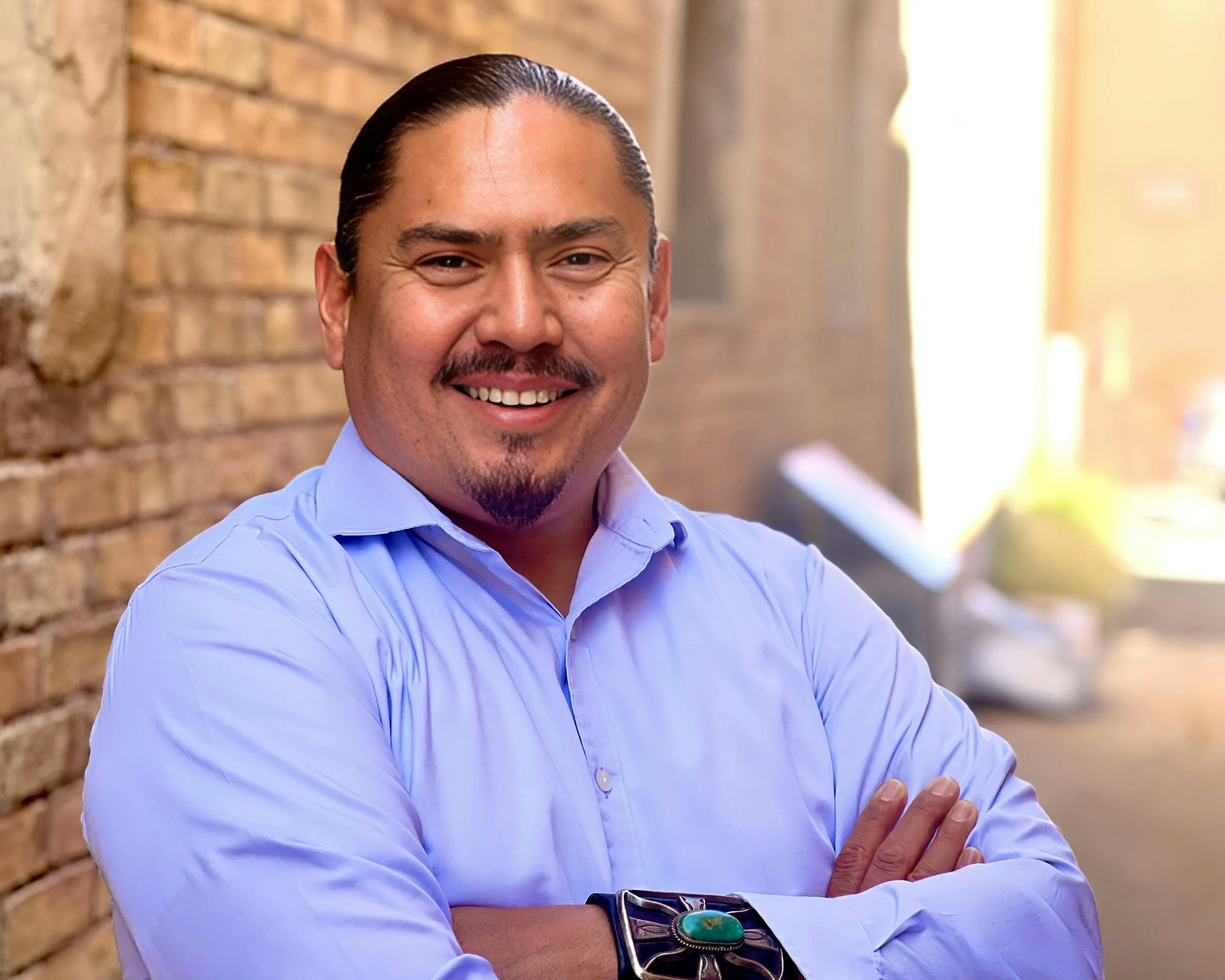
Eric Descheenie is a father, public servant and proud Native of Arizona, running for Congress to fight for dignity, justice and opportunity in every corner of the 2nd District.
He was born in the rural community of Tuba City, Arizona, and raised in the East Valley of the Phoenix Metro Area, where his mother pursued her dream of becoming a nurse. Growing up, Eric was known as the kid who couldn’t get enough of basketball—and never missed a Phoenix Suns game. But even in the city, his family never lost touch with their roots.
Eric is Diné (Navajo), originally from Chinle, Arizona, on the Navajo Nation. Though he didn’t grow up there, his family’s connection to the land runs deep. His mother, grandmother, and generations of women before them were born and raised in Chinle. In Diné knowledge, identity is tied to matrilineal ancestry, place and clan—a living thread that connects past to present.
Eric is Ma’ii deeshgiizhinii (Coyote Pass People Clan), born for Kiyaa’aanii (Towering House Clan). His maternal grandfathers are Bit’ahnii (Within His Cover Clan), and his paternal grandfathers are Honághááhnii (One Who Walks Around Clan).
He attended Arizona State University and earned his degree in Sociology. In 2004, he began his career in public service with the Arizona Governor’s Office of Equal Opportunity. From there, he became Tribal Liaison for the Arizona Department of Housing, managing the Governor’s Tribal Housing Initiative and advocating for Native communities long overlooked by state leadership.
In 2009, Eric and his family moved back to Diné ancestral land—first to Chinle, then to Window Rock—so his sons could grow up grounded in the stories, land and traditions that shaped generations before them. He held leadership roles across the Navajo Nation government, including with the Office of the Speaker and Office of the President and Vice President, and with Navajo County government.
In 2013, Eric and his sons lived in a hooghan—a traditional Diné home with dirt floors, no running water, and, for a time, no electricity. It was one of the most meaningful chapters of their lives. They learned how little you truly need to feel secure, how much a community can offer when systems fall short and why housing, clean water and energy access should never be political. That experience didn’t just shape Eric’s values—it solidified his mission to bring those lessons to Congress and fight for every family still waiting to be seen.
In 2016, Eric was elected to the Arizona House of Representatives, serving from 2017 to 2018. His district included many of the communities now part of Arizona’s 2nd Congressional District. While in office, he became a leading voice for Native rights, education, and sustainable development.
His leadership has reached the global stage. In 2018, he served as a delegate to the United Nations Expert Mechanism on the Rights of Indigenous Peoples in Geneva, Switzerland. In 2019, he spoke at Chiang Mai University in Thailand about how Indigenous Peoples are building inclusive, accountable, and peaceful societies. And in 2023, he joined an international exchange in Victoria, Australia, connecting with Indigenous leaders from across the world to share knowledge on protecting rivers and ancestral lands.
In 2022, inspired by his youngest son trying out for the team, Eric became a basketball coach at Mt. Elden Middle School. Watching his children grow, discover their passions and find their voice remains his greatest pride.
Today, Eric lives in Flagstaff, Arizona, with his three sons—and he’s running for Congress to ensure every child, every family, and every community has the chance to live with dignity, rootedness and hope.
Eric’s message on policy
I agree with Frederick Douglass that “It’s easier to build strong children than to repair broken men”, and it’s essentially why I passed on reelection from the Arizona House of Representatives seven years ago. My sons were in their impressionable years, and I couldn’t miss them. I, like many of you, wanted to ensure my children were ready to enter this world strong and well and make cherished memories to carry through a lifetime. Now, as my sons enter adulthood, I question the world they will find.
The time spent with my children has been beautiful; I am proud. As a single parent, however, I know first-hand the challenges of raising children and finding economic stability in this abandoning, lopsided economy. The greed rooted in our economy robs families’ ability to live even humble dreams and I refuse to accept it, not for others and not for mine. While the billionaire-led oligarchy hold their thumbs on us, they rake in millions to billions of dollars overnight. And that, my friends, doesn’t make me a concerned or disappointed father, it makes me a pissed off father. And we’re doing something about it in this campaign.
Over the last twenty years, I’ve worked among all levels of government – state, tribal, and federal – and with some of the highest elected officials. If there is anything I’ve learned, it is that intentions are everything, and in these moments bad intentions are precisely what we are up against. Even before the insanity of the Trump administration, the United States began as a deeply unjust place. While the U.S. rightfully celebrates remarkable feats, especially over recent generations, and extraordinary innovation since its formation, it must also come to terms with its guilty past. This is a country that, at its founding, treated Indigenous Peoples as savages, protected chattel slavery and treated women as nothing more than a reflection of their husbands and deprived them of equal rights. And many of those earliest intentions didn’t end, they simply transformed, and we don’t have to look any further than today’s draconian policies to know this.
Today, those cruel intentions are directed at: women, in particular their right to autonomous bodily choice; undocumented immigrants; 2SLGBTQIA+ persons; those on the autism spectrum; our differently abled; the genocide of Palestinians; tribal sovereignty and treaties; Indigenous ancestral territories; public lands; scientists; journalists; judges; universities; law firms fighting injustice; public education and more. To rid ourselves of our ills, we must root out the problem, no matter how uncomfortable that may be and no matter how far back we must go.
As a Diné (Navajo) man, I see a different future: one that puts people and decency first and treats our neighbors and families as they should be treated. One that prioritizes basic human rights such as universal healthcare, a livable wage, affordable housing, fully funded public education and adequate and clean drinking water.
The future is now, so far as what is due to those who’ve earned it. The individuals who chose to defend this country in uniform await that which is due, a solemn debt that continues to go fully unpaid. As for Social Security and Medicaid, who would’ve thought we would have to protect our taxpayer funded programs from billionaire oligarchs looking to line their pockets at our expense? We will protect the integrity and viability of these critical government programs that many of us depend on.
The future is now, so far as the climate crisis. Scientists nationally and internationally with overwhelming consensus assert that climate change is real, present and caused by human activity, in particular carbon dioxide emissions via fossil fuels. If we do not significantly curb what is causing climate change, rising global temperature will lead to increasingly intense heatwaves, drought, wildfires and continued sea level rise. Such conditions can lead to severe weather pattern shifts, leading to more intense rainstorms in some areas and drier conditions in others. All of this will severely impact our health, local ecosystems and infrastructure; in other words, our ability to live in peace. We must address these causes head-on as well as prepare adequately to be able to effectively respond to these emergencies.
The future is now, so far as unchecked technological advancements. Experts standing at the intersection of commerce and Artificial Intelligence (AI) point to a fast-approaching economy where many service industry workers and others will be displaced and replaced by AI and robots. This emerging reality is developing so rapidly that we are less than ten years out from having to adjust and respond to its anticipated and unanticipated effects on you, me and our communities. Beyond that, questions as to how such technology will impact environment, personal privacy, national security, small businesses and other areas must also be addressed, now.
The future is now, so far as whether we achieve peace. I stand principally with the formal statement provided by the Elders and Medicine Peoples Council titled “Unite and Work Together for Peace”. We stand on largely unceded ancestral territories of Indigenous Peoples, where they, with their knowledge systems, stand ready to guide and facilitate solutions for a rebalanced place, the spaces from which we all learn, work and play. As the Council stated, “No one can survive without clean Air, clean Water, and a clean Earth. We cannot breathe money; we cannot eat or drink money.” These voices have repeatedly sought a seat at the decision-making table to reestablish such peace and wellness for all, only to be sent to the back of the line or ignored altogether. My policy aims to include their strengths as we collectively problem solve some of our most urgent, shared issues.
The issues are many. I add dire sensible gun safety measures, robust criminal justice reform and small business viability as key areas, and they certainly are, across our district and across the country. Regardless the issue, know that fair, humane and accountable government is crucial to the future we seek, and is central policy priority.
Respectfully,
Eric Descheenie