Representative Cardiss Collins
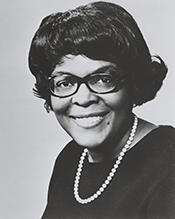
Here you will find contact information for Representative Cardiss Collins, including email address, phone number, and mailing address.
| Name | Cardiss Collins |
| Position | Representative |
| State | Illinois |
| District | 7 |
| Party | Democratic |
| Status | Former Representative |
| Term Start | June 5, 1973 |
| Term End | January 3, 1997 |
| Terms Served | 12 |
| Born | September 24, 1931 |
| Gender | Female |
| Bioguide ID | C000634 |
About Representative Cardiss Collins
Cardiss Hortense Collins (née Robertson; September 24, 1931 – February 3, 2013) was an American politician from Illinois who served as a Representative from Illinois in the United States Congress from 1973 to 1997. A member of the Democratic Party, she was the fourth African-American woman in Congress and the first to represent the Midwest. Over 12 consecutive terms in office, she contributed to the legislative process during a significant period in American history, participating in the democratic process and representing the interests of her constituents in Chicago and its surrounding communities.
Collins was born on September 24, 1931, in St. Louis, Missouri, and later moved to Chicago, Illinois, where she was raised on the city’s West Side. She attended public schools in Chicago and went on to study at Northwestern University, where she took business and accounting courses that prepared her for a career in public administration. Before entering elective office, she worked as an accountant and auditor in various Illinois state government positions, including with the Illinois Department of Revenue and the Illinois Department of Public Aid. This early professional experience in fiscal and administrative matters provided her with a grounding in government operations and public finance that would inform her later legislative work.
Collins married George W. Collins, who became a Democratic member of the U.S. House of Representatives from Illinois. Her path to Congress was shaped by tragedy when her husband died in the crash of United Airlines Flight 553 on December 8, 1972, a month after being elected to a second term in the House. Following his death, she ran in the special election to fill the vacancy. On June 5, 1973, she was elected to the United States House of Representatives. The seat, which had been renumbered and combined from the 6th district to the 7th, had been redrawn to include Chicago’s Loop, reflecting a changing urban constituency. Her election made her the first African-American woman to represent a Midwestern district in Congress.
During her congressional service from June 5, 1973, to January 3, 1997, Collins emerged as a leading advocate for women’s health, consumer protection, and social welfare issues. In 1975, she played a key role in prompting the Social Security Administration to revise Medicare regulations so that post-mastectomy breast prostheses would be covered, reversing the prior practice of treating them as merely cosmetic. She consistently supported efforts to expand access to health care and pressed for universal health insurance. In 1979, she was elected chairwoman of the Congressional Black Caucus, using that position to advance civil rights and economic justice and at times serving as an outspoken critic of certain policies of President Jimmy Carter. She later served as vice chair of the caucus, reinforcing her leadership role among African-American lawmakers.
Throughout the 1980s, Collins solidified her political base in Chicago while facing and overcoming significant primary challenges. She twice defeated Alderman Danny K. Davis in Democratic primaries, maintaining her seat in a district that was both politically competitive and demographically diverse; Davis would later be elected to succeed her after she chose not to seek reelection in 1996. Her legislative interests extended to gender equity in education and athletics, reform of federal child care facilities, and broader consumer protections. In 1990, she joined with 15 other African-American women and men to form African-American Women for Reproductive Freedom, underscoring her support for reproductive rights and her commitment to ensuring that African-American women’s voices were represented in national debates over reproductive health policy.
In 1991, Collins was named chair of the Energy and Commerce Subcommittee on Commerce, Consumer Protection, and Competitiveness, a key post that gave her substantial influence over legislation affecting business practices, consumer rights, and regulatory policy. She gained national prominence in 1993 as chairwoman of a congressional committee investigating college sports, where she became a noted critic of the National Collegiate Athletic Association (NCAA) and pressed for reforms related to the treatment and academic support of student-athletes. That same year, she engaged in a widely noted debate with Representative Henry Hyde over Medicaid funding of abortion, reflecting her strong stance on reproductive freedom and health care access. During her last term in Congress, from 1995 to 1997, she served as the ranking member of the House Government Reform and Oversight Committee, where she helped shape oversight of federal agencies and programs during a period of divided government.
Collins did not seek re-election in 1996, citing her age and a desire to retire from elective office after more than two decades in the House. At the time of her retirement, she was the longest-serving Black female member of Congress, marking a historic tenure that spanned changing political eras from the post–civil rights period through the end of the Cold War and into the 1990s. After leaving Congress, she remained active in public and civic affairs. In 2004, Nielsen Media Research selected her to head an independent task force examining the representation of African Americans in television rating samples, reflecting her longstanding concern with fairness, representation, and equity in national institutions.
In her later years, Collins resided in Alexandria, Virginia. She died there on February 3, 2013, at the age of 81. Her legacy in Illinois is commemorated in part by the United States Postal Service’s Cardiss Collins Processing and Distribution Center, located at 433 W. Harrison Street in Chicago, Illinois. Completed in 1996 to replace the old Main Post Office on Van Buren Street, the facility was named in her honor, recognizing her long service to Chicago and her pioneering role as a Midwestern African-American woman in the United States Congress.