Representative Carl Albert
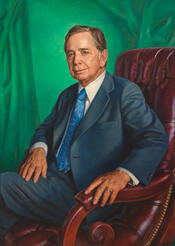
Here you will find contact information for Representative Carl Albert, including email address, phone number, and mailing address.
| Name | Carl Albert |
| Position | Representative |
| State | Oklahoma |
| District | 3 |
| Party | Democratic |
| Status | Former Representative |
| Term Start | January 3, 1947 |
| Term End | January 3, 1977 |
| Terms Served | 15 |
| Born | May 10, 1908 |
| Gender | Male |
| Bioguide ID | A000073 |
About Representative Carl Albert
Carl Bert Albert (May 10, 1908 – February 4, 2000) was an American lawyer and politician who served as the 46th Speaker of the United States House of Representatives from 1971 to 1977 and represented Oklahoma’s 3rd congressional district as a Democrat from 1947 to 1977. A member of the Democratic Party, he contributed to the legislative process during 15 consecutive terms in office, a period that spanned the early Cold War, the civil rights era, the Great Society, and the Watergate crisis. At 5 feet 4 inches (1.63 metres) tall, he was affectionately known as the “Little Giant from Little Dixie,” and he held the highest political office of any Oklahoman in American history.
Albert was born in McAlester, Oklahoma, on May 10, 1908, the son of Leona Ann (Scott) and Ernest Homer Albert, a coal miner and farmer. Shortly after his birth, his family moved to Bugtussle, a small community just north of McAlester, where he grew up in a log cabin on his father’s farm. In high school he excelled in debate, served as student body president, and won the national high school oratorical contest, earning a trip to Europe that broadened his early exposure to international affairs. During this period he was an active member of his local Order of DeMolay chapter and was later inducted into the Order of DeMolay Hall of Fame. He subsequently petitioned his local Masonic lodge and became an active Freemason, laying the foundation for a lifelong association with fraternal organizations.
Albert entered the University of Oklahoma in 1927, majoring in political science. While there he won the National Oratorical Championship in 1928, again receiving an all-expense-paid trip to Europe. He financed much of his education by working in the college registrar’s office and participating in the Reserve Officers’ Training Corps. At Oklahoma he was an accomplished amateur wrestler, a member of the Kappa Alpha Order fraternity, and a member of the RUF/NEKS spirit organization. He graduated Phi Beta Kappa in 1931 as the top male student in his class. Awarded a Rhodes Scholarship, he went on to study at St Peter’s College, University of Oxford, where he received a Bachelor of Arts in jurisprudence and a Bachelor of Civil Laws before returning to the United States in 1934. In 1935 he opened a law practice in Oklahoma City and subsequently worked for a series of oil companies in leasing work, gaining experience in both private practice and the energy industry on the eve of World War II.
Albert joined the United States Army as a private in 1941. He served briefly with the 3rd Armored Division before being commissioned a second lieutenant in the Army Air Forces. On August 20, 1942, while stationed in Columbia, South Carolina, he married Mary Harmon; shortly thereafter he was sent to the South Pacific. The couple had two children, Mary Frances and David. During the war he served in the Judge Advocate General’s Corps as a prosecutor assigned to the Far East Air Service Command. He earned the Bronze Star Medal and other decorations and left active duty with the rank of lieutenant colonel in 1946. He remained in the Army Reserve after the war and retired in 1968 with the rank of colonel. His cousin Charles W. Vursell also served in Congress, representing Illinois from 1943 to 1959, underscoring the family’s broader involvement in national politics.
Albert was first elected to the U.S. House of Representatives in 1946 and took office in January 1947 as the Democratic representative from Oklahoma’s 3rd congressional district, a seat he would hold until his retirement in 1977. His service in Congress occurred during a significant period in American history, encompassing the Truman, Eisenhower, Kennedy, Johnson, Nixon, and Ford administrations. A Cold War liberal, he supported President Harry S. Truman’s policy of containing Soviet expansion and backed domestic initiatives such as public housing, federal aid to education, and farm price supports, reflecting the interests of his largely rural constituency. Speaker Sam Rayburn took note of Albert’s diligence and began inviting him to informal strategy meetings in the Speaker’s office, advising him to seek the chairmanship of the House Agriculture Committee in 1949. Albert was appointed House Majority Whip in 1955 and, following Rayburn’s death, was elected House Majority Leader in 1961. He described himself as a political moderate, stating that he “very much disliked doctrinaire liberals –– they want to own your minds. And I don’t like reactionary conservatives. I like to face issues in terms of conditions and not in terms of someone’s inborn political philosophy.” In recognition of his growing influence, he was inducted into the Oklahoma Hall of Fame in 1957.
As Majority Leader, Albert became a central figure in advancing the Democratic legislative agenda, particularly in health care and social policy. He played a key role in the early congressional strategy for Medicare, initially proposed by the Kennedy Administration as an amendment to the Social Security program. Recognizing that the bill lacked sufficient support in the House due to opposition from Republicans and southern Democrats, he advised President John F. Kennedy to seek Senate passage first and then return the measure to the House as a conference committee report on a broader welfare bill. Although this initial effort failed, Albert used the aftermath of Kennedy’s assassination to press for changes in House rules that strengthened majority control over the Rules Committee and increased majority influence on the Ways and Means Committee. These reforms enabled him to help secure passage of the Medicare program as part of the Social Security Act of 1965 and to shepherd other elements of President Lyndon B. Johnson’s Great Society through the House. On civil rights, Albert did not sign the 1956 Southern Manifesto and voted in favor of the Civil Rights Acts of 1960, 1964, and 1968, the 24th Amendment abolishing the poll tax in federal elections, and the Voting Rights Act of 1965. He voted against the initial House resolution for the Civil Rights Act of 1957 on June 18, 1957, but later supported the Senate amendment to that bill on August 27, 1957. In 1968 he also chaired the tumultuous Democratic National Convention in Chicago, presiding over one of the most chaotic party gatherings in modern history amid widespread protests, urban unrest, and deep divisions over the Vietnam War following the assassinations of Martin Luther King Jr. and Robert F. Kennedy.
When Speaker John W. McCormack retired in January 1971, during the second half of Richard Nixon’s first term, Albert was elected Speaker of the House of Representatives. As Speaker, he presided over the House during the Vietnam War’s final years, the unfolding of the Watergate scandal, and two separate vacancies in the vice presidency. In September 1972 he was involved in a widely reported incident in Washington’s Cleveland Park neighborhood, where he was witnessed driving while intoxicated and crashing into two cars. During the Watergate crisis, Albert referred some two dozen impeachment resolutions against President Nixon to the House Judiciary Committee for consideration. In 1973 he appointed Felda Looper as the first female House page, marking a small but notable step toward gender integration in House operations. That same year, Vice President Spiro Agnew resigned amid charges of tax evasion and money laundering related to bribes he had taken while governor of Maryland, placing Albert, as Speaker, next in the line of presidential succession.
Under the Twenty-fifth Amendment, President Nixon nominated House Minority Leader Gerald R. Ford to succeed Agnew in October 1973. As the Watergate investigation intensified and impeachment became increasingly likely, there was a period of several weeks in which, had Nixon left office before Ford’s confirmation, Albert would have become acting president under the Presidential Succession Act of 1947. As Speaker, he presided over the only chamber empowered to impeach the president and could have delayed or blocked a vote on Ford’s confirmation, thereby positioning himself to assume the presidency. A contingency plan for such a scenario was prepared by presidential adviser Ted Sorensen, outlining the steps Albert would have taken if he became president. Ford was confirmed and sworn in as vice president in December 1973, ending that first period of uncertainty. When Nixon resigned on August 9, 1974, Ford became president and the vice presidency again fell vacant, once more placing Albert next in line. Former New York Governor Nelson Rockefeller was nominated by Ford and confirmed as vice president in December 1974, closing a second interval in which Albert stood one step from the presidency. During his final term as Speaker he was confronted with the Tongsun Park influence-peddling scandal; Albert was accused of accepting gifts and bribes from a lobbyist tied to South Korean intelligence. He denied accepting bribes, acknowledged receiving only token gifts, and disclosed them. He decided to retire at the end of the 94th Congress in January 1977, and after leaving the House he turned the gifts over to the General Services Administration as required by law. He was never charged with any crime.
After leaving Washington, Albert returned to Bugtussle, Oklahoma, declining numerous lucrative corporate offers. He remained engaged in public life through writing, lecturing, and advising. With the assistance of University of Oklahoma professor Danney Goble, he published his memoir, “Little Giant,” with the University of Oklahoma Press in 1990. A New York Times editorial written after his retirement described him as “a conciliator and seeker of consensus, a patient persuader . . . trusted for his fairness and integrity.” He lectured at the University of Oklahoma and delivered speeches throughout the United States and abroad. Several institutions and public facilities were named in his honor, reflecting his stature in Oklahoma and national politics. The Carl Albert Center at the University of Oklahoma in Norman was established in 1979 to study Congress generally and Albert’s life and political career in particular; it houses his congressional papers along with those of Robert S. Kerr, Helen Gahagan Douglas, Millicent Fenwick, Ernest Istook, Fred R. Harris, Percy Gassaway, and others, with holdings extending from the Civil War era to the present but especially rich for the 1930s–1970s. The Carl Albert Indian Health Facility in Ada, part of the Public Health Service and administered by the Chickasaw Nation of Oklahoma, also bears his name. Durant, Oklahoma, named its Carl Albert Park for him, and a monument to Albert stands at his birthplace in McAlester. Educational institutions including Carl B. Albert Middle School and Carl B. Albert High School in Midwest City and Carl Albert State College in Poteau, as well as the Carl Albert Federal Building in McAlester, commemorate his legacy. The University of Oxford established a monument to him in the Eunomia Chambers of the St Peter’s College Law Library, recognizing his achievements as a Rhodes Scholar and statesman.
Carl Albert died in McAlester, Oklahoma, on February 4, 2000, at the age of 91. He is buried in Oak Hill Cemetery in McAlester. He was survived by his wife, Mary Harmon Albert, whom he had married in 1942, and their son and daughter.