Representative Carl Atwood Elliott
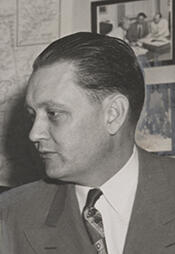
Here you will find contact information for Representative Carl Atwood Elliott, including email address, phone number, and mailing address.
| Name | Carl Atwood Elliott |
| Position | Representative |
| State | Alabama |
| District | At-Large |
| Party | Democratic |
| Status | Former Representative |
| Term Start | January 3, 1949 |
| Term End | January 3, 1965 |
| Terms Served | 8 |
| Born | December 20, 1913 |
| Gender | Male |
| Bioguide ID | E000120 |
About Representative Carl Atwood Elliott
Carl Atwood Elliott (December 20, 1913 – January 9, 1999) was an American lawyer, judge, and Democratic politician who represented Alabama’s 7th congressional district in the United States House of Representatives for eight consecutive terms from 1949 to 1965. Serving during a significant period in mid‑twentieth‑century American history, he played a prominent role in education and library legislation while also participating in the contentious politics of civil rights and Southern resistance to desegregation.
Elliott was born in rural Franklin County in northwest Alabama and grew up in modest circumstances during the years leading into the Great Depression. He graduated at the age of sixteen from Vina High School in Vina, Franklin County. Because of the economic hardships of the era, few expected him to be able to attend college. The University of Alabama, under President George H. Denny, enabled Elliott to enroll by allowing him to work a variety of jobs on campus to pay his expenses. He received his undergraduate degree from the University of Alabama in 1933 and then entered the University of Alabama School of Law in Tuscaloosa. As a law student, he ran for president of the Student Government Association and, with strong support from out‑of‑state students and women, became the first candidate to defeat “the Machine,” the powerful coalition of fraternities and sororities that dominated campus politics. He completed his term as SGA president and graduated with his law degree in 1936.
After earning his law degree, Elliott began practicing law in Russellville, near his Franklin County home, but soon moved to Jasper in Walker County, Alabama, the community that would remain his home for the rest of his life. In Jasper he built a practice largely devoted to representing coal miners and their families, work that reflected and reinforced his political identification with Alabama’s poorest and most disadvantaged citizens. During World War II, he served in the United States Army from 1942 to 1944. Returning to Jasper after his military service, he resumed his legal career and entered local politics. He was twice elected a local judge in Jasper, gaining a reputation as an advocate for working‑class constituents and establishing the public profile that would undergird his later congressional campaigns.
Elliott ran for Congress in 1948, presenting himself to voters with a “Farm Boy to Congress” persona that resonated with the working‑class electorate of his district. In that election he unseated incumbent Representative Carter Manasco, an outcome that surprised many political observers in Alabama. A member of the Democratic Party, he was elected to the U.S. House of Representatives from Alabama’s 7th congressional district and took office in January 1949. Upon his election, Elliott and his wife purchased a residence in Washington, D.C., and for the next sixteen years he commuted regularly between the nation’s capital and Jasper. He would ultimately serve eight consecutive terms, remaining in Congress until January 1965.
During his congressional service, Elliott served on several key House committees, including the Veterans Committee, the Education and Labor Committee, and the powerful Rules Committee. He also chaired the Select Committee for Government Research. He became particularly noted for his work in expanding educational and library services. In 1956, he authored the Library Services Act, which provided federal support for library services in rural areas and brought bookmobiles and continuing library access to millions of Americans who had previously lacked such resources. Two years later, in 1958, he co‑authored the National Defense Education Act (NDEA), landmark legislation enacted in response to the Soviet Union’s early lead in the Space Race after Sputnik. The NDEA strengthened science, foreign language, and technology education nationwide and established low‑interest loans for college and graduate students with financial need. The law was repeatedly extended, and more than 30 million college students across the United States ultimately obtained loans under Elliott’s NDEA provisions.
Elliott’s record on civil rights placed him firmly within the segregationist mainstream of mid‑century Southern politics, even as he pursued progressive policies in education and social welfare. In 1956, he was one of 101 Southern politicians to sign the Southern Manifesto, a document opposing racial integration of public schools and other public places following the Supreme Court’s decision in Brown v. Board of Education. He voted against the Civil Rights Act of 1957 and later opposed the Civil Rights Acts of 1960 and 1964. These positions reflected the prevailing views of many white constituents in his district but increasingly placed him at odds with the national Democratic Party and the evolving direction of federal civil rights policy.
Elliott’s congressional career was also shaped by Alabama’s failure to timely redistrict after the 1960 census reduced the state’s representation from nine to eight House seats. In 1962, primaries were held in all nine existing districts, followed by a statewide runoff to determine which eight nominees would go to Congress. By the time of the 1964 primaries, the legislature still had not enacted a redistricting plan. Elliott defeated future Representative Tom Bevill in the 1964 Democratic primary, but in the subsequent statewide runoff designed to eliminate one sitting member, he was the congressman who lost his seat. His defeat was widely attributed to policy conflicts with Governor George C. Wallace, whose influence in Alabama politics was then at its height. After the runoff, Alabama finally passed a redistricting plan to avoid another statewide general election. In the 1964 general election, Democrat George C. Hawkins, president pro tempore of the Alabama State Senate, lost to Republican James D. Martin in the 7th District. Some Elliott supporters, hoping to create an opening for his return to Congress in 1966, threatened to withhold votes from Hawkins or to support Martin, reasoning that Elliott might have a better chance to reclaim the seat against a Republican in a historically Democratic district.
In 1966, however, Elliott did not run for Congress against Martin, and Martin himself chose not to seek reelection to the House. Instead, both men entered the Alabama gubernatorial race. Elliott joined a crowded Democratic primary field that included Attorney General Richmond Flowers, Sr., and former governors James E. Folsom and John Malcolm Patterson. All four lost the Democratic nomination to Lurleen Burns Wallace, the wife and surrogate candidate of Governor George C. Wallace, who was then barred by term limits from succeeding himself. Lurleen Wallace went on to defeat Martin in the general election. In his gubernatorial campaign, Elliott emphasized federal assistance for the poor, improved education, and racial tolerance, positions that drew fierce opposition from segregationist elements. He endured bomb threats, vandalism of his campaign billboards, and Ku Klux Klan protests at several of his public appearances. The campaign exhausted much of his personal resources, including his congressional pension, and his defeat effectively ended his prospects for high elective office.
After his gubernatorial loss, Elliott slipped into political obscurity and returned full‑time to the practice of law in Jasper. He devoted increasing energy to writing and publishing, producing books on local and regional history, as well as columns and book reviews for area newspapers. His works included five volumes of “Annals of Northwest Alabama,” a history of Red Bay, Alabama, and seven volumes on the history of coal miners in the region, reflecting both his professional background and his longstanding concern for working people. In recognition of his contributions to libraries and literacy, the American Library Association awarded him Honorary Membership in 1982.
In the final decade of his life, Elliott received renewed national attention and recognition. In 1990, he became the first recipient of the John F. Kennedy Profile in Courage Award, presented by the John F. Kennedy Library Foundation, honoring public officials who have demonstrated political courage. The following year, U.S. Representative Charles Weltner of Georgia became the second honoree. Elliott traveled to Boston, Massachusetts, to accept the award from U.S. Senator Edward M. Kennedy, an event he regarded as a vindication of his public service. His autobiography, “The Cost of Courage: The Journey of an American Congressman,” written with journalist Michael D’Orso, was published in 1992 and later reprinted by the University of Alabama Press. The University of Alabama Center for Public Television & Radio produced a one‑hour documentary, “Conscience of a Congressman: The Life and Times of Carl Elliott,” as part of its series The Alabama Experience. Jacqueline Kennedy Onassis, who had known Elliott during her husband’s presidency and served as the editor of his memoirs, viewed the documentary shortly before her death and wrote to Elliott that the power of the program “was going to be in what it does to young people.”
Carl Atwood Elliott died on January 9, 1999. His career left a complex legacy: he was a New Deal–style Democrat who championed education, libraries, and assistance to the poor, while also aligning himself with Southern resistance to federal civil rights legislation. His later recognition, including the Profile in Courage Award and the continued influence of the National Defense Education Act and Library Services Act, underscored the enduring national impact of his work in Congress.