Representative Carl Edgar Mapes
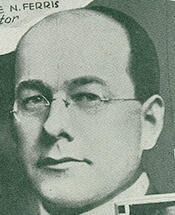
Here you will find contact information for Representative Carl Edgar Mapes, including email address, phone number, and mailing address.
| Name | Carl Edgar Mapes |
| Position | Representative |
| State | Michigan |
| District | 5 |
| Party | Republican |
| Status | Former Representative |
| Term Start | April 7, 1913 |
| Term End | January 3, 1941 |
| Terms Served | 14 |
| Born | December 26, 1874 |
| Gender | Male |
| Bioguide ID | M000119 |
About Representative Carl Edgar Mapes
Carl Edgar Mapes (December 26, 1874 – December 12, 1939) was a Republican politician from the U.S. state of Michigan who served as a Representative in the United States Congress from 1913 to 1941. Over the course of fourteen consecutive terms in the House of Representatives, he contributed to the legislative process during a period that spanned the Progressive Era, World War I, the Roaring Twenties, the Great Depression, and the early years of the New Deal, representing the interests of his constituents in Michigan’s 5th congressional district.
Mapes was born on a farm near Kalamo, Eaton County, Michigan, to Selah W. Mapes and Sarah Ann (Brooks) Mapes. His father, born in New York, came with his parents to Kalamo at the age of seven and became a county district schoolteacher, holding various township offices and taking an active role in local civic affairs. Selah Mapes also served as president of the Barry and Eaton County Farmers Mutual Fire Insurance Company and the Michigan Tornado and Cyclone Insurance Company, reflecting the family’s engagement in both education and agricultural insurance. Sarah Ann Brooks was from Washtenaw County, Michigan, and married Selah Mapes on April 12, 1887. That same year, Selah and Sarah Ann moved to Olivet, Michigan, where the family established its home and where Carl spent much of his youth.
Mapes attended the common schools of Olivet, receiving a basic education that prepared him for higher study. He enrolled at Olivet College, a small liberal arts institution in Olivet, and graduated in 1896. Seeking a career in law, he then attended the law department of the University of Michigan at Ann Arbor, one of the leading law schools in the Midwest, and completed his legal studies in 1899. That same year he was admitted to the bar and commenced the practice of law in Grand Rapids, Kent County, Michigan, beginning a professional path that would lead him into public service and elective office.
Early in his legal career, Mapes entered public life at the county level. In 1901, he was appointed assistant prosecuting attorney of Kent County, a position in which he served until January 1, 1905. His work as a prosecutor brought him into close contact with the administration of justice and local government, and it helped establish his reputation in Grand Rapids and the surrounding area. In 1904, he successfully ran for the Michigan House of Representatives, representing the 1st district of Kent County. He served in the state House beginning in 1905, but was an unsuccessful candidate for renomination in 1906. Undeterred, he remained active in Republican politics, and in 1908 he was elected to the Michigan Senate from the 16th district. He served in the state Senate from 1909 to 1912, gaining further legislative experience and building a political base that would support his later bid for Congress.
In the 1912 election, Mapes challenged and defeated incumbent Democratic U.S. Representative Edwin F. Sweet for Michigan’s 5th congressional district, winning a seat in the 63rd United States Congress as a Republican. He took office on March 4, 1913, and was subsequently re-elected to the thirteen succeeding Congresses, serving continuously until his death in 1939. During his long tenure in the House of Representatives, Mapes participated in debates and votes on major national issues, including American involvement in World War I, Prohibition, economic policy during the 1920s, and federal responses to the Great Depression. In the 66th Congress (1919–1921), he served as chairman of the Committee on the District of Columbia, where he played a role in overseeing legislation affecting the governance and public affairs of the nation’s capital. His extended service made him one of the more senior members of the Michigan delegation and a familiar figure in Republican ranks during a transformative era in American politics.
Mapes’s personal life was centered in Grand Rapids. On August 14, 1907, he married Julia Pike, the daughter of Abram and Eliza (Roberts) Pike of Grand Rapids, a family well known in the community. Carl and Julia Mapes had four children: Robert W. Mapes, John Pike Mapes, Jane Elizabeth Mapes, and Ruth Mapes. The family maintained strong ties to local religious and civic institutions. Mapes belonged to the Park Congregational Church in Grand Rapids, reflecting his involvement in the religious life of the city. He was also active in fraternal organizations, including the Freemasons, the Independent Order of Odd Fellows, and the Woodmen. Within the Masonic fraternity, he was particularly prominent, serving in 1913 as Worshipful Master of York Lodge No. 410 in Grand Rapids, Michigan.
Carl Edgar Mapes’s congressional service continued without interruption until his final days. While still in office, he died on December 12, 1939, in New Orleans, Louisiana, where he had traveled during the course of his duties. His death brought to a close more than a quarter-century of continuous service in the U.S. House of Representatives. He was interred at Oak Hill Cemetery in Grand Rapids, Michigan, returning to the city that had been the center of his legal practice, his family life, and his political base.