Representative Carl May Weideman
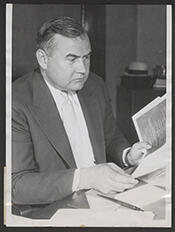
Here you will find contact information for Representative Carl May Weideman, including email address, phone number, and mailing address.
| Name | Carl May Weideman |
| Position | Representative |
| State | Michigan |
| District | 14 |
| Party | Democratic |
| Status | Former Representative |
| Term Start | March 9, 1933 |
| Term End | January 3, 1935 |
| Terms Served | 1 |
| Born | March 5, 1898 |
| Gender | Male |
| Bioguide ID | W000254 |
About Representative Carl May Weideman
Carl May Weideman (March 5, 1898 – March 5, 1972) was a naval officer, attorney, legislator, and jurist from the State of Michigan. Born of German ancestry in Detroit, Wayne County, Michigan, he was educated in the Detroit public schools. He grew up in an urban, industrial environment that would later shape his understanding of the needs and concerns of his constituents in the Detroit area.
Weideman pursued higher education at the University of Michigan in Ann Arbor, which he attended from 1914 until the outbreak of the First World War. With the United States’ increasing involvement in the conflict, he enrolled in the Naval Officers Training School at Ann Arbor and enlisted in the United States Navy as an apprentice seaman. He subsequently served in the United States Naval Reserve from 1918 to 1922, gaining military experience during and immediately after World War I. Following his naval service, he turned to the study of law, attending the Detroit College of Law. He was admitted to the bar in 1920 and received his LL.B. degree in 1921, thereafter commencing the practice of law in Detroit.
As a young attorney, Weideman became active in Democratic Party politics in Michigan. He served as a delegate to the Democratic State conventions from 1932 to 1944, reflecting his growing influence in state political affairs. He was also chosen as a delegate to the 1940 Democratic National Convention, participating in the national party’s deliberations during a critical period marked by the Great Depression and the onset of World War II in Europe.
In 1932, amid the political realignment accompanying the New Deal, Weideman was elected as a Democrat to the United States House of Representatives from Michigan’s newly created 14th congressional district. He served one term in the 73rd Congress from March 4, 1933, to January 3, 1935. As a member of the House of Representatives, Carl May Weideman participated in the democratic process and represented the interests of his constituents during a significant period in American history. A member of the Democratic Party, he contributed to the legislative process during his single term in office. During this tenure, he served on the McCormack–Dickstein Committee, the special House committee that investigated the so‑called “Business Plot,” an alleged conspiracy to overthrow President Franklin Delano Roosevelt. In 1934, he was defeated in the Democratic primary by Louis C. Rabaut, bringing his congressional service to a close after one term.
After leaving Congress, Weideman resumed the practice of law in Detroit, continuing his legal career while remaining a prominent figure in Wayne County public life. He was elected circuit court commissioner of Wayne County in 1936, 1942, and 1948, and served in that capacity from January 1, 1937, to April 30, 1950. His work as circuit court commissioner further established his reputation as a careful and experienced legal practitioner, dealing with a broad range of civil and criminal matters in one of the nation’s largest urban counties.
On May 1, 1950, the day after leaving the office of circuit court commissioner, Weideman assumed the bench as a circuit judge for the Third Judicial Circuit of Michigan, which encompasses Wayne County. He served as a circuit judge from May 1, 1950, until September 15, 1968, presiding over a period of significant social and economic change in metropolitan Detroit. His long judicial tenure capped a public career that had spanned military service, elective office in Congress, and more than three decades on the county and circuit courts.
Outside his professional duties, Carl M. Weideman was a Lutheran and was active in several civic and fraternal organizations, including the American Legion, the Freemasons, and the Independent Order of Odd Fellows. He resided in Grosse Pointe Park, Michigan, during his later years. Weideman died there on his 74th birthday, March 5, 1972. He was interred in Woodlawn Cemetery in Detroit, closing a life marked by service in war, in the halls of Congress, and on the bench of Michigan’s courts.