Representative Carlos French
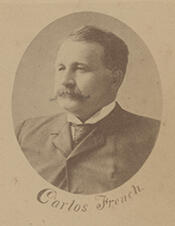
Here you will find contact information for Representative Carlos French, including email address, phone number, and mailing address.
| Name | Carlos French |
| Position | Representative |
| State | Connecticut |
| District | 2 |
| Party | Democratic |
| Status | Former Representative |
| Term Start | December 5, 1887 |
| Term End | March 3, 1889 |
| Terms Served | 1 |
| Born | August 6, 1835 |
| Gender | Male |
| Bioguide ID | F000376 |
About Representative Carlos French
Carlos French (August 6, 1835 – April 14, 1903) was an American businessman and Democratic politician who served one term as a United States Representative from Connecticut from 1887 to 1889. His congressional service took place during a significant period in American history in the late nineteenth century, when industrial growth and political realignment were reshaping the nation, and he represented the interests of his Connecticut constituents in the House of Representatives.
French was born on August 6, 1835, in Humphreysville, Connecticut, a community later renamed Seymour, in New Haven County. He was the son of Raymond French and Olive Curtis French. Raised in a manufacturing region of the Naugatuck Valley, he attended the common schools of Seymour, receiving a basic education that prepared him for both business and public life. He later pursued further studies at General Russell’s Military School in New Haven, Connecticut, an institution that combined academic instruction with military discipline and training.
After completing his education, French engaged in manufacturing, a field in which he would spend the greater part of his life. An inventive industrialist, he is credited with the invention of the spiral steel car spring and the corrugated volute spring, innovations that contributed to advances in railroad and industrial equipment. His business activities expanded over time, and he became a prominent figure in Connecticut’s manufacturing and financial sectors.
French entered public life as a young man. He was elected to the Connecticut House of Representatives in 1860, at the outset of the sectional crisis that preceded the Civil War, and he returned to the state legislature for another term in 1868 during the Reconstruction era. As a member of the Democratic Party, he participated in state-level lawmaking while simultaneously building his business career. His growing prominence in both politics and industry led to further responsibilities within the Democratic Party, and he later served as a member of the Democratic National Committee, helping to shape party affairs at the national level.
In the business sphere, French held a series of important corporate offices. Beginning in 1869, he served as president and treasurer of the Fowler Nail Company, a position he held continuously until his death in 1903. He was also vice president of the H.A. Matthews Manufacturing Company, extending his influence in the regional industrial economy. In addition, he served as a director of the Union Horse Shoe Nail Company of Chicago, Illinois, and held directorships in key financial and transportation institutions, including the Second National Bank of New Haven, the Colonial Trust Company of Waterbury, Connecticut, and the New York, New Haven & Hartford Railroad Company. These roles placed him at the intersection of manufacturing, finance, and transportation during a period of rapid economic expansion.
French’s national political career culminated in his election as a Democrat to the Fiftieth Congress. He represented Connecticut in the United States House of Representatives from March 4, 1887, to March 3, 1889. During this single term in Congress, he contributed to the legislative process and participated in the democratic governance of the country, aligning his work with the interests of his Connecticut constituents and the broader priorities of the Democratic Party. He chose not to be a candidate for renomination in 1888, thereby limiting his congressional service to one term.
After leaving Congress in 1889, French resumed his former manufacturing pursuits and continued to oversee his extensive corporate connections. He remained active in business and civic affairs in Connecticut, maintaining his leadership at the Fowler Nail Company and his various directorships in banking, manufacturing, and railroads. Carlos French died in Seymour, Connecticut, on April 14, 1903. He was interred in Fair Haven Union Cemetery in New Haven, Connecticut, closing a career that combined industrial innovation, corporate leadership, and service in both state and national government.