Representative Carlos J. Moorhead
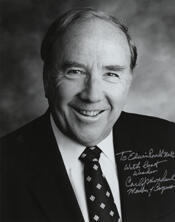
Here you will find contact information for Representative Carlos J. Moorhead, including email address, phone number, and mailing address.
| Name | Carlos J. Moorhead |
| Position | Representative |
| State | California |
| District | 27 |
| Party | Republican |
| Status | Former Representative |
| Term Start | January 3, 1973 |
| Term End | January 3, 1997 |
| Terms Served | 12 |
| Born | May 6, 1922 |
| Gender | Male |
| Bioguide ID | M000926 |
About Representative Carlos J. Moorhead
Carlos John Moorhead (May 5, 1922 – November 23, 2011) was an American lawyer and Republican politician who served twelve terms as a United States Representative from California from 1973 to 1997. Over the course of his long tenure in the House of Representatives, he contributed to the legislative process during a significant period in American history, participating in the democratic process and representing the interests of his constituents in Southern California.
Moorhead was born in Long Beach, California, on May 5, 1922. He was raised in nearby Glendale, where he attended the public schools and graduated from Herbert Hoover High School in 1940. He went on to study at the University of California, Los Angeles, earning a Bachelor of Arts degree in 1943. Following his undergraduate education, he pursued legal studies at the University of Southern California Law School, from which he received a Juris Doctor degree in 1949. His early life and education in the Los Angeles area established the regional ties that would later shape his legal and political career.
During World War II, Moorhead served in the United States Army from 1942 to 1945. He attained the rank of lieutenant colonel, reflecting significant responsibility and leadership during his military service. His wartime experience coincided with his formative years as a young adult and preceded his entry into the legal profession and public life.
After the war, Moorhead was admitted to the California State Bar in 1949 and commenced the practice of law in Glendale. He built a legal career that included admission to practice before the Supreme Court of the United States in 1973. In addition to his private practice, he served as a member of the California Law Revision Commission, contributing to the review and modernization of state statutes. His work as an attorney and legal reformer provided a foundation for his later legislative activities at both the state and federal levels.
Moorhead entered elective office as a member of the California State Assembly, representing the 43rd district from 1967 to 1973. In the Assembly he gained experience in state-level lawmaking and constituent service during a period of rapid growth and change in California. His performance in Sacramento helped establish his reputation within the Republican Party and prepared him for higher office.
In 1972, Moorhead was elected as a Republican to the 93rd Congress and was subsequently reelected to the eleven succeeding Congresses, serving in the U.S. House of Representatives from January 3, 1973, to January 3, 1997. Over these twelve terms, he represented a district centered in the Los Angeles area and participated in major national debates spanning the post–Vietnam War era, the Watergate crisis, the Cold War’s final decades, and the early years of the information age. He was best known for supporting President Richard Nixon during the House Judiciary Committee’s impeachment proceedings, voting “no” on all three articles of impeachment. During his congressional career he was involved in legislative work that reflected his legal background, and he contributed to the broader policymaking process of the House. He chose not to be a candidate for reelection to the 105th Congress, thus concluding his service in Congress in 1997.
In his later years, Moorhead lived in California following his retirement from public office. He died on November 23, 2011, after a long battle with Alzheimer’s disease. His career spanned military service, legal practice, state legislative office, and nearly a quarter century in the United States Congress, marking him as a significant figure in late twentieth-century California and national politics.