Representative Carrie P. Meek
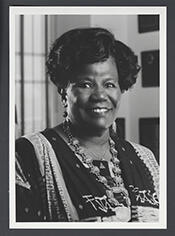
Here you will find contact information for Representative Carrie P. Meek, including email address, phone number, and mailing address.
| Name | Carrie P. Meek |
| Position | Representative |
| State | Florida |
| District | 17 |
| Party | Democratic |
| Status | Former Representative |
| Term Start | January 5, 1993 |
| Term End | January 3, 2003 |
| Terms Served | 5 |
| Born | April 29, 1926 |
| Gender | Female |
| Bioguide ID | M000628 |
About Representative Carrie P. Meek
Carrie Mae Meek (née Pittman; April 29, 1926 – November 28, 2021) was an educator and Democratic legislator who represented Florida’s 17th congressional district in the United States House of Representatives from 1993 to 2003. A pioneering public servant, she was the first African American since the Reconstruction era elected to represent Florida in the United States Congress. Over the course of a public career that spanned more than two decades in the Florida Legislature and a decade in Congress, she became known for her advocacy on behalf of economic development, housing, health care, education, immigrants, and senior citizens, and for her role in founding the Carrie Meek Foundation.
Carrie Mae Pittman was born on April 29, 1926, in Tallahassee, Florida, the youngest of twelve children of Willie and Carrie Pittman. The daughter of sharecroppers and the granddaughter of a slave, she grew up in the segregated South, experiences that shaped her lifelong commitment to civil rights and social justice. She attended Lincoln High School in Tallahassee and went on to remain in north Florida for college, enrolling at Florida A&M University—then known as Florida A&M College for Negroes, a historically Black institution. She graduated in 1946 with a degree in physical education and biology and lettered in track and field. Because African Americans were barred from attending graduate schools in Florida at the time, she enrolled at the University of Michigan, where she earned a Master of Science degree in 1948.
Following her graduate studies, Meek embarked on a career in higher education. She was first hired as a teacher at Bethune-Cookman College, a historically Black college in Daytona Beach, Florida. She later returned to her alma mater, Florida A&M University, as a faculty member. In 1961, she moved to Miami to become a special assistant to the vice president of Miami-Dade Community College. In that role, she played an integral part in the administration of the college during the early 1960s, and her efforts contributed significantly to the desegregation of the institution in 1963. Throughout her years as an educator, she was active in community projects in the Miami area, building relationships and a reputation that would later support her transition into electoral politics.
Meek’s legislative career began after the death of State Representative Gwen Cherry, Florida’s first African American woman legislator, who was killed in a car crash in 1979. Meek ran in the special election to succeed her and was elected to the Florida House of Representatives as a Democrat, serving from 1979 to 1982. During her tenure in the House, she introduced legislation criminalizing stalking and focused on issues affecting working families and underserved communities. In 1982, she successfully ran for a newly drawn Florida Senate seat based in northern Dade County, becoming the first African American woman elected to the Florida Senate. Serving in the Senate from 1982 to 1992, she sat on the education appropriations subcommittee and used her position to influence state spending on schools and colleges. Her legislative efforts also led to the construction of thousands of affordable rental housing units, reflecting her long-standing concern with housing access and urban development.
In 1992, a court-ordered congressional redistricting plan created three Florida districts with substantial African American populations to comply with the federal Voting Rights Act. Meek ran for one of these new seats, the 17th congressional district, centered in northern Dade County. She won the election and entered the U.S. House of Representatives in January 1993, joining Corrine Brown and Alcee Hastings as the first Black members of Congress from Florida since the post–Civil War Reconstruction era. She served five terms in Congress, from 1993 to 2003, representing her constituents as a member of the Democratic Party and participating actively in the legislative process during a significant period in American political history.
Upon taking office in the House of Representatives, Meek immediately confronted the challenge of helping her district recover from the devastation of Hurricane Andrew, which had struck South Florida in 1992. As the only freshman Democrat appointed to the powerful House Appropriations Committee, she played a key role in securing $100 million in federal assistance to rebuild Dade County. During her decade in Congress, she focused on economic development, health care, education, and housing. She led legislation to improve Dade County’s transit system, airport, and seaport; to construct a new family and childcare center in northern Dade County; and to fund advanced aviation training programs at Miami-Dade Community College. She emerged as a strong advocate for Haitian immigrants, pressing for fair treatment and immigration relief, and was also a prominent voice for senior citizens, reflecting the demographic composition and needs of her district.
Meek was deeply engaged with questions of representation and voting rights. She believed that her district had been undercounted in the 1990 Census, which she argued diminished the political power and federal resources due to her constituents. In the aftermath of the closely contested 2000 presidential election, she joined other members of the U.S. House of Representatives in objecting to Florida’s 25 electoral votes, which were awarded to George W. Bush after a contentious recount. Because no U.S. senator joined the objection, it was dismissed during the joint session to certify the Electoral College vote, which was presided over by Vice President Al Gore, Bush’s opponent in the election. Throughout her congressional career, Meek never lost a race for reelection. In 2002, she announced that she would not seek another term, and she retired from the House at the end of her fifth term in January 2003. Her son, Kendrick Meek, ran for and won her vacated seat, continuing the family’s representation of the district in Congress.
In addition to her public service, Meek was active in civic and cultural life. She was a member of Delta Sigma Theta sorority and an honorary member of Iota Phi Lambda sorority. She received honorary degrees from several institutions, including Florida A&M University, the University of Miami, Barry University, Florida Atlantic University, and Rollins College. In recognition of her contributions to education and African American history, the Carrie Meek – James N. Eaton, Sr. Southeastern Regional Black Archives Research Center and Museum on the campus of Florida A&M University in Tallahassee was co-named in her honor.
Meek was married twice, to Lucius Davis and Harold Meek; both marriages ended in divorce. She had three children—two daughters and a son, Kendrick Meek. Known for her liberal views, her folksy yet forceful oratory, and her often colorful criticism of Republican policies, she once summarized her partisan allegiance by remarking, “The last Republican that did something for me was Abraham Lincoln.” In 2001, while still in Congress, she founded the Carrie Meek Foundation to provide resources and opportunities for residents of Miami-Dade County, focusing on education, economic development, and community revitalization. After retiring from elective office, she devoted much of her time to the foundation’s work until stepping down for health reasons in 2015. Carrie Mae Meek died at her home in Miami, Florida, on November 28, 2021, at the age of 95.