Representative Carroll Hubbard Jr.
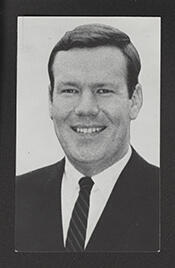
Here you will find contact information for Representative Carroll Hubbard Jr., including email address, phone number, and mailing address.
| Name | Carroll Hubbard Jr. |
| Position | Representative |
| State | Kentucky |
| District | 1 |
| Party | Democratic |
| Status | Former Representative |
| Term Start | January 14, 1975 |
| Term End | January 3, 1993 |
| Terms Served | 9 |
| Born | July 7, 1937 |
| Gender | Male |
| Bioguide ID | H000878 |
About Representative Carroll Hubbard Jr.
Carroll Hubbard Jr. (July 7, 1937 – November 12, 2022) was an American politician and attorney from Kentucky who served nine terms as a Democratic Representative from Kentucky in the United States Congress from 1975 to 1993. Over the course of 18 years in the U.S. House of Representatives, he represented Kentucky’s First Congressional District and became known as an energetic and highly visible advocate for his constituents. In the later years of his life, after his electoral career had ended, he switched his party affiliation from Democrat to Republican.
Hubbard began his political career in the Kentucky Senate, where he established himself in state politics before seeking national office. In May 1974, while serving as a state senator, he challenged and defeated incumbent Congressman Frank Stubblefield in the Democratic primary election for Kentucky’s First District. He went on to win the general election in November 1974 and took his seat in Washington, D.C., in January 1975 as part of the large post-Watergate class of new lawmakers. As one of 75 freshmen members of the 94th Congress, Hubbard was elected president of this freshman class, reflecting the confidence his colleagues placed in his leadership abilities early in his congressional tenure.
During his time in the House of Representatives, Hubbard was repeatedly returned to office by the voters of western Kentucky. He was reelected in 1976, 1978, 1980, 1982, 1984, 1986, 1988, and 1990, serving continuously from January 3, 1975, until January 3, 1993. His congressional service occurred during a significant period in American history, spanning the end of the Vietnam era, the Cold War’s final decade, and the early post–Cold War years. While in Congress, he served on the House Banking, Finance and Urban Affairs Committee and the House Merchant Marine and Fisheries Committee, positions that placed him at the center of legislative work on financial regulation, urban policy, maritime affairs, and fisheries issues. In 1979, while still a sitting member of Congress, Hubbard mounted an unsuccessful primary challenge for Governor of Kentucky, seeking to extend his political influence to the state’s chief executive office.
Hubbard devoted considerable effort to constituent service and maintaining close contact with the people of his district. In addition to his office in the Rayburn House Office Building in Washington, he maintained district offices in Madisonville, Henderson, Hopkinsville, and Paducah, Kentucky. He traveled back to Kentucky from Washington nearly every weekend, participating in hundreds of community meetings and events, delivering numerous speeches, and engaging personally with constituents. In the era before email and social media, he placed great emphasis on written communication, personally signing and sending hundreds of thousands of letters, newsletters, calendars, and Christmas cards to citizens throughout western Kentucky, reflecting a traditional, hands-on approach to representation.
Hubbard’s congressional career also intersected with significant international events. In 1983, he was invited to South Korea to attend a celebration of the 30th anniversary of the United States–South Korea Mutual Defense Treaty, traveling with three fellow members of Congress, including Representative Larry McDonald and Senator Jesse Helms. Hubbard and Helms planned to meet McDonald to discuss joining him on Korean Air Lines Flight 007. As delays mounted, however, Hubbard at the last minute canceled his reservations and accepted a speaking engagement in Kentucky instead of boarding the flight. KAL Flight 007 was later shot down by the Soviet Union, killing all passengers and crew, an incident that underscored the narrowness of Hubbard’s escape from the tragedy.
Despite his long record of service, Hubbard’s congressional career ended amid controversy. He became embroiled in the House banking scandal, a controversy in the early 1990s involving the House of Representatives’ bank and the handling of members’ overdrafts. The scandal damaged his political standing, and he was defeated for reelection in 1992, bringing his 18-year tenure in Congress to a close in January 1993. Legal consequences followed, and he ultimately spent two years in prison, a dramatic reversal for a once-prominent and long-serving member of the House.
Following his release from prison, Hubbard sought to reenter public life and revive his political career at the state level. Remaining active in Kentucky politics, he ran unsuccessfully for the Kentucky General Assembly on four occasions, demonstrating his continued interest in legislative service and public affairs even after his congressional defeat and legal troubles. Although he had been a Democrat throughout his years in elected office, in the last years of his life he changed his party affiliation to Republican, reflecting a personal and political realignment late in his career. Hubbard died on November 12, 2022, closing a life marked by notable achievement in public office, intense engagement with his constituents, and significant controversy.