Representative Cass Ballenger
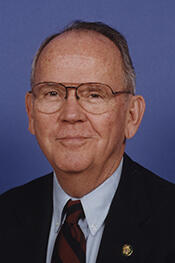
Here you will find contact information for Representative Cass Ballenger, including email address, phone number, and mailing address.
| Name | Cass Ballenger |
| Position | Representative |
| State | North Carolina |
| District | 10 |
| Party | Republican |
| Status | Former Representative |
| Term Start | January 3, 1985 |
| Term End | January 3, 2005 |
| Terms Served | 10 |
| Born | December 6, 1926 |
| Gender | Male |
| Bioguide ID | B000104 |
About Representative Cass Ballenger
Thomas Cass Ballenger (December 6, 1926 – February 18, 2015) was an American politician and businessman who represented North Carolina’s 10th congressional district in the United States House of Representatives from 1986 to 2005. A member of the Republican Party, he served 10 consecutive terms in Congress, representing a district centered in the foothills of North Carolina and contributing actively to the legislative process during a significant period in modern American history. Over 38 consecutive years in elective office at the local, state, and federal levels, Ballenger never lost an election.
Ballenger was born on December 6, 1926, and was the great-great-grandson of Lewis Cass, a former U.S. senator, Secretary of State, and the Democratic presidential nominee in 1848. After graduating from Episcopal High School, he attended the University of North Carolina and later completed a liberal arts degree at Amherst College in Amherst, Massachusetts, where he was initiated into the Delta Kappa Epsilon (DKE) fraternity. During World War II, he served in the U.S. Naval Air Corps. A committed Episcopalian, he later volunteered as a lay reader for the Episcopal Diocese of Western North Carolina, traveling to lead services in parishes without rectors, and was a longtime active member of the Episcopal Church of the Ascension in Hickory, North Carolina.
In addition to his public service, Ballenger built a substantial career in business. He was the founder and former chairman of the board of Plastic Packaging, Inc., a manufacturing company with plants in Hickory and Forest City, North Carolina. His business background informed his later reputation in Congress as an expert on business and workforce issues. At the local level, he entered public life as a member of the Catawba County Board of Commissioners, serving from 1966 to 1974. During his two terms as a county commissioner, Catawba Memorial Hospital (now Catawba Valley Medical Center) and Catawba Valley Community College (formerly Catawba Valley Technical Institute) were established. He was recognized as North Carolina’s County Commissioner of the Year in 1974 and served as chairman of the Catawba County Board of Commissioners. He was also at one time chairman of the Catawba County Republican Party.
Ballenger’s state legislative career began in the North Carolina House of Representatives, where he served from 1975 to 1977, followed by service in the North Carolina Senate from 1977 to 1986, including a period as Minority Leader. In the Senate he introduced the Government in the Sunshine Act of 1976, the first substantive open meetings law enacted in North Carolina, which increased transparency in state and local government. He also authored legislation known as the “Ridge Law” to protect scenic vistas in the North Carolina mountains. His effectiveness as a legislator was recognized in 1981 when the North Carolina Institute of Government named him the Most Effective Republican Legislator. Beyond the legislature, he was a co-founder and former chairman of the North Carolina Legislative Forum and participated in statewide Republican politics, including service on the Jim Martin for Governor Steering Committee and as Western Co-Chairman of the North Carolina Reagan–Bush Campaign in 1984.
Elected to the U.S. House of Representatives in a 1986 special election, Ballenger represented North Carolina’s 10th congressional district until his retirement in 2004, with his service formally concluding in January 2005. During his time in Congress, he was a member of the Republican leadership, serving as a deputy whip and as a member of the House Steering Committee. He served on the Committee on Education and the Workforce and chaired the House Subcommittee on Workforce Protections. In that role, he authored landmark legislation to reform the Occupational Safety and Health Administration (OSHA), making the agency less adversarial and more collaborative while maintaining strong worker safety protections; this measure constituted the first major legislative revision to OSHA workplace rules since the agency’s creation. He also authored legislation to make the use of hypodermic needles safer for healthcare workers and sponsored a bill to designate Wilson Creek in Caldwell County as a Wild and Scenic River.
Ballenger’s congressional work extended to infrastructure, regional development, and foreign affairs. He secured major federal funding for the completion of U.S. Highway 321 between Hickory and Gastonia and helped establish the Future Forward Economic Alliance, a regional economic development initiative serving 11 counties in western North Carolina. Through Future Forward, he led efforts to secure funding for the North Carolina Center for Engineering Technologies in Hickory and was instrumental in the creation of the Hickory Metro Higher Education Center, now the Appalachian State University Center at Hickory. On the international stage, he served on the House International Relations Committee and chaired its Western Hemisphere Subcommittee, where he focused on promoting democracy and human rights, combating poverty, and improving relations with developing countries in Central and South America. He became known in Congress as a leading Republican voice on business issues and foreign affairs, particularly regarding Central and South America.
Ballenger placed a strong emphasis on constituent service throughout his congressional tenure. He developed A Comprehensive Guide to Constituent Service, a benchmark publication that has continued to be updated for each new Congress and used to train new congressional staff members. His approach to representing his district underscored his commitment to the practical needs of his constituents as well as broader policy concerns. After nearly two decades in the House, he retired in 2004 and was succeeded by Republican Patrick McHenry, then a one-term member of the North Carolina House of Representatives.
Beyond elective office, Ballenger was deeply involved in philanthropy and community organizations. In 1990, he and his wife Donna founded the Ballenger Foundation to continue their longstanding charitable work in Central America, which had begun after the devastating 1972 earthquake in Managua, Nicaragua. Through the foundation, they established medical clinics in high-poverty areas, sponsored an orphanage, provided school furniture and textbooks, and delivered other relief supplies over many years. In his home community, he co-founded the Community Ridge Day Care Center in Hickory and served as chairman of the Greater Hickory United Fund and board chairman of the Western Piedmont Council of Governments. He was a director of the Greater Hickory Chamber of Commerce and a sustaining member or patron of several cultural institutions, including the North Carolina School of the Arts, the North Carolina Symphony, and the North Carolina Arts Society. He also served on the board of development and board of directors at Lenoir-Rhyne College, on the board of directors for the Salvation Army, and on the board of trustees for the Florence Crittenton Home.
Thomas Cass Ballenger died on February 18, 2015, at the age of 88. His long career in business, local and state government, and nearly two decades in the U.S. House of Representatives left a lasting imprint on North Carolina’s political, economic, and civic life, particularly in the foothills region he represented.