Representative Cassius Clay Dowell
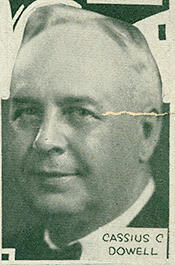
Here you will find contact information for Representative Cassius Clay Dowell, including email address, phone number, and mailing address.
| Name | Cassius Clay Dowell |
| Position | Representative |
| State | Iowa |
| District | 6 |
| Party | Republican |
| Status | Former Representative |
| Term Start | December 6, 1915 |
| Term End | January 3, 1941 |
| Terms Served | 12 |
| Born | February 29, 1864 |
| Gender | Male |
| Bioguide ID | D000468 |
About Representative Cassius Clay Dowell
Cassius Clay Dowell (February 29, 1864 – February 4, 1940) was a Republican U.S. Representative from Iowa who served twelve terms in the United States Congress between 1915 and 1940. Over the course of his long tenure, he represented Iowa during a period of profound national change, including World War I, the Roaring Twenties, the onset of the Great Depression, and the New Deal era. A member of the Republican Party, he contributed to the legislative process over more than two decades in the House of Representatives, participating in the democratic process and representing the interests of his constituents in central Iowa.
Dowell was born on a farm near the unincorporated town of Summerset, in Warren County, Iowa, near Indianola. He attended local public schools before pursuing higher education at Baptist College in Des Moines, Iowa, and Simpson College in Indianola. He then enrolled at Drake University in Des Moines, graduating from its liberal arts department in 1886. Demonstrating an early interest in the law and public affairs, he continued at Drake University Law School, from which he graduated in 1887. The following year, in 1888, he was admitted to the bar and commenced the practice of law in Des Moines, establishing the professional foundation that would support his later political career.
Dowell entered public service at the state level before his election to Congress. From 1894 to 1898, he served as a member of the Iowa House of Representatives, where he began to build a reputation as a careful and influential legislator. He then advanced to the Iowa State Senate, serving from 1902 to 1912. During these years in the state legislature, he gained extensive experience in lawmaking and constituent service, and he became well known in Iowa Republican circles. His work in Des Moines and at the state capitol helped position him for a successful bid for national office.
In 1914, Dowell was elected as a Republican to the U.S. House of Representatives from Iowa’s 7th congressional district, beginning his first period of congressional service on March 4, 1915, in the Sixty-fourth Congress. He was re-elected eight times to represent the 7th district, serving in the Sixty-fourth and the nine succeeding Congresses through January 3, 1935. During this time, he held important committee assignments, serving as chairman of the Committee on Elections in the Sixty-sixth and Sixty-seventh Congresses and as chairman of the Committee on Roads in the Sixty-eighth through Seventy-first Congresses. His committee work placed him at the center of issues involving electoral disputes and the development of the nation’s transportation infrastructure, and he became recognized for his steady influence rather than frequent participation in floor debate.
Following the reapportionment that occurred between 1930 and 1932, Dowell’s home county was moved from Iowa’s 7th to Iowa’s 6th congressional district. Adapting to the new political landscape, he ran for and won the seat in the 6th district in 1932, prevailing by more than 13,000 votes despite the national Democratic landslide that accompanied Franklin D. Roosevelt’s election to the presidency. This victory extended his continuous service in Congress to nearly twenty years. However, in 1934 he was defeated in his campaign for reelection by former Iowa Supreme Court Justice Hubert Utterback, who unseated him by more than 4,000 votes. This unsuccessful 1934 campaign created an interregnum in his congressional career between 1935 and 1937.
After leaving Congress in 1935, Dowell returned to Des Moines to resume the practice of law. He remained active in public affairs and the Republican Party, and in 1936 he successfully reclaimed his former House seat when Hubert Utterback chose to run unsuccessfully for the U.S. Senate. Dowell thus began his second period of congressional service in 1937, again representing Iowa in the House of Representatives. In 1938, when Utterback attempted to regain the House seat, Dowell defeated him decisively, reaffirming his political strength in the district. During these later years in Congress, he continued to focus on legislative matters important to his constituents and to the state of Iowa, including infrastructure, veterans’ affairs, and federal investment in the region.
Throughout his long tenure in Congress, Dowell was known more for his behind-the-scenes effectiveness than for frequent speeches on the House floor. An Iowa newspaper, reporting on his death, observed that “only rarely did he participate in house debate but his influence upon legislation was strong.” He was credited with being instrumental in securing veterans’ hospitals for Des Moines and Knoxville, Iowa, in the establishment of Camp Dodge near Des Moines during wartime, and in obtaining an $800,000 federal building on Des Moines’ waterfront. These projects reflected his focus on tangible benefits for his district and his ability to navigate the federal appropriations and legislative processes to advance local and state interests.
Cassius Clay Dowell filed for reelection in the 1940 congressional race, intending to continue his service, but he died of heart disease in Washington, D.C., on February 4, 1940, while still in office. He was interred in Glendale Cemetery in Des Moines, Iowa, returning to the city where he had built his legal and political career. Following his death, Republican Robert K. Goodwin won the special election to complete Dowell’s unexpired term, and Republican Paul Cunningham won the 1940 general election for a full term. Dowell’s congressional service, spanning from 1915 to 1935 and from 1937 until his death in 1940, secured his place among the long-serving members of the House of Representatives from Iowa during the first half of the twentieth century.