Representative Cave Johnson
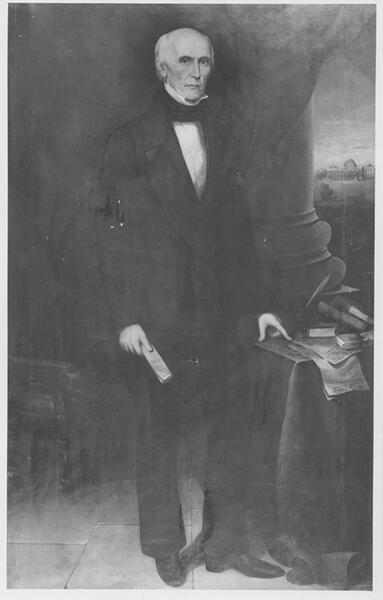
Here you will find contact information for Representative Cave Johnson, including email address, phone number, and mailing address.
| Name | Cave Johnson |
| Position | Representative |
| State | Tennessee |
| District | 9 |
| Party | Democratic |
| Status | Former Representative |
| Term Start | December 7, 1829 |
| Term End | March 3, 1845 |
| Terms Served | 7 |
| Born | January 11, 1793 |
| Gender | Male |
| Bioguide ID | J000122 |
About Representative Cave Johnson
Cave Johnson (January 11, 1793 – November 23, 1866) was an American politician who served the state of Tennessee as a Democratic congressman in the United States House of Representatives and later as the 12th United States Postmaster General in the administration of President James K. Polk from 1845 to 1849. He was born near present-day Springfield, Tennessee, to Robert and Mary Noel Johnson. He was named for the Rev. Richard Cave, a Baptist minister in the Travelling Church with whom his maternal grandmother, also named Mary Noel, had been acquainted in Kentucky. Johnson suspected, but could never prove, a relation to William Cave Johnson of Boone County, Kentucky.
Johnson pursued his early education in Tennessee and was studying at Cumberland College when the War of 1812 began. He organized a band of volunteers for service, but the unit was declined by General Andrew Jackson. In 1813 he joined his father’s militia unit in the Creek War, serving in that campaign before returning to Nashville the following year. There he completed his legal studies in the law firm of Parry Wayne Humphreys, preparing for a career at the bar. Johnson proposed marriage to Elizabeth Dortch in 1815, but she rejected him for another suitor, an embarrassment that reportedly discouraged him from courting again for more than twenty years.
After his admission to the bar, Johnson settled in Clarksville, Tennessee, where he established a law practice and became active in local affairs. He served on Clarksville’s first board of aldermen, reflecting his early engagement in municipal governance. By the time of his first election to Congress in 1829, he owned an iron factory that employed both free and enslaved Black workers. His ownership of this enterprise and his views on slavery shaped his political outlook. Johnson advocated legal protection of slavery under the federal Constitution, believing that such guarantees would prevent “moderate” southerners from being overwhelmed by more radical secessionist “Fire-Eaters.”
Johnson served as a Representative from Tennessee in the United States Congress from 1829 to 1845, holding office for seven terms as a member of the Democratic Party. During this significant period in American history, encompassing the Jacksonian era and the early 1840s, he participated in the legislative process and represented the interests of his Tennessee constituents in the House of Representatives. Among the notable issues that came before Congress during his tenure was Samuel Morse’s proposal for federal funding of the Baltimore–Washington telegraph line. Johnson initially mocked the proposal by introducing a rider to fund research into animal magnetism, reflecting skepticism about the new technology. After the telegraph line was successfully demonstrated, however, he publicly apologized to Morse and described the telegraph as an “astonishing invention.”
Johnson played an important role in national Democratic politics in the 1840s. He acted as a campaign manager for James K. Polk’s presidential bid, working both at the Democratic Party convention and during the general election campaign. Following Polk’s victory in 1844, Johnson was appointed Postmaster General and served in that cabinet position for the entirety of Polk’s administration from 1845 to 1849. As Postmaster General, he oversaw a major administrative shift in the Post Office Department from a collect-on-delivery system to a prepaid system, most notably through the introduction of the adhesive postage stamp in 1847. His responsibilities also included supervision of the federally funded Baltimore–Washington telegraph line. Johnson struggled to make this line profitable as competing private telegraph companies expanded, and he urged that telegraph lines not be left entirely in unregulated private hands. He warned that such a situation could undermine the Post Office while enriching those with preferential access to information, but his fellow Democrats were largely unreceptive to his proposals for greater federal oversight.
After leaving the Polk administration, Johnson continued his public and business career in Tennessee. He served as a state circuit court judge, further drawing on his legal background, and later became president of the Third Bank of Tennessee, a position he held from 1854 to 1860. During the secession crisis that preceded the Civil War, Johnson joined the short-lived Union Party in Tennessee, which sought to keep the state loyal to the federal government. He participated in drafting an address urging Tennessee to remain in the Union while at the same time refusing to support coercive measures against the seceding Southern states. When this effort failed and Tennessee joined the Confederacy, Johnson ultimately sided with the Confederacy, though he took no personal part in the fighting during the war.
The war nevertheless touched Johnson’s community and public role. After the Battle of Fort Donelson in February 1862 brought Clarksville under Union control, Johnson was one of three local spokesmen who greeted the administering Union officer, reflecting his continued prominence in local affairs despite the shifting political landscape. In 1866, during the early phase of Reconstruction, he was elected to the Tennessee state Senate. However, allies of Republican Governor William G. Brownlow refused to seat him, illustrating the intense partisan and sectional conflicts of the period.
In his personal life, Johnson renewed his earlier connection with Elizabeth Dortch. More than two decades after his first, unsuccessful proposal, he again proposed marriage to her in 1838, by which time she had been widowed. She accepted, and the couple had three sons. Johnson was also the maternal uncle of Lieutenant Colonel Cave Johnson Couts of California, extending his family’s prominence beyond Tennessee. Cave Johnson died in Tennessee on November 23, 1866, closing a career that had spanned local office in Clarksville, seven terms in the U.S. House of Representatives, and service as Postmaster General during a pivotal presidential administration.