Representative Cecil Murray Harden
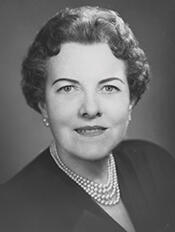
Here you will find contact information for Representative Cecil Murray Harden, including email address, phone number, and mailing address.
| Name | Cecil Murray Harden |
| Position | Representative |
| State | Indiana |
| District | 6 |
| Party | Republican |
| Status | Former Representative |
| Term Start | January 3, 1949 |
| Term End | January 3, 1959 |
| Terms Served | 5 |
| Born | November 21, 1894 |
| Gender | Female |
| Bioguide ID | H000182 |
About Representative Cecil Murray Harden
Cecil Murray Harden (November 21, 1894 – December 5, 1984) was an American educator, Republican politician, and prominent advocate of women’s rights who represented Indiana’s 6th congressional district in the United States House of Representatives for five consecutive terms from January 3, 1949, to January 3, 1959. A member of the Republican Party, she was the only Republican woman elected to represent Indiana in the U.S. Congress until 2012 and played an active role in national party affairs and in shaping legislation affecting civil rights, government operations, and women’s economic equality.
Harden was born Cecil Murray on November 21, 1894, in Covington, Fountain County, Indiana, to Jennie (Clotfelter) Murray and Timothy J. Murray. Her father worked as a real estate broker and was a longtime leader of the local Democratic Party, a background that contrasted with his daughter’s later Republican affiliation. She attended local public schools and graduated from Covington High School in 1912. Murray enrolled at Indiana University in Bloomington, Indiana, but left before completing her degree to become a teacher in the Troy Township schools and later in her hometown of Covington, beginning a career in education that preceded her entry into politics.
On December 22, 1914, she married Frost Revere Harden, who eventually became an automobile dealer in Covington. The couple had one child, a son, Murray Harden (1915–1989), who became a physician in Lafayette, Indiana. Despite her father’s Democratic leadership, Cecil Harden aligned herself with the Republican Party. Her interest in politics deepened in 1931 when President Herbert Hoover appointed her husband as Covington’s postmaster, and intensified in 1933 when President Franklin D. Roosevelt, a Democrat, replaced her husband with a Democratic appointee. This experience helped spur her own political activism and solidified her commitment to Republican causes.
Harden formally entered politics in 1932 as the Republican precinct vice chairman, a position she held until 1940. She became vice chairman of the Fountain County Republican Party in 1938, serving in that role until 1950, and also served as vice chair of a Republican congressional district organization. In 1940 she joined the Republican National Speakers Bureau, gaining experience as a party spokesperson. Her influence within the party expanded when she was elected Indiana’s Republican National Committeewoman in 1944, a post she held until 1959 and then again from 1964 to 1972. She was a delegate-at-large to the Republican National Conventions in 1948, 1952, 1956, and 1968, and later again in 1972, reflecting her longstanding role in national party leadership and strategy.
In 1948, when Indiana Republican Representative Noble J. Johnson resigned from Congress to accept a federal judgeship, Harden sought and won the Republican nomination to succeed him in the U.S. House of Representatives. In her first bid for elective office, she narrowly defeated Democrat John James (Jack J.) O’Grady, a U.S. Army veteran and former member of both houses of the Indiana legislature from Vigo County, by a margin of only 483 votes out of approximately 132,000 cast. Harden was elected to the 81st Congress and to the four succeeding Congresses, serving from January 3, 1949, to January 3, 1959, as the representative of Indiana’s 6th congressional district. Her decade in Congress coincided with a significant period in American history marked by the early Cold War, the Korean War, and the beginnings of the modern civil rights movement. During this time she participated actively in the legislative process, representing the interests of her Indiana constituents while aligning her political priorities closely with the Republican administrations of the era, particularly that of President Dwight D. Eisenhower.
During her first term in the House, beginning in 1949, Harden was assigned to the Veterans’ Affairs Committee. In the following Congress she transferred to the House Committee on Expenditures in Executive Departments, later known as the Committee on Government Operations. In the 83rd Congress she chaired the Inter-Governmental Relations Subcommittee of Government Operations, where she examined relationships among federal, state, and local governments and worked on issues of administrative efficiency. She also served for six years, from 1953 to 1959, on the Committee on the Post Office and Civil Service. In these roles she toured military installations to evaluate procurement procedures and sought ways to improve efficiency and reduce costs. Under the Eisenhower administration she urged military and other government offices to consider contracting with private companies for certain functions as a means of cutting government expenditures. Harden also supported civil rights legislation, voting in favor of the Civil Rights Act of 1957, the first federal civil rights law enacted since Reconstruction.
An advocate for women’s rights throughout her congressional career, Harden worked with other prominent Republican women in Congress to advance issues of particular concern to women. She joined with Senator Margaret Chase Smith of Maine and Representative Frances Bolton of Ohio in pressing the Republican Party to adopt platform planks addressing women’s interests and participation in public life. In 1957 she and Representative Florence Dwyer of New Jersey introduced a bill to provide equal pay for women, reflecting her commitment to economic equality and fair employment practices. For her Indiana constituents, Harden focused on practical concerns such as infrastructure and employment. She promoted flood control projects in the Wabash River valley and helped secure federal funding for flood control measures in her state. She was critical of the U.S. Atomic Energy Commission’s 1956 plan to close its heavy water plant in Dana, Indiana, located in her district, warning that the closure would result in the loss of approximately 900 jobs.
Harden’s close identification with the Eisenhower administration and the national Republican Party did not shield her from the broader political currents of the late 1950s. In the 1958 elections, amid a national recession that adversely affected industrial employment in places such as Terre Haute, Indiana, she lost her bid for a sixth term in Congress to Democrat Fred Wampler, a Terre Haute high school football coach, by a margin of slightly more than two percent of the vote. Her defeat was part of a larger setback for Republicans that year, when the party lost forty-seven seats in the House of Representatives, including seven of Indiana’s Republican incumbents. Harden’s congressional service concluded on January 3, 1959, but she chose to remain in Washington, D.C., where she continued her public service in the federal government.
In March 1959, two months after leaving Congress, Harden was appointed special assistant for women’s affairs to U.S. Postmaster General Arthur Summerfield. In this capacity she advised on issues affecting women employees and helped shape policies within the Post Office Department until March 1961, when the incoming Democratic administration of President John F. Kennedy replaced the Eisenhower administration. Harden resumed an active role in Republican politics in the 1960s, again serving as Indiana’s Republican National Committeewoman from 1964 to 1972 and participating as a delegate-at-large to the Republican National Conventions in 1968 and 1972. In 1970 President Richard M. Nixon appointed her to the National Advisory Committee for the White House Conference on Aging, where she served in 1972 and 1973, contributing to national discussions on policies affecting older Americans.
Harden outlived her husband, Frost Harden, by nearly two decades. After retiring from active politics in the early 1970s, she returned to Covington, Indiana, where she remained a respected figure in state and national Republican circles. She spent her final years in an assisted living facility. On December 5, 1984, Cecil Harden died of cancer in Lafayette, Indiana, at the age of ninety. She was interred at Mount Hope Cemetery in Fountain County. Her papers, the “Cecil Murray Harden Papers, 1938–1984,” are preserved in the collections of the Indiana Historical Society in Indianapolis, documenting her long career in public service, party leadership, and advocacy for women.
Harden’s contributions were recognized in a lasting way when President Gerald R. Ford signed legislation on December 14, 1974, renaming Mansfield Lake in Parke County, Indiana, as Cecil M. Harden Lake in her honor. As a member of Congress she had been instrumental in securing funds for the project. The lake, created under the Flood Control Act of 1938 by the U.S. Army Corps of Engineers through the damming of Big Raccoon Creek as part of a flood control project for Big Raccoon Creek and the lower Wabash River watersheds, encompasses approximately 2,060 acres (830 hectares). Construction began in October 1956 and was completed in July 1960. The Indiana Department of Natural Resources administers recreational uses of the reservoir within the Raccoon State Recreation Area, ensuring that Harden’s name remains associated both with environmental management and with the region she represented in Congress.