Representative Charles Eugene Belknap
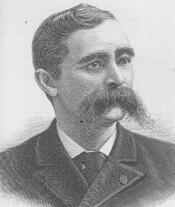
Here you will find contact information for Representative Charles Eugene Belknap, including email address, phone number, and mailing address.
| Name | Charles Eugene Belknap |
| Position | Representative |
| State | Michigan |
| District | 5 |
| Party | Republican |
| Status | Former Representative |
| Term Start | December 2, 1889 |
| Term End | March 3, 1893 |
| Terms Served | 2 |
| Born | October 17, 1846 |
| Gender | Male |
| Bioguide ID | B000328 |
About Representative Charles Eugene Belknap
Charles Eugene Belknap (October 17, 1846 – January 16, 1929) was an American politician and businessman who served as a Republican U.S. Representative from Michigan from 1889 to 1893. Over two terms in the United States House of Representatives, he represented Michigan’s 5th congressional district and participated actively in the legislative process during a significant period in American history, advocating for the interests of his Grand Rapids–area constituents.
Belknap was born in Massena, St. Lawrence County, New York, and attended the common schools there. In 1855 he moved with his family to Grand Rapids, Michigan, which would remain the center of his personal, business, and political life. His early years in Michigan were shaped by the rapid growth of Grand Rapids and the looming national conflict that would soon engulf the country.
During the American Civil War, Belknap enlisted as a private on August 12, 1862, in Company H of the Twenty-first Regiment, Michigan Volunteer Infantry. He advanced rapidly through the ranks: he was promoted to fourth sergeant on September 1, 1862, first sergeant on January 1, 1863, and sergeant major of the regiment on February 1, 1863. He received a commission as second lieutenant on April 1, 1863. For gallant service at the Battle of Chickamauga, he was brevetted first lieutenant on September 22, 1863, by special order of General Philip Sheridan, and was later brevetted captain on January 8, 1864, in recognition of his services at and near Chattanooga, Tennessee. Serving with the Army of the Cumberland, Belknap took part in the Atlanta campaign, General William T. Sherman’s March to the Sea, and the Carolinas campaign. He was mustered out of service on June 8, 1865, and was brevetted to the rank of major. At the battles of Stones River and Chickamauga he received seven wounds, none of them very serious. In later years he joined the Michigan Commandery of the Military Order of the Loyal Legion of the United States, reflecting his continued association with veterans of the Union Army.
After the war, from the fall of 1865 to 1871, Belknap lived on a farm in Sparta, Michigan, where he engaged in agriculture and began to establish himself in civilian life. In 1871 he returned to Grand Rapids and organized the Belknap Wagon and Sleigh Company, which became a successful manufacturing enterprise producing wagons and sleighs for the growing regional market. His prominence as a businessman paralleled his increasing involvement in local civic affairs and laid the foundation for his later political career.
Beginning in 1872, Belknap served for many years in the Grand Rapids volunteer fire service, acting as foreman of Company No. 3 and later as assistant chief. He played an important role in the city’s transition from a volunteer to a paid professional fire department, reflecting his interest in modernizing municipal services. He was a member of the Grand Rapids Board of Education from 1878 to 1885, helping to oversee the city’s public schools during a period of expansion. He also served on the Grand Rapids Board of Aldermen from the Seventh Ward from 1880 to 1882. In 1884 he was elected mayor of Grand Rapids, further elevating his public profile. In 1885, Governor Russell A. Alger appointed him a trustee of the Institution for the Deaf and Dumb in Flint, Michigan, for a term ending in 1891, extending his public service to statewide educational and charitable concerns.
Belknap entered national politics in 1888, when he defeated Democrat Melbourne H. Ford to win election as a Republican from Michigan’s 5th congressional district to the Fifty-first Congress. He served his first term in the U.S. House of Representatives from March 4, 1889, to March 3, 1891. Although he chose not to be a candidate for renomination to the Fifty-second Congress in 1890, circumstances soon returned him to Washington. Following the death of his former opponent, Representative Melbourne H. Ford, on April 20, 1891, Belknap was elected to fill the resulting vacancy. He served this second term from November 3, 1891, to March 3, 1893, thus completing two nonconsecutive periods in Congress. During these years he contributed to the legislative work of the House at a time marked by debates over tariffs, veterans’ issues, and economic policy. After leaving office, he unsuccessfully contested the election of George F. Richardson to the Fifty-third Congress, demonstrating his continued engagement in national politics even after his own tenure had ended.
In addition to his Civil War service, Belknap returned to military-related duties during the Spanish–American War, when he performed staff duty at Fort Oglethorpe, Georgia. In his later years he also became known as an author and local historian. He wrote several works reflecting both his military experiences and his interest in Michigan history and folklore, including “Bentonville: what a bummer knows about it,” read at a meeting on January 4, 1893; “History of the Michigan organizations at Chickamauga, Chattanooga and Missionary Ridge, 1863” (Lansing, 1897); “The yesterdays of Grand Rapids” (Grand Rapids, 1922); and “The legend of the trailing arbutus” (Grand Rapids, 1924). These publications contributed to the preservation of Civil War history and the historical record of Grand Rapids and its surroundings.
Charles Eugene Belknap died in Grand Rapids, Michigan, on January 16, 1929. He was interred in Greenwood Cemetery in Grand Rapids. His life encompassed distinguished military service, successful business enterprise, extensive local civic leadership, and two terms in the United States Congress, marking him as a significant figure in the political and civic history of Michigan in the late nineteenth and early twentieth centuries.