Representative Charles Rollin Buckalew
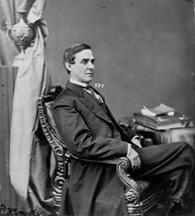
Here you will find contact information for Representative Charles Rollin Buckalew, including email address, phone number, and mailing address.
| Name | Charles Rollin Buckalew |
| Position | Representative |
| State | Pennsylvania |
| District | 17 |
| Party | Democratic |
| Status | Former Representative |
| Term Start | December 7, 1863 |
| Term End | March 3, 1891 |
| Terms Served | 3 |
| Born | December 28, 1821 |
| Gender | Male |
| Bioguide ID | B001019 |
About Representative Charles Rollin Buckalew
Charles Rollin Buckalew (December 28, 1821 – May 19, 1899) was an American lawyer, diplomat, and Democratic Party politician from Pennsylvania who became one of the most influential early advocates of proportional representation and cumulative voting in the United States. Over the course of a long public career, he served in both houses of the Pennsylvania legislature, in the United States Senate, and in the United States House of Representatives, and held several diplomatic and appointive posts.
Buckalew was born in Fishing Creek Township, Columbia County, Pennsylvania, on December 28, 1821, to John McKinney Sr. and Martha Funston Buckalew. He was educated at Harford Academy in Susquehanna County, Pennsylvania, where he pursued legal studies. After completing his preparation for the bar, he was admitted to practice law in 1843. He established himself as an attorney in Pennsylvania, building the legal and political connections that would underpin his later career in state and national public life.
Buckalew entered elective office in the Pennsylvania Senate, where he served three nonconsecutive terms representing his state in that body from 1851 to 1854, again from 1859 to 1860, and once more from 1869 to 1870. In addition to his legislative service, he undertook several important assignments for the Commonwealth and the federal government. In 1854 he served as commissioner to exchange ratifications of a treaty with Paraguay. In 1857 he was appointed chairman of the Democratic State Committee and was also named one of the commissioners to revise the penal code of Pennsylvania, reflecting his growing prominence in legal and political reform circles.
Buckalew’s diplomatic career began under President James Buchanan, who appointed him Minister Resident to the Republic of Ecuador, a post he held from 1858 to 1861. Returning to Pennsylvania at the close of his diplomatic service, he continued his involvement in Democratic Party affairs and legislative work. His reputation as a thoughtful legal mind and party leader contributed to his selection by the Pennsylvania General Assembly as a United States Senator.
Elected by the Pennsylvania General Assembly, Buckalew represented Pennsylvania in the United States Senate from 1863 to 1869, during the Civil War and early Reconstruction. In the Senate he became the foremost national proponent of proportional representation and cumulative voting. He chaired the Select Committee on Representative Reform of the United States Senate and, in that capacity, advanced a bill that would have allowed all electors in a state to cast a number of votes equal to the number of House members to be elected from that state, with the option to concentrate all votes on one candidate or distribute them among several. The candidates receiving the highest vote totals would be elected. Buckalew elaborated these ideas in a series of notable speeches, including an address in the Senate on July 11, 1867; a major public speech in Philadelphia in November 1867; a presentation before the Social Science Association in Philadelphia in October 1870; and remarks in the Pennsylvania Senate on March 27, 1871. His advocacy contributed to the adoption of cumulative voting for state legislative elections in Illinois in 1870, a system that remained in place there until 1980. During his Senate tenure he also took positions on Reconstruction-era issues, including casting a vote in 1866 against the District of Columbia Suffrage Act, a measure intended by congressional Republicans as a model for extending voting rights to Black men in the postwar South.
After leaving the U.S. Senate in 1869, Buckalew returned to the Pennsylvania Senate for his third nonconsecutive term, serving from 1869 to 1870. He remained active in Democratic politics and reform efforts. In 1872 he was the unsuccessful Democratic candidate for governor of Pennsylvania. That same year, his major writings and speeches on electoral reform were collected and published in Philadelphia by J. Campbell & Son under the title Proportional Representation. In 1873 he served as a delegate to the Pennsylvania constitutional convention, where his long-standing interest in representative reform and legal structure informed his contributions to the revision of the state’s fundamental law.
Buckalew later returned to federal elective office as a member of the United States House of Representatives from Pennsylvania. A member of the Democratic Party, he served two consecutive terms in the House from 1887 to 1891, participating in the legislative process and representing the interests of his constituents during a period of industrial expansion and political realignment in the late nineteenth century. His service in Congress, which encompassed his earlier Senate term from 1863 to 1869 and his later House tenure, occurred during a significant period in American history marked by the Civil War, Reconstruction, and the nation’s transition into the Gilded Age.
When Buckalew left the House of Representatives in 1891 at the age of 69, he resumed the practice of law in Bloomsburg, Columbia County, Pennsylvania. He continued to be recognized as an authority on electoral systems and legal reform, even as he withdrew from active political life. Charles Rollin Buckalew died in Bloomsburg on May 19, 1899. He was interred in Rosemont Cemetery in Bloomsburg, leaving a legacy as a legislator, diplomat, and pioneering theorist of proportional representation and cumulative voting in the United States.