Representative Charles T. Canady
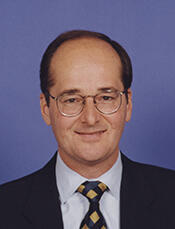
Here you will find contact information for Representative Charles T. Canady, including email address, phone number, and mailing address.
| Name | Charles T. Canady |
| Position | Representative |
| State | Florida |
| District | 12 |
| Party | Republican |
| Status | Former Representative |
| Term Start | January 5, 1993 |
| Term End | January 3, 2001 |
| Terms Served | 4 |
| Born | June 22, 1954 |
| Gender | Male |
| Bioguide ID | C000107 |
About Representative Charles T. Canady
Charles Terrance Canady (born June 22, 1954) is an American attorney, former legislator, and judge who has served as a justice of the Supreme Court of Florida since September 6, 2008. A member of the Republican Party, he previously served as Chief Justice of the Supreme Court of Florida from 2010 to 2012 and again from 2018 to 2022. Before his judicial service, he represented Florida in the United States House of Representatives from 1993 to 2001, completing four terms in Congress, and earlier served in the Florida House of Representatives from 1984 to 1990.
Canady was born in Lakeland, Florida, and raised in that community. He pursued his undergraduate education at Haverford College in Pennsylvania, where he received a Bachelor of Arts degree in 1976. He then attended Yale Law School, earning his Juris Doctor in 1979. That same year he was admitted to the bar and returned to Lakeland to begin the private practice of law, establishing his professional roots in his hometown.
In 1983, Canady entered public service as legal counsel for the Central Florida Regional Planning Commission, providing legal and policy advice on regional planning issues. The following year, in 1984, he was elected to the Florida House of Representatives. Initially elected as a conservative Democrat, he served in the state legislature through 1990. In June 1989, while still in office, he switched his party affiliation from Democrat to Republican, a move that generated controversy because it followed his acceptance of Democratic campaign funds for his re-election. In 1990, he sought a seat in the Florida State Senate but was unsuccessful, temporarily returning his focus to legal practice and public policy work.
In 1992, Canady ran for the United States House of Representatives and won a closely contested race, narrowly defeating Democratic opponent Tom Mims. He took office in January 1993 as a Republican Representative from Florida and went on to serve four consecutive terms, remaining in Congress until January 2001. His service in the House occurred during a significant period in American political history marked by partisan realignment and major national debates. As a member of the House of Representatives, he participated actively in the legislative process and represented the interests of his Florida constituents. He honored a term-limits pledge he made during his initial campaign by choosing not to seek re-election to a fifth term in 2000.
During his congressional tenure, Canady became particularly known for his work on constitutional and social issues. He served as Chairman of the Subcommittee on the Constitution of the House Judiciary Committee from January 1995 to January 2001. In that role, he led an inquiry into the legal and constitutional questions surrounding assisted suicide in the United States. The resulting report from his subcommittee was later cited by the Supreme Court of the United States in Washington v. Glucksberg (1997), in which the Court held that the Constitution did not protect a right to assisted suicide. Canady was also credited with coining the term “partial-birth abortion” while helping to develop the Partial-Birth Abortion Ban Act of 1995. According to Keri Folmar, the lawyer responsible for drafting the bill’s language, the term was devised in early 1995 during a meeting among herself, Canady, and National Right to Life Committee lobbyist Douglas Johnson, after Canady and his aides were unable to find an established medical term for the specific abortion procedure they sought to restrict. In addition, he played a prominent role in the impeachment proceedings against President Bill Clinton, serving as one of the House managers appointed to prosecute the case in the Senate trial.
After leaving Congress in January 2001, Canady returned to state-level public service. He served as general counsel to Florida Governor Jeb Bush, advising the governor on legal and constitutional matters. In 2002, Bush appointed him to the Second District Court of Appeal of Florida. Canady took his seat on that court in November 2002 and served there until 2008, participating in a broad range of appellate decisions and gaining a reputation for careful legal analysis and a conservative judicial philosophy.
On August 27, 2008, Governor Charlie Crist appointed Canady to the Supreme Court of Florida to fill the vacancy created by the departure of Justice Raoul Cantero, who returned to private practice. Canady became the 82nd justice of the Florida Supreme Court upon taking office on September 6, 2008. He was selected by his colleagues to serve as Chief Justice from 2010 to 2012 and again from 2018 to 2022, overseeing the administration of the state court system and guiding the court through a period of significant legal and institutional change. During his time on the court, he has participated in numerous high-profile decisions, including cases involving capital punishment. In 2013, Governor Rick Scott signed the Timely Justice Act (HB 7101), which revised Florida’s procedures for capital punishment. After the United States Supreme Court struck down part of that law in Hurst v. Florida in January 2016, the Florida Legislature enacted a new sentencing statute. When the revised scheme came before the Florida Supreme Court in October 2016, the court held that a death sentence must be based on a unanimous jury recommendation. Canady was one of two justices who dissented from that decision, a stance noted in the context of his inclusion on a list of potential U.S. Supreme Court nominees released by then-presidential candidate Donald Trump less than a month earlier.
Throughout his career, Charles T. Canady has moved from private legal practice to state legislative service, then to the United States Congress, and finally to the appellate and supreme courts of Florida. His work has spanned legislative policymaking, constitutional adjudication, and judicial administration, reflecting a long-standing engagement with questions at the intersection of law, public policy, and the structure of government.