Representative Charles E. Chamberlain
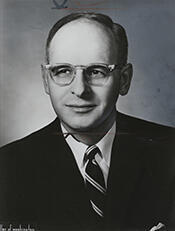
Here you will find contact information for Representative Charles E. Chamberlain, including email address, phone number, and mailing address.
| Name | Charles E. Chamberlain |
| Position | Representative |
| State | Michigan |
| District | 6 |
| Party | Republican |
| Status | Former Representative |
| Term Start | January 3, 1957 |
| Term End | January 3, 1975 |
| Terms Served | 9 |
| Born | July 22, 1917 |
| Gender | Male |
| Bioguide ID | C000275 |
About Representative Charles E. Chamberlain
Charles Ernest Chamberlain (July 22, 1917 – November 25, 2002) was an American politician and lawyer who represented Michigan’s 6th congressional district in the United States House of Representatives from January 3, 1957, until December 31, 1974. A member of the Republican Party, he served nine consecutive terms in Congress and participated actively in the legislative process during a significant period in American history, representing the interests of his Michigan constituents.
Chamberlain was born in Locke Township, Michigan, and grew up in the Lansing area. He attended public schools and graduated from Lansing Central High School in Lansing. He then enrolled at the University of Virginia in Charlottesville, where he earned a Bachelor of Science degree in 1941. Following his undergraduate studies, he continued at the University of Virginia School of Law, receiving a Bachelor of Laws degree in 1949, an education that laid the foundation for his subsequent legal and political career.
During World War II, Chamberlain served in the United States Coast Guard from 1942 to 1946, contributing to the nation’s wartime efforts. After the war, he continued his military association in the United States Coast Guard Reserve from 1946 to 1977, extending his service across three decades. Concurrent with the early years of his reserve duty, he began his civilian professional career, combining legal practice with public service.
Chamberlain worked briefly as an Internal Revenue Service agent in the United States Treasury Department from 1946 to 1947, gaining experience in federal taxation and administration. He then entered private law practice and soon moved into local public office. In 1950 he served as assistant prosecutor for Ingham County, Michigan. He later became city attorney of East Lansing and legal counsel to the Michigan State Senate Judiciary Committee in 1953 and 1954, roles that deepened his involvement in state and municipal lawmaking. From 1955 to 1956 he was the prosecuting attorney for Ingham County, building a reputation that helped launch his congressional career.
In 1956, Chamberlain was elected as a Republican from Michigan’s 6th congressional district to the Eighty-fifth Congress, defeating Democratic incumbent Donald Hayworth. He was subsequently re-elected to the eight succeeding Congresses, serving nine terms from January 3, 1957, to December 31, 1974. His tenure in the House coincided with major national developments, including the civil rights movement, the Cold War, and the Vietnam era. He took part in the democratic process as a member of the House of Representatives and contributed to the legislative work of Congress over nearly two decades.
Chamberlain’s voting record placed him in support of key civil rights legislation of the mid-twentieth century. He voted in favor of the Civil Rights Acts of 1957, 1960, 1964, and 1968, as well as the 24th Amendment to the United States Constitution, which abolished the poll tax in federal elections, and the Voting Rights Act of 1965, which sought to eliminate racial discrimination in voting. In the 1972 election, he narrowly defeated Democratic challenger Milton Robert Carr, receiving 97,666 votes (50.68 percent) to Carr’s 95,029 votes (49.32 percent), a close result in what was otherwise a strong Republican year nationally. In 1974, Carr succeeded him as representative for the district, marking the end of Chamberlain’s congressional service.
After leaving Congress, Chamberlain remained associated with the communities and institutions that had shaped his career, while his long-standing ties to veterans’ and civic organizations reflected his continued engagement in public life. He was a member of the American Legion, the Society of the Cincinnati, the Veterans of Foreign Wars, and Kiwanis, affiliations that underscored both his military service and his commitment to civic and community affairs.
Charles Ernest Chamberlain died in Leesburg, Virginia, on November 25, 2002, of renal failure and congestive heart failure. He was interred in Evergreen Cemetery in Lansing, Michigan, returning in death to the region where he had grown up, practiced law, and begun his public career.